Jilka Sagar, Murray Claire, Wieczorek Ania, Griffiths Helena, Wykes Til, McShane Rupert
Post-doctoral Research Associate and Patient and Public Involvement Coordinator, Institute of Psychiatry, Psychology & Neuroscience, King's College London; and South London and Maudsley NHS Foundation Trust, UK.
Patient and Public Involvement Manager, Oxford Health NHS Foundation Trust, Warneford Hospital, UK.
BJPsych Open. 2019 Jul 30;5(5):e62. doi: 10.1192/bjo.2019.52.
Only one-third of patients with major depressive disorder achieve remission. One new and promising treatment, ketamine, may prove challenging to implement because of its abuse potential. Although clinicians' views have been sought, we need patients' views before large scale roll-out is considered.
To explore patients' and carers' views to inform policy and practical decisions about the clinical use of ketamine.
We carried out a mixed-methods study using data from 44 participants in 21 focus groups in three sessions and an online survey with patients, carers and advocates during a consultation day. Focus groups explored participant's views about ketamine as a form of treatment and the best way for ketamine to be prescribed and monitored. The qualitative data were analysed by two patient-researchers using an exploratory framework analysis and was supplemented by a survey.
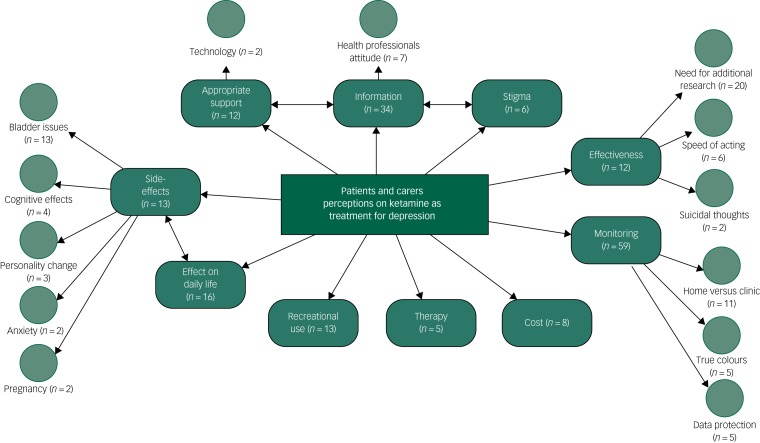
The ten themes generated were monitoring, information, effect on daily life, side-effects, recreational use, effectiveness, appropriate support, cost, stigma and therapy. Participants wanted better evidence on the safety of ketamine after long-term use and felt that monitoring was required. Collecting this information would provide evidence for ketamine's safe use and administration. There were, however, concerns about the misuse of this information. Practical issues of access were important: repeated travelling to clinics and a lack of sufficiently informed medical staff were key barriers.
Clinicians have some similar and some different views to those of patients, carers and advocates, which need to be considered in any future roll-out of ketamine.
R.M. has had UK National Institute for Health Research grant funding to study ketamine, is participating in trials of esketamine, runs a clinic that provides ketamine treatment, and has consulted for Johnson & Johnson and Eleusis.
重度抑郁症患者中只有三分之一实现缓解。一种新的、有前景的治疗方法——氯胺酮,由于其潜在的滥用可能性,在实施过程中可能具有挑战性。尽管已经征求了临床医生的意见,但在考虑大规模推广之前,我们还需要了解患者的看法。
探讨患者及其护理人员的看法,为氯胺酮临床使用的政策和实际决策提供参考。
我们进行了一项混合方法研究,采用了来自三个场次的21个焦点小组中44名参与者的数据,以及在咨询日对患者、护理人员和倡导者进行的在线调查。焦点小组探讨了参与者对氯胺酮作为一种治疗形式的看法,以及氯胺酮处方和监测的最佳方式。定性数据由两名患者研究人员使用探索性框架分析进行分析,并辅以一项调查。
产生的十个主题是监测、信息、对日常生活的影响、副作用、娱乐用途、有效性、适当的支持、成本、耻辱感和治疗。参与者希望获得更多关于氯胺酮长期使用安全性的证据,并认为需要进行监测。收集这些信息将为氯胺酮的安全使用和给药提供证据。然而,人们担心这些信息会被滥用。获取方面的实际问题很重要:反复前往诊所以及缺乏充分了解情况的医务人员是关键障碍。
临床医生与患者、护理人员和倡导者的看法有些相似,有些不同,在未来氯胺酮的任何推广中都需要考虑这些因素。
R.M.获得了英国国家卫生研究院的资助以研究氯胺酮,正在参与艾氯胺酮的试验,经营一家提供氯胺酮治疗的诊所,并曾为强生公司和Eleusis提供咨询服务。