Vilaiyuk Soamarat, Lerkvaleekul Butsabong, Soponkanaporn Sirisucha, Setthaudom Chavachol, Buranapraditkun Supranee
Division of Rheumatology, Department of Pediatrics, Faculty of Medicine, Ramathibodi Hospital, Mahidol University, Bangkok, Thailand.
Immunology Laboratory, Department of Pathology, Faculty of Medicine, Ramathibodi Hospital, Mahidol University, Bangkok, Thailand.
Cent Eur J Immunol. 2019;44(2):150-158. doi: 10.5114/ceji.2019.87066. Epub 2019 Jul 30.
Interleukin (IL)-6 is a proinflammatory cytokine involved in systemic juvenile idiopathic arthritis (SJIA). Since these patients are often treated with tocilizumab (TCZ), anti-IL-6 receptor (IL-6R) antibody, we investigated correlations between serum IL-6 and soluble IL-6R-levels and disease activity in SJIA patients treated with or without TCZ.
164 serum samples were taken from 42 SJIA patients treated with or without TCZ (69 and 95 samples, respectively). Patients were assigned to three groups according to disease status: 1) systemic (patients with systemic features and/or arthritis), 2) arthritis (patients with arthritis but no systemic features), and 3) inactive (clinically inactive disease). Disease activity was assessed using the Juvenile Arthritis Disease Activity Score-27 (JADAS-27) at the time of blood collection.
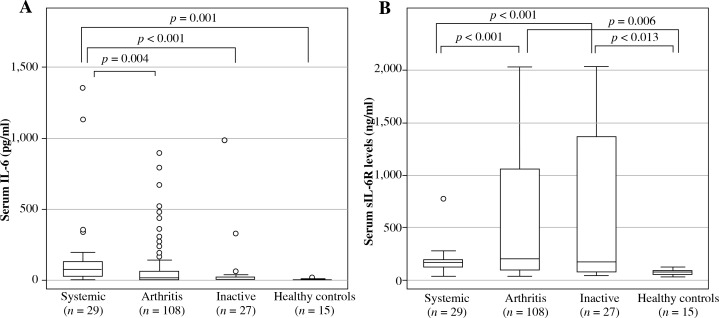
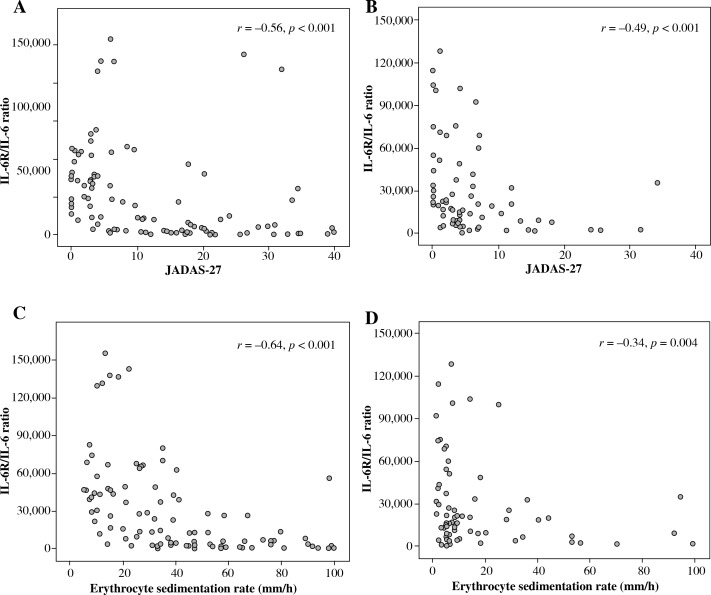
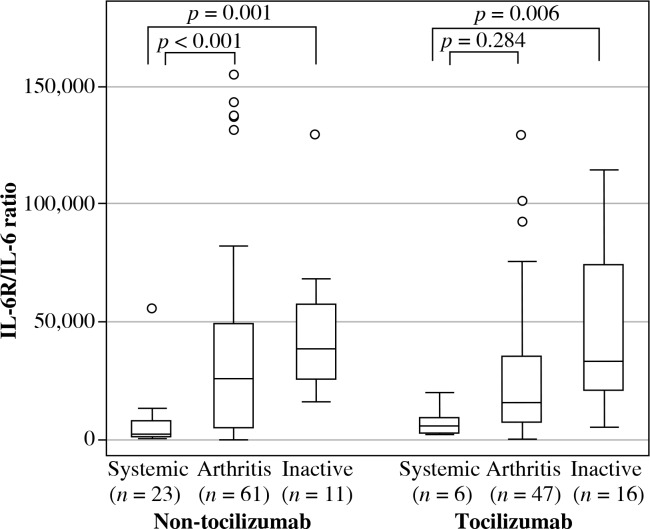
IL-6 levels were highest in SJIA patients with predominant systemic features, while serum sIL-6R levels were highest in patients with persistent arthritis. Serum IL-6 correlated with JADAS-27 in patients treated with and without TCZ (r = 0.38 and r = 0.65, respectively), whereas serum sIL-6R levels correlated with JADAS-27 in patients treated without (r = 0.30) but not with (r = -0.14) TCZ. The sIL-6R/IL-6 ratio negatively correlated with JADAS-27 in patients treated with and without TCZ (r = -0.49 and r = -0.56, respectively).
Serum IL-6 levels correlated more strongly with disease activity parameters than did sIL-6R levels and could be useful for monitoring disease activity in SJIA patients. The sIL-6R/IL-6 ratio might be a promising disease activity marker in both SJIA patients treated with and without TCZ.
白细胞介素(IL)-6是一种参与全身型幼年特发性关节炎(SJIA)的促炎细胞因子。由于这些患者常接受托珠单抗(TCZ),即抗IL-6受体(IL-6R)抗体治疗,我们研究了接受或未接受TCZ治疗的SJIA患者血清IL-6和可溶性IL-6R水平与疾病活动度之间的相关性。
从42例接受或未接受TCZ治疗的SJIA患者中采集了164份血清样本(分别为69份和95份样本)。根据疾病状态将患者分为三组:1)全身型(具有全身特征和/或关节炎的患者),2)关节炎型(有关节炎但无全身特征的患者),3)非活动型(临床非活动疾病)。在采血时使用幼年关节炎疾病活动评分-27(JADAS-27)评估疾病活动度。
具有主要全身特征的SJIA患者中IL-6水平最高,而持续性关节炎患者的血清可溶性IL-6R水平最高。接受和未接受TCZ治疗的患者血清IL-6均与JADAS-27相关(分别为r = 0.38和r = 0.65),而未接受TCZ治疗的患者血清可溶性IL-6R水平与JADAS-27相关(r = 0.30),接受TCZ治疗的患者则不相关(r = -0.14)。接受和未接受TCZ治疗的患者中,可溶性IL-6R/IL-6比值均与JADAS-27呈负相关(分别为r = -0.49和r = -0.56)。
血清IL-6水平与疾病活动参数的相关性比可溶性IL-6R水平更强,可用于监测SJIA患者的疾病活动度。可溶性IL-6R/IL-6比值可能是接受和未接受TCZ治疗的SJIA患者中一种有前景的疾病活动标志物。