A Rezaeian, M J Tahmasebi Birgani, N Chegeni, M Sarkarian, M Gh Hanafi, Gh Akbarizadeh
Department of Medical Physics, Faculty of Medicine, Ahvaz Jundishapur University of Medical Sciences, Ahvaz, Iran.
Department of Urology, Golestan Hospital, Ahvaz Jundishapur University of Medical Sciences, Ahvaz, Iran.
J Biomed Phys Eng. 2019 Aug 1;9(4):453-458. doi: 10.31661/jbpe.v0i0.811. eCollection 2019 Aug.
Diffusion-weighted imaging (DWI) is a main component of multiparametric MRI for prostate cancer detection. Recently, high b value DWI has gained more attention because of its capability for tumor characterization.
To assess based on histopathological findings of transrectal ultrasound (TRUS)-guided prostate biopsy as a reference, an increase in signal intensity of prostatic lesions in comparison with normal background tissue on high b-value diffusion-weighted images could be a sign of malignancy.
Fifty-three consecutive patients retrospectively included in the study. All patients underwent routine TRUS-guided prostate biopsies involving 12 cores after the magnetic resonance imaging (MRI) examinations. In seventeen patients (n =35 lesions), the prostate cancer was histologically confirmed by TRUS-guided prostate biopsy. The biopsy results of other patients were negative. Signal intensities on the high b-value (1600 s/mm) images of the peripheral zone, the central gland, and the defined lesions were evaluated using region of interest-based measurements. Sensitivity, specificity, positive predictive value (PPV) and negative predictive value (NPV) for prostate cancer detection using signal intensity of high b value diffusion-weighted images were calculated.
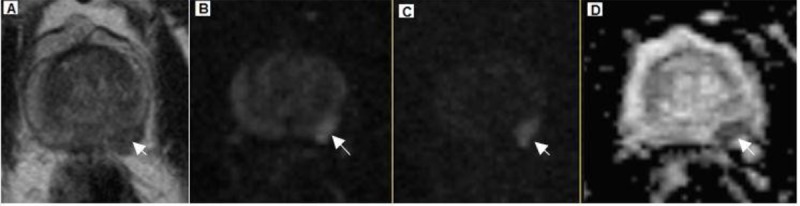
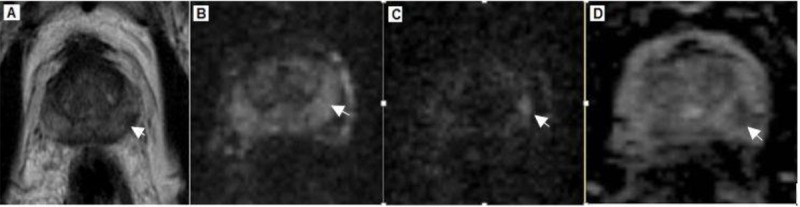
In the patients with confirmed prostate cancer, fourteen had visually increased SI on the high b-value images. The SI of lesions for these patients was higher than the SI of peripheral zone (22±18%) or central gland (31±20%). In patients with a negative biopsy, eight had visually increased SI on the high b-value images. The SI of lesions for these patients was 23±21% and 35±18% higher than the SI in the peripheral zone and the central gland, respectively. The sensitivity, specificity, PPV, and NPV for prostate cancer using SI of high b value DWI were 71, 87, 62, and 87 %, respectively.
Visually increased SI on the high b-value images can be an indication of malignancy, although some benign lesions also show this increase in signal intensity.
扩散加权成像(DWI)是多参数MRI用于前列腺癌检测的主要组成部分。近年来,高b值DWI因其具有肿瘤特征化能力而受到更多关注。
以经直肠超声(TRUS)引导下前列腺穿刺活检的组织病理学结果为参考,评估高b值扩散加权图像上前列腺病变与正常背景组织相比信号强度增加是否可能提示恶性肿瘤。
回顾性纳入连续53例患者。所有患者在磁共振成像(MRI)检查后均接受了常规TRUS引导下的前列腺穿刺活检,共取12针组织。17例患者(n = 35个病变)经TRUS引导下前列腺穿刺活检组织学确诊为前列腺癌。其他患者的活检结果为阴性。使用基于感兴趣区的测量方法评估外周带、中央腺体及明确病变在高b值(1600 s/mm²)图像上的信号强度。计算使用高b值扩散加权图像信号强度检测前列腺癌的敏感性、特异性、阳性预测值(PPV)和阴性预测值(NPV)。
在确诊为前列腺癌的患者中,14例在高b值图像上可见信号强度增加。这些患者病变的信号强度高于外周带(22±18%)或中央腺体(31±20%)。活检结果为阴性的患者中,8例在高b值图像上可见信号强度增加。这些患者病变的信号强度分别比外周带和中央腺体的信号强度高23±21%和35±18%。使用高b值DWI信号强度检测前列腺癌的敏感性、特异性、PPV和NPV分别为71%、87%、62%和87%。
高b值图像上信号强度明显增加可能提示恶性肿瘤,尽管一些良性病变也会出现这种信号强度增加。