Kamstrup-Larsen Nina, Dalton Susanne Oksbjerg, Grønbæk Morten, Broholm-Jørgensen Marie, Thomsen Janus Laust, Larsen Lars Bruun, Johansen Christoffer, Tolstrup Janne
National Institute of Public Health, University of Southern Denmark, Copenhagen, Denmark
Survivorship Research Unit, Danish Cancer Society, Copenhagen, Denmark.
BMJ Open. 2019 Sep 18;9(9):e029180. doi: 10.1136/bmjopen-2019-029180.
The effectiveness of health checks aimed at the general population is disputable. However, it is not clear whether health checks aimed at certain groups at high risk may reduce adverse health behaviour and identify persons with metabolic risk factors and non-communicable diseases (NCDs).
To assess the effect of general practice-based health checks on health behaviour and incidence on NCDs in individuals with low socioeconomic position.
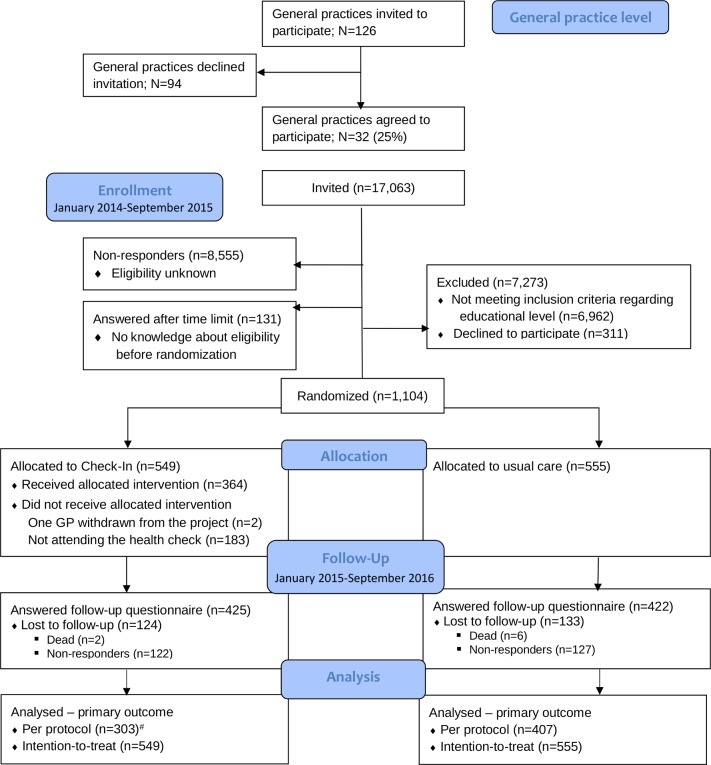
Individuals with no formal education beyond lower secondary school and aged 45-64 years were randomly assigned to the intervention group of a preventive health check or to control group of usual care in a 1:1 allocation. Randomisation was stratified by gender and 5-year age group. Due to the real-life setting, blinding of participants was only possible in the control group. Effects were analysed as intention to treat (ITT) and per protocol. The trial was undertaken in 32 general practice units in Copenhagen, Denmark.
Invitation to a prescheduled preventive health check from the general practitioner (GP) followed by a health consultation and an offer of follow-up with health risk behaviour change or preventive medical treatment, if necessary.
Smoking status at 12-month follow-up. Secondary outcomes included status in other health behaviours such as alcohol consumption, physical activity and body mass index (measured by self-administered questionnaire), as well as incidence of metabolic risk factors and NCDs such as hypertension, hypercholesterolaemia, chronic obstructive pulmonary disease, diabetes mellitus, hypothyroidism, hyperthyroidism and depression (drawn from national healthcare registries).
1104 participants were included in the study. For the primary outcome, 710 participants were included in the per protocol analysis, excluding individuals who did not attend the health check, and 1104 participants were included in the ITT analysis. At 12-month follow-up, 37% were daily smokers in the intervention group and 37% in the control group (ORs=0.99, 95% CI: 0.76 to 1.30). No difference in health behaviour nor in the incidence of metabolic risk factors and NCDs between the intervention and control group were found. Side effects were comparable across the two groups.
The lack of effectiveness may be due to low intensity of intervention, a high prevalence of metabolic risk factors and NCDs among the participants at baseline as well as a high number of contacts with the GPs in general or to the fact that general practices are not an effective setting for prevention.
NCT01979107.
针对普通人群的健康检查的有效性存在争议。然而,针对某些高危人群的健康检查是否可以减少不良健康行为并识别出具有代谢风险因素和非传染性疾病(NCD)的个体尚不清楚。
评估基于全科医疗的健康检查对社会经济地位较低个体的健康行为及非传染性疾病发病率的影响。
将未接受过初中以上正规教育且年龄在45 - 64岁的个体按1:1随机分配到预防性健康检查干预组或常规护理对照组。随机分组按性别和5岁年龄组进行分层。由于是现实生活场景,仅对照组的参与者能够做到盲法。按意向性分析(ITT)和符合方案分析来分析效果。该试验在丹麦哥本哈根的32个全科医疗单位进行。
由全科医生(GP)邀请进行预定的预防性健康检查,随后进行健康咨询,并在必要时提供针对健康风险行为改变或预防性医疗的随访。
12个月随访时的吸烟状况。次要结局包括其他健康行为状况,如饮酒、身体活动和体重指数(通过自我填写问卷测量),以及代谢风险因素和非传染性疾病的发病率,如高血压、高胆固醇血症、慢性阻塞性肺疾病、糖尿病、甲状腺功能减退、甲状腺功能亢进和抑郁症(从国家医疗保健登记处获取)。
1104名参与者纳入研究。对于主要结局,符合方案分析纳入710名参与者,排除未参加健康检查的个体,意向性分析纳入1104名参与者。在12个月随访时,干预组37%为每日吸烟者,对照组为37%(比值比 = 0.99,95%可信区间:0.76至1.30)。干预组和对照组在健康行为、代谢风险因素和非传染性疾病发病率方面均未发现差异。两组的副作用相当。
缺乏有效性可能是由于干预强度低、基线时参与者中代谢风险因素和非传染性疾病的高患病率、与全科医生的总体接触次数多,或者是因为全科医疗不是有效的预防场所。
NCT01979107。