Elomaa Jenny, Gallegos Laura, Gomez Frank A
Department of Chemistry and Biochemistry, California State University, Los Angeles, 5151 State University Drive, Los Angeles, CA 90032-8202, USA.
Micromachines (Basel). 2019 Sep 15;10(9):614. doi: 10.3390/mi10090614.
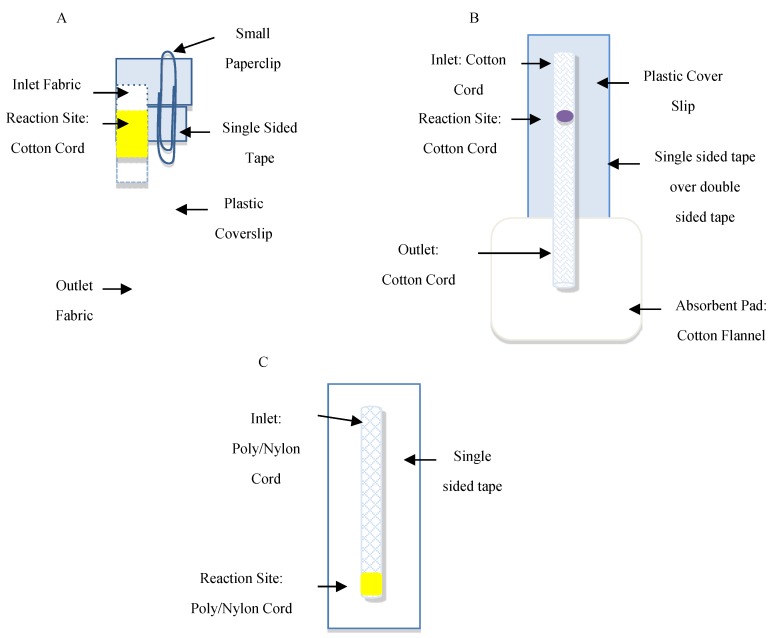
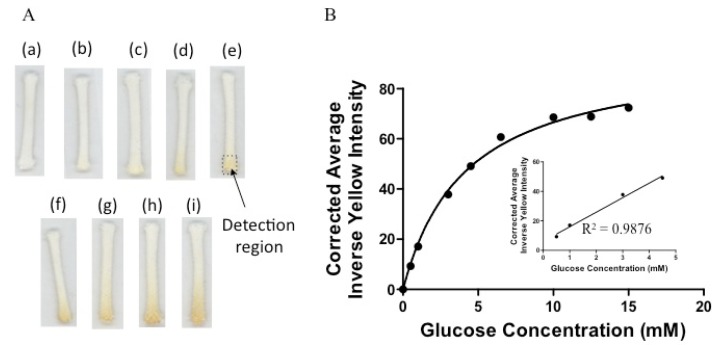
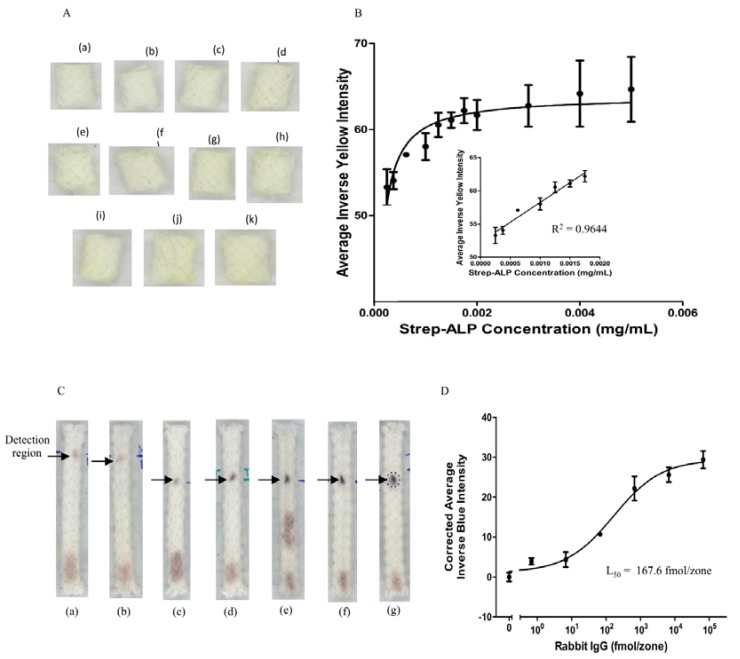
This paper describes the development and application of microfluidic cord-based analytical devices (µCADs) in two enzyme-linked immunosorbent assays (ELISAs) and glucose assay. In this study, biotinylated goat anti-mouse immunoglobulin (IgG) antibody, rabbit IgG antibody, and glucose are quantitatively detected. In the ELISA systems, the antibody is spotted on the cord at the detection site and a series of washes, followed by streptavidin-alkaline phosphatase (Strep-ALP) or alkaline phosphatase (ALP)-conjugated secondary antibody and colorimetric substrate, completing the experiment. The devices are subsequently scanned and analyzed yielding a correlation between inverse yellow or inverse blue intensity and antibody concentration. For the first ELISA, a linear range of detection was observed at lower concentrations (2.50 × 10-1.75 × 10 mg/mL) of Strep-ALP with saturation of the enzyme achieved at higher concentrations (>2.50 × 10). For the second ELISA, the L was demonstrated to be 167.6 fmol/zone. The glucose assay consisted of spotting increasing concentrations of glucose on the analysis sites and transporting, via capillary action, a solution containing glucose oxidase (GOx), horseradish peroxidase (HRP), and potassium iodide (KI) to the detection sites realizing a yellow-brown color indicating oxidation of iodide to iodine. The device was then dried, scanned, and analyzed to show the correlation between yellow inverse intensity and glucose. Glucose in artificial urine showed good correlation using the devices.
本文描述了基于微流控芯片的分析装置(µCADs)在两种酶联免疫吸附测定(ELISA)和葡萄糖检测中的开发与应用。在本研究中,对生物素化山羊抗小鼠免疫球蛋白(IgG)抗体、兔IgG抗体和葡萄糖进行了定量检测。在ELISA系统中,将抗体点样于检测部位的芯片上,经过一系列洗涤步骤,随后加入链霉亲和素 - 碱性磷酸酶(Strep - ALP)或碱性磷酸酶(ALP)偶联的二抗以及比色底物,完成实验。随后对装置进行扫描和分析,得出反向黄色或反向蓝色强度与抗体浓度之间的相关性。对于第一次ELISA,在较低浓度(2.50×10 - 1.75×10 mg/mL)的Strep - ALP下观察到线性检测范围,在较高浓度(>2.50×10)时酶达到饱和。对于第二次ELISA,检测限为167.6 fmol/区。葡萄糖检测包括在分析部位点样浓度递增的葡萄糖,并通过毛细作用将含有葡萄糖氧化酶(GOx)、辣根过氧化物酶(HRP)和碘化钾(KI)的溶液输送至检测部位,实现碘化物氧化为碘的黄褐色显色反应。然后将装置干燥、扫描并分析,以显示反向黄色强度与葡萄糖之间的相关性。使用该装置检测人工尿液中的葡萄糖显示出良好的相关性。