Pharmacoepidemiology, Spanish Centre for Pharmacoepidemiologic Research (CEIFE), Madrid, Spain
Pharmacoepidemiology, Spanish Centre for Pharmacoepidemiologic Research (CEIFE), Madrid, Spain.
BMJ Open. 2019 Sep 20;9(9):e031341. doi: 10.1136/bmjopen-2019-031341.
To evaluate the appropriateness of the initial prescribed daily dose of non-vitamin K antagonist oral anticoagulants (NOACs) according to label in patients with non-valvular atrial fibrillation (NVAF) in the UK.
Population-based cross-sectional study.
UK primary care.
30 467 patients with NVAF and a first prescription for apixaban, dabigatran or rivaroxaban between January 2011 and December 2016.
Percentage of patients prescribed a NOAC dose according to the European Union (EU) labels (appropriately dosed), and not according to the EU labels (inappropriately dosed-including both underdosed and overdosed patients); percentage of patients prescribed an initial NOAC dose according to renal function status.
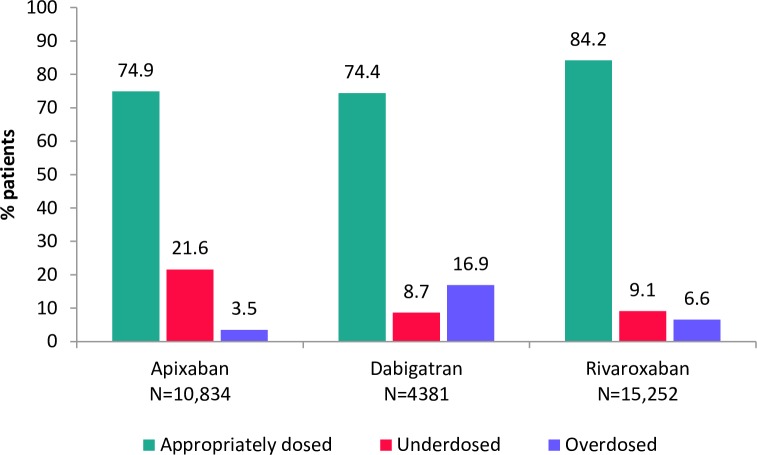
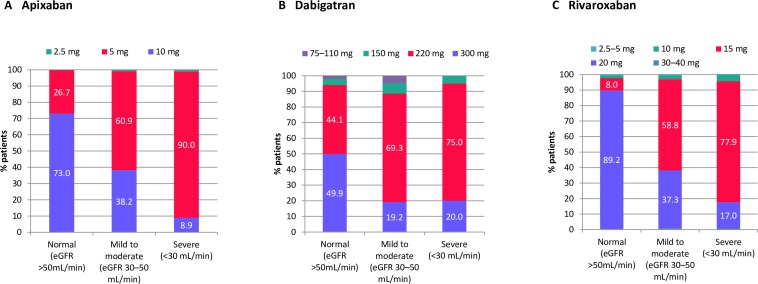
A total of 15 252 (50.1%) patients started NOAC therapy on rivaroxaban, 10 834 (35.6%) on apixaban and 4381 (14.4%) on dabigatran. Among patients starting NOAC therapy on rivaroxaban, 17.3% were eligible to receive a reduced dose compared with 12.8% of patients starting on apixaban and 53.8% of patients starting on dabigatran. The majority of patients were prescribed an appropriate dose according to the EU labels: apixaban 74.9 %, dabigatran, 74.4%; rivaroxaban, 84.2%. Underdosing occurred in 21.6% (apixaban), 8.7% (dabigatran), 9.1% (rivaroxaban). Overdosing was more frequent for dabigatran (16.9%) than for rivaroxaban (6.6%) or apixaban (3.5%). There was a trend towards dose reduction with increasing renal impairment. Among patients with severe renal impairment, the majority received a reduced dose NOAC: apixaban, 91.1%, dabigatran, 80.0%, rivaroxaban, 83.0%.
Between 2011 and 2016, the majority of patients starting NOAC therapy in UK primary care were prescribed a daily dose in line with the approved EU drug label. Underdosing was more than twice as common among patients starting on apixaban than those starting on dabigatran or rivaroxaban. Research into the patient characteristics that may influence inappropriate underdosing of NOACs in UK primary care is warranted.
评估 2011 年 1 月至 2016 年 12 月期间,在英国服用新型口服抗凝剂(NOAC)的非瓣膜性房颤(NVAF)患者中,根据标签初始规定剂量的适宜性。
基于人群的横断面研究。
英国初级保健。
30467 例 NVAF 患者,首次服用阿哌沙班、达比加群或利伐沙班。
根据欧盟(EU)标签(适当剂量)和不根据 EU 标签(包括剂量不足和剂量过大的患者)规定剂量的患者比例;根据肾功能状态,规定初始 NOAC 剂量的患者比例。
共有 15252 例(50.1%)患者开始服用利伐沙班,10834 例(35.6%)开始服用阿哌沙班,4381 例(14.4%)开始服用达比加群。与开始服用阿哌沙班的患者相比,开始服用利伐沙班的患者中有 17.3%符合接受减少剂量的条件,而开始服用达比加群的患者中有 53.8%符合接受减少剂量的条件。大多数患者根据欧盟标签接受了适当剂量的治疗:阿哌沙班 74.9%,达比加群 74.4%;利伐沙班 84.2%。根据欧盟标签,21.6%(阿哌沙班)、8.7%(达比加群)和 9.1%(利伐沙班)的患者剂量不足。与利伐沙班(6.6%)或阿哌沙班(3.5%)相比,达比加群(16.9%)的剂量过大更为常见。随着肾功能损害的增加,剂量减少的趋势越明显。在严重肾功能损害的患者中,大多数患者接受了减少剂量的 NOAC:阿哌沙班 91.1%,达比加群 80.0%,利伐沙班 83.0%。
2011 年至 2016 年间,在英国初级保健中开始服用新型口服抗凝剂的患者中,大多数患者的日剂量符合欧盟批准的药物标签。与开始服用达比加群或利伐沙班的患者相比,开始服用阿哌沙班的患者中剂量不足的情况更为常见,超过两倍。需要研究可能影响英国初级保健中新型口服抗凝剂不适当剂量不足的患者特征。