Wang Jicun, Zhao Shuai, Kakade Apurva, Kulshreshtha Saurabh, Liu Pu, Li Xiangkai
Gansu Key Laboratory of Biomonitoring and Bioremediation for Environment Pollution, School of Life Science, Lanzhou University, 222 South Tianshui Rd, Lanzhou 730000, China.
Faculty of Applied Sciences and Biotechnology, Shoolini University of Biotechnology and Management Sciences, Bajhol, Solan, Himachal Pradesh 173229, India.
Microorganisms. 2019 Sep 20;7(10):372. doi: 10.3390/microorganisms7100372.
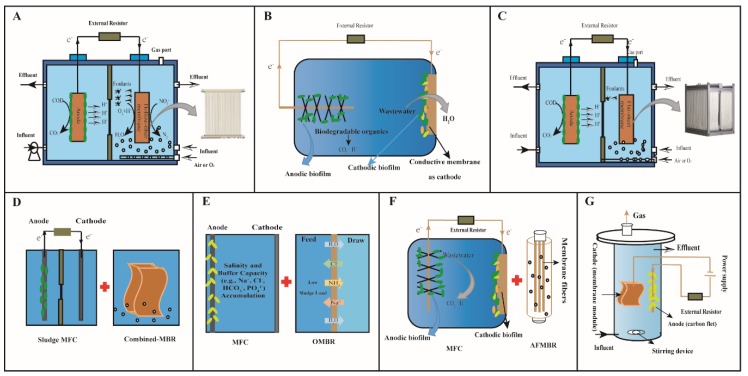
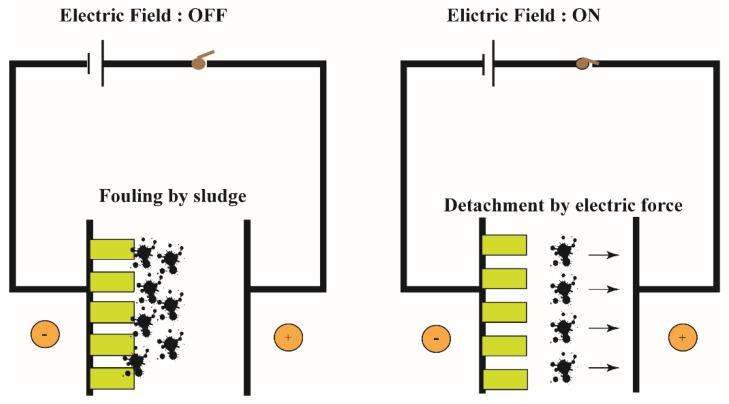
Microbial electrocatalysis is an electro reaction that uses microorganisms as a biocatalyst, mainly including microbial electrolytic cells (MEC) and microbial fuel cells (MFC), which has been used for wastewater treatment. However, the low processing efficiency is the main drawback for its practical application and the additional energy input of MEC system results in high costs. Recently, MFC/MEC coupled with other treatment processes, especially membrane bioreactors (MBR), has been used for high efficiency and low-cost wastewater treatment. In these systems, the wastewater treatment efficiency can be improved after two units are operated and the membrane fouling of MBR can also be alleviated by the electric energy that was generated in the MFC. In addition, the power output of MFC can also reduce the energy consumption of microbial electrocatalysis systems. This review summarizes the recent studies about microbial electrocatalysis systems coupled with MBR, describing the combination types and microorganism distribution, the advantages and limitations of the systems, and also addresses several suggestions for the future development and practical applications.
微生物电催化是一种利用微生物作为生物催化剂的电化学反应,主要包括微生物电解池(MEC)和微生物燃料电池(MFC),已用于废水处理。然而,处理效率低是其实际应用的主要缺点,且MEC系统的额外能量输入导致成本高昂。最近,MFC/MEC与其他处理工艺相结合,特别是与膜生物反应器(MBR)相结合,已用于高效低成本的废水处理。在这些系统中,两个单元运行后废水处理效率可得到提高,MBR的膜污染也可通过MFC产生的电能得到缓解。此外,MFC的功率输出还可降低微生物电催化系统的能耗。本综述总结了最近关于MFC与MBR耦合的微生物电催化系统的研究,描述了组合类型和微生物分布、系统的优缺点,并对未来的发展和实际应用提出了几点建议。