Borja-Maldonado Fátima, López Zavala Miguel Ángel
Tecnologico de Monterrey, School of Engineering and Sciences, Ave. Eugenio Garza Sada 2501, Monterrey, 64849, N.L., Mexico.
Heliyon. 2022 Jun 30;8(7):e09849. doi: 10.1016/j.heliyon.2022.e09849. eCollection 2022 Jul.
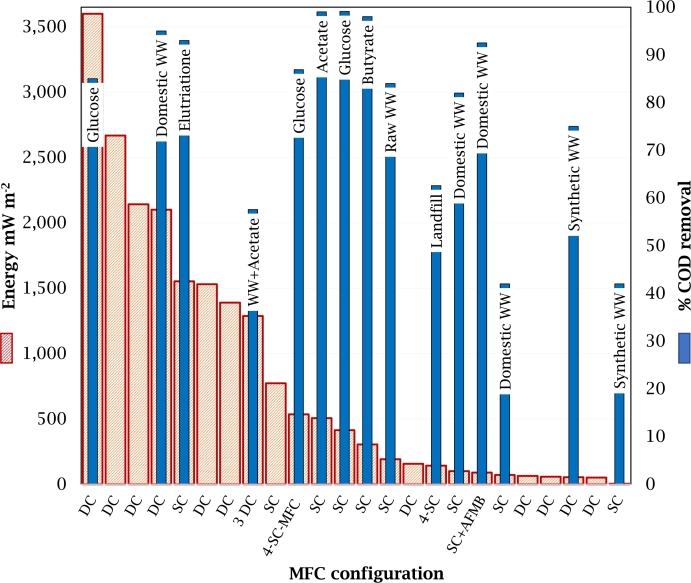
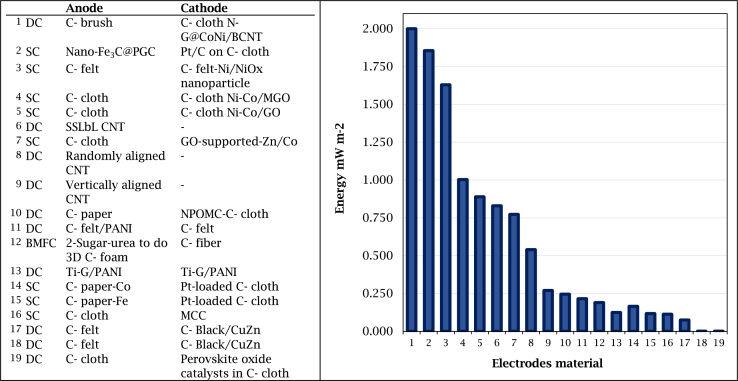
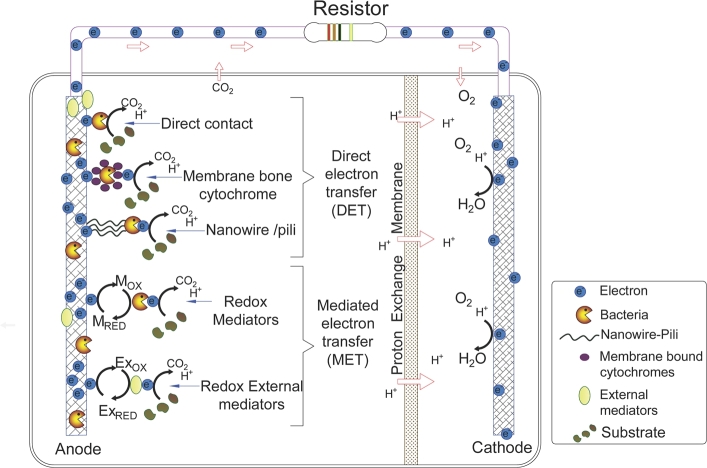
Microbial fuel cells (MFCs) are a technology that can be applied to both the wastewater treatment and bioenergy generation. This work discusses the contribution of improvements regarding the configurations, electrode materials, membrane materials, electron transfer mechanisms, and materials cost on the current and future development of MFCs. Analysis of the most recent scientific publications on the field denotes that dual-chamber MFCs configuration offers the greatest potential due to the excellent ability to be adapted to different operating environments. Carbon-based materials show the best performance, biocompatibility of carbon-brush anode favors the formation of the biofilm in a mixed consortium and in wastewater as a substrate resembles the conditions of real scenarios. Carbon-cloth cathode modified with nanotechnology favors the conductive properties of the electrode. Ceramic clay membranes emerge as an interesting low-cost membrane with a proton conductivity of 0.0817 S cm, close to that obtained with the Nafion membrane. The use of nanotechnology in the electrodes also enhances electron transfer in MFCs. It increases the active sites at the anode and improves the interface with microorganisms. At the cathode, it favors its catalytic properties and the oxygen reduction reaction. These features together favor MFCs performance through energy production and substrate degradation with values above 2.0 W m and 90% respectively. All the recent advances in MFCs are gradually contributing to enable technological alternatives that, in addition to wastewater treatment, generate energy in a sustainable manner. It is important to continue the research efforts worldwide to make MFCs an available and affordable technology for industry and society.
微生物燃料电池(MFCs)是一种可应用于废水处理和生物能源生产的技术。本文讨论了在配置、电极材料、膜材料、电子转移机制和材料成本方面的改进对MFCs当前和未来发展的贡献。对该领域最新科学出版物的分析表明,双室MFCs配置具有最大的潜力,因为它具有出色的适应不同操作环境的能力。碳基材料表现出最佳性能,碳刷阳极的生物相容性有利于在混合菌群中形成生物膜,并且以废水作为底物类似于实际场景的条件。用纳米技术改性的碳布阴极有利于电极的导电性能。陶瓷粘土膜作为一种有趣的低成本膜出现,其质子传导率为0.0817 S/cm,接近用Nafion膜获得的传导率。在电极中使用纳米技术也增强了MFCs中的电子转移。它增加了阳极的活性位点并改善了与微生物的界面。在阴极,它有利于其催化性能和氧还原反应。这些特性共同通过能量产生和底物降解促进MFCs的性能,其值分别高于2.0 W/m和90%。MFCs的所有最新进展正在逐渐促成技术替代方案,这些方案除了废水处理外,还能以可持续的方式产生能量。全球范围内继续开展研究工作以使MFCs成为工业和社会可用且负担得起的技术非常重要。