McAusland Lorna, Atkinson Jonathan A, Lawson Tracy, Murchie Erik H
1Division of Plant and Crop Science, School of Biosciences, University of Nottingham, Sutton Bonington Campus, Sutton Bonington, Leicestershire LE12 5RD UK.
2School of Life Sciences, University of Essex, Wivenhoe Park, Colchester, Essex CO4 3SQ UK.
Plant Methods. 2019 Sep 18;15:109. doi: 10.1186/s13007-019-0485-x. eCollection 2019.
As yields of major crops such as wheat () have begun to plateau in recent years, there is growing pressure to efficiently phenotype large populations for traits associated with genetic advancement in yield. Photosynthesis encompasses a range of steady state and dynamic traits that are key targets for raising Radiation Use Efficiency (RUE), biomass production and grain yield in crops. Traditional methodologies to assess the full range of responses of photosynthesis, such a leaf gas exchange, are slow and limited to one leaf (or part of a leaf) per instrument. Due to constraints imposed by time, equipment and plant size, photosynthetic data is often collected at one or two phenological stages and in response to limited environmental conditions.
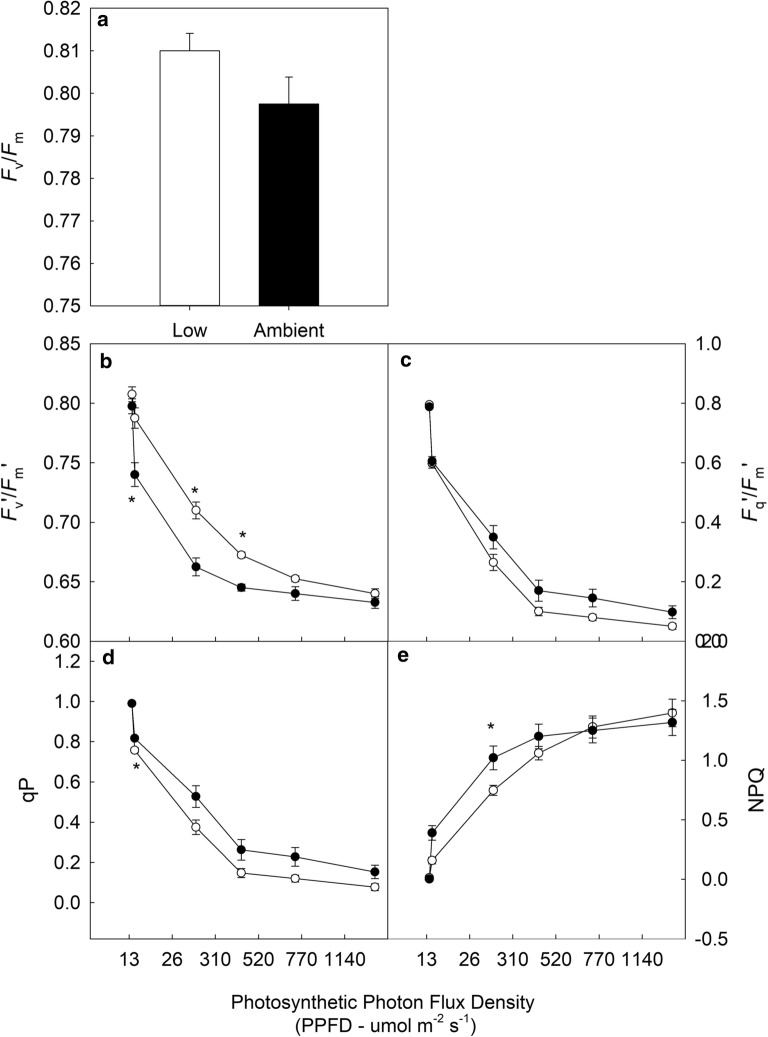
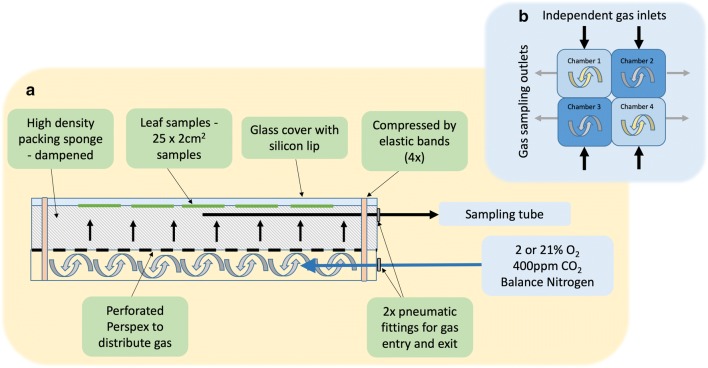
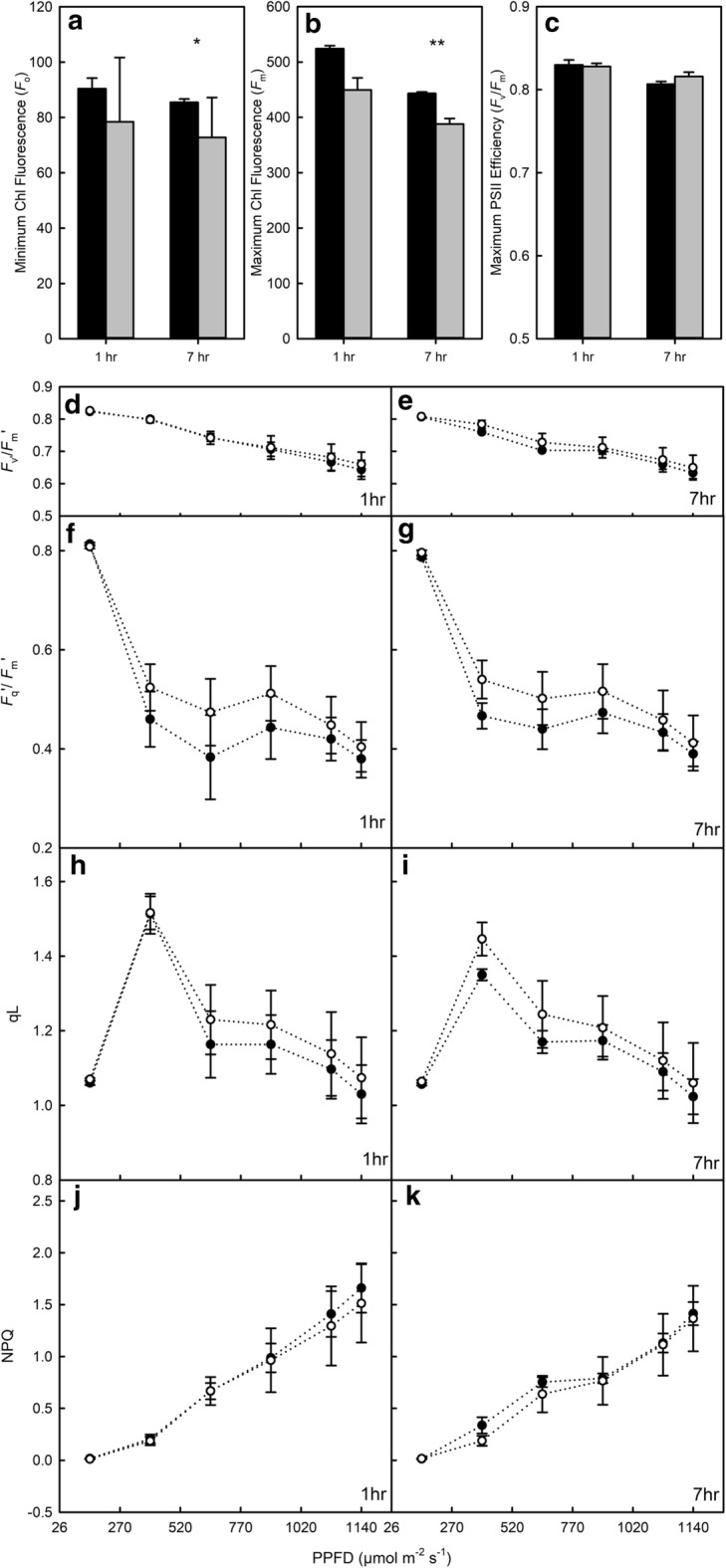
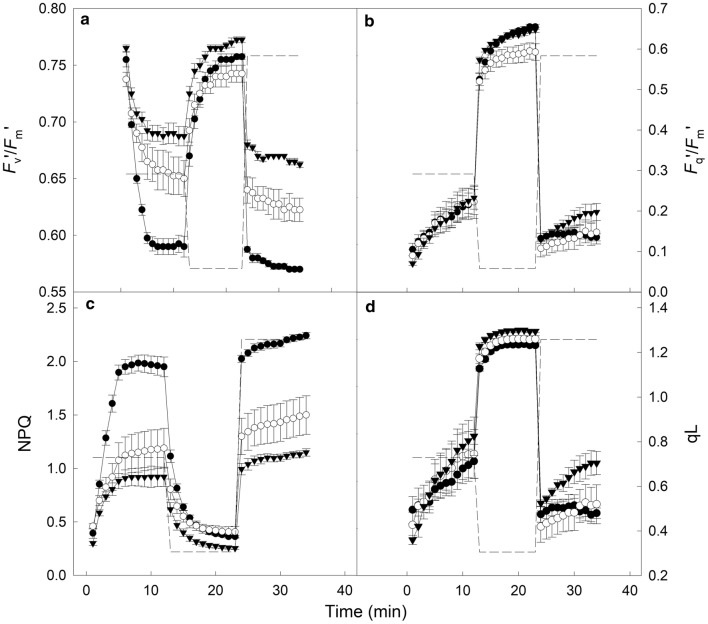
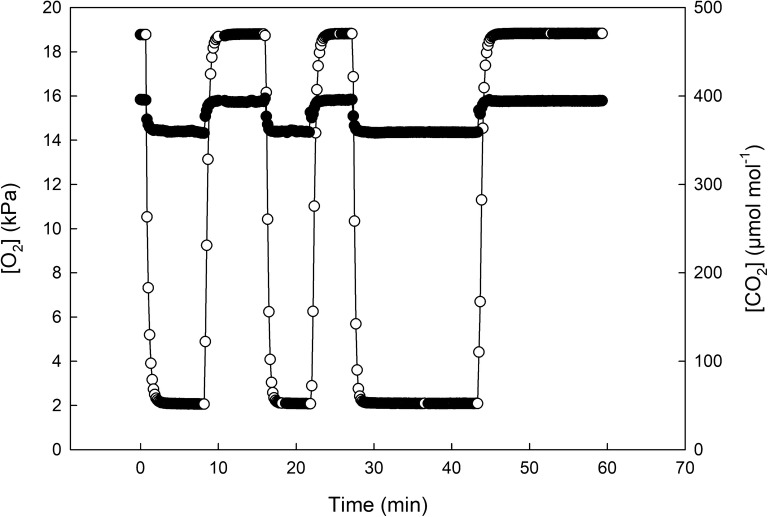
Here we describe a high throughput procedure utilising chlorophyll fluorescence imaging to phenotype dynamic photosynthesis and photoprotection in excised leaves under controlled gaseous conditions. When measured throughout the day, no significant differences ( > 0.081) were observed between the responses of excised and intact leaves. Using excised leaves, the response of three cultivars of to a user-defined dynamic lighting regime was examined. Cultivar specific differences were observed for maximum PSII efficiency ( '/ '- < 0.01) and PSII operating efficiency ( '/ '- = 0.04) under both low and high light. In addition, the rate of induction and relaxation of non-photochemical quenching (NPQ) was also cultivar specific. A specialised imaging chamber was designed and built in-house to maintain gaseous conditions around excised leaf sections. The purpose of this is to manipulate electron sinks such as photorespiration. The stability of carbon dioxide (CO) and oxygen (O) was monitored inside the chambers and found to be within ± 4.5% and ± 1% of the mean respectively. To test the chamber, 'Pavon76' leaf sections were measured under at 20 and 200 mmol mol O and ambient [CO] during a light response curve. The '/ 'was significantly higher ( < 0.05) under low [O] for the majority of light intensities while values of NPQ and the proportion of open PSII reaction centers (qP) were significantly lower under > 130 μmol m s photosynthetic photon flux density (PPFD).
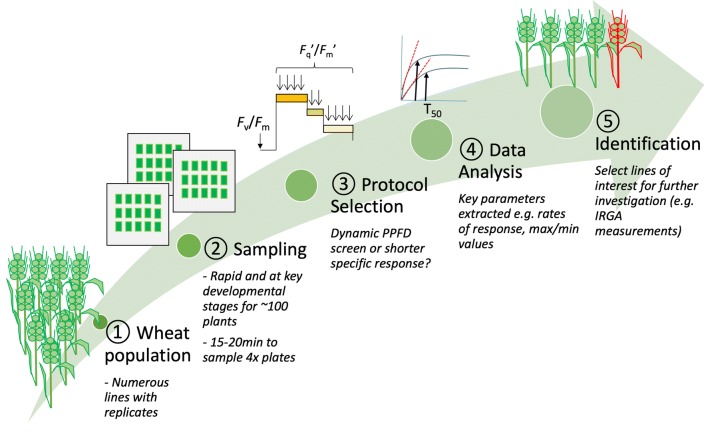
Here we demonstrate the development of a high-throughput (> 500 samples day) method for phenotyping photosynthetic and photo-protective parameters in a dynamic light environment. The technique exploits chlorophyll fluorescence imaging in a specifically designed chamber, enabling controlled gaseous environment around leaf sections. In addition, we have demonstrated that leaf sections do not different from intact plant material even > 3 h after sampling, thus enabling transportation of material of interest from the field to this laboratory based platform. The methodologies described here allow rapid, custom screening of field material for variation in photosynthetic processes.
近年来,小麦等主要作物的产量已开始趋于平稳,因此高效地对大量群体进行与产量遗传进展相关性状的表型分析面临着越来越大的压力。光合作用包含一系列稳态和动态性状,这些性状是提高作物辐射利用效率(RUE)、生物量生产和籽粒产量的关键目标。评估光合作用全范围响应的传统方法,如叶片气体交换,速度缓慢且每台仪器仅限于一片叶子(或叶子的一部分)。由于时间、设备和植株大小的限制,光合数据通常在一两个物候阶段收集,且仅针对有限的环境条件。
在此,我们描述了一种高通量方法,利用叶绿素荧光成像在受控气体条件下对离体叶片的动态光合作用和光保护进行表型分析。当全天测量时,离体叶片和完整叶片的响应之间未观察到显著差异(P>0.081)。使用离体叶片,研究了三个小麦品种对用户定义的动态光照方案的响应。在低光和高光条件下,均观察到品种间最大PSII效率(Fv'/Fm'-P<0.01)和PSII运行效率(Fq'/Fm'-P=0.04)存在差异。此外,非光化学猝灭(NPQ)的诱导和弛豫速率也具有品种特异性。我们自行设计并建造了一个专门的成像室,以维持离体叶片切片周围的气体条件。这样做的目的是操纵诸如光呼吸等电子汇。监测了室内二氧化碳(CO₂)和氧气(O₂)的稳定性,发现其分别在平均值的±4.�%和±1%范围内。为了测试该室,在光响应曲线期间,在20和200 mmol mol⁻¹ O₂以及环境[CO₂]条件下测量了‘Pavon76’叶片切片。在大多数光强下,低[O₂]条件下的Fv'/Fm'显著更高(P<0.05),而在光合光子通量密度(PPFD)>130 μmol m⁻² s⁻¹时,NPQ值和开放PSII反应中心比例(qP)显著更低。
在此,我们展示了一种高通量(>500个样本/天)方法的开发,用于在动态光环境下表征光合和光保护参数。该技术利用专门设计的室内的叶绿素荧光成像,能够控制叶片切片周围的气体环境。此外,我们已经证明,即使在采样>3小时后,叶片切片与完整植物材料也没有差异,从而能够将感兴趣的材料从田间运输到这个基于实验室的平台。这里描述的方法允许对田间材料进行快速、定制的光合过程变异筛选。