Wang Zhibo, Li Guofang, Sun Hanqing, Ma Li, Guo Yanping, Zhao Zhengyang, Gao Hua, Mei Lixin
Key Laboratory of Horticulture Plant Biology and Germplasm Innovation in Northwest China, Yangling, Shaanxi 712100, China.
College of Horticulture, Northwest A&F University, Yangling, Shaanxi 712100, China.
Biol Open. 2018 Nov 22;7(11):bio035279. doi: 10.1242/bio.035279.
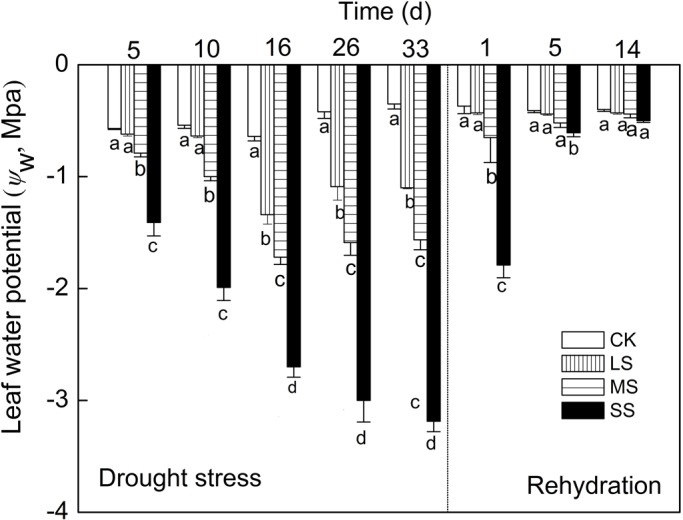
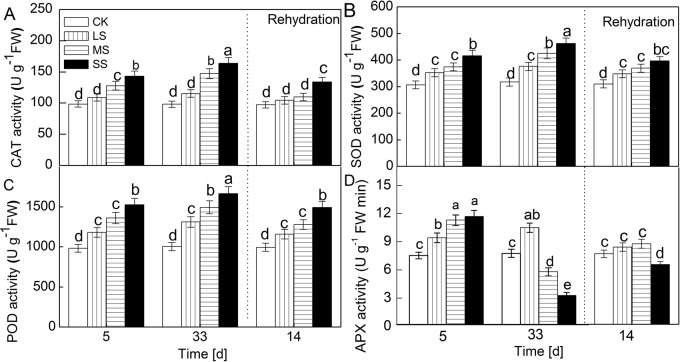
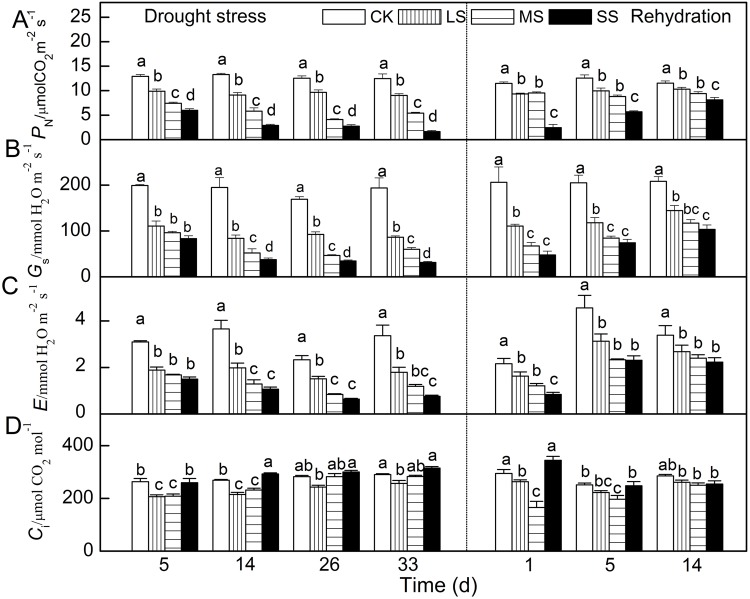
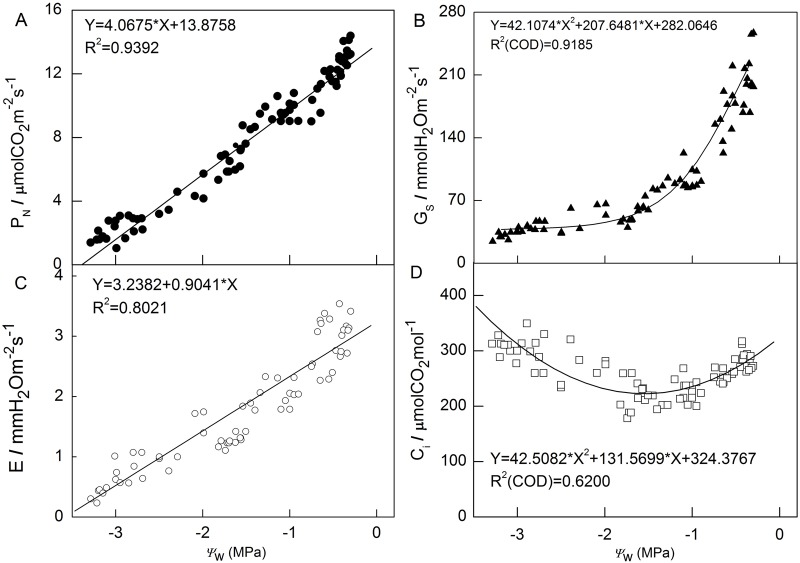
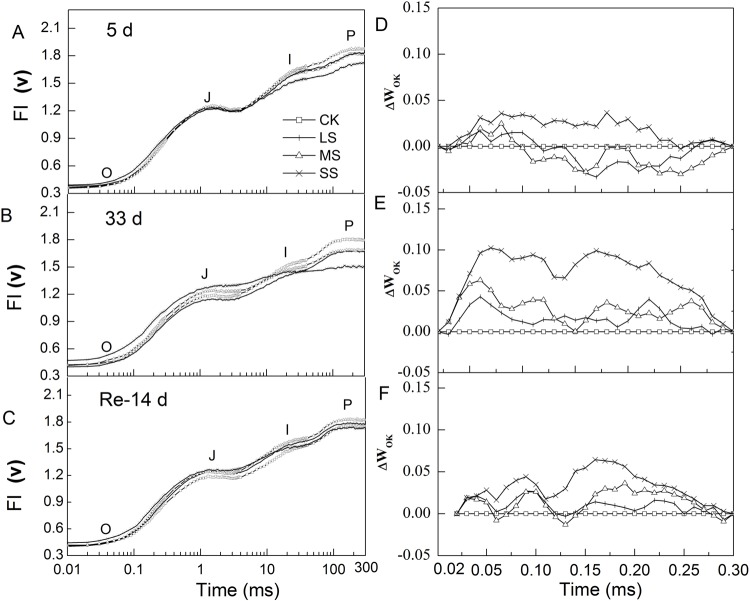
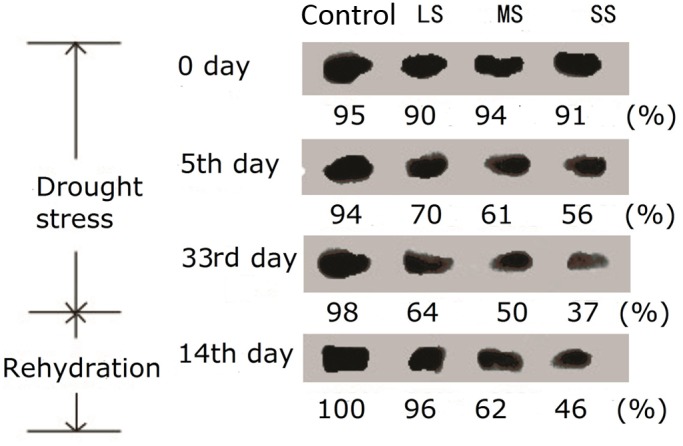
In our study, the effects of water stress on photosynthesis and photosynthetic electron transport chain (PETC) were studied in several ways, including monitoring the change of gas exchange parameters, modulated chlorophyll fluorescence, rapid fluorescence induction kinetics, reactive oxygen species (ROS), antioxidant enzyme activities and D1 protein levels in apple leaves. Our results show that when leaf water potential ( ) is above -1.5 MPa, the stomatal limitation should be the main reason for a drop of photosynthesis. In this period, photosynthetic rate ( ), stomatal conductance ( ), transpiration rate () and intercellular CO concentration ( ) all showed a strong positive correlation with Modulated chlorophyll fluorescence parameters related to photosynthetic biochemistry activity including maximum photochemical efficiency (F/F), actual photochemical efficiency of PSII (Φ), photochemical quenching coefficient ( ) and coefficient of photochemical fluorescence quenching assuming interconnected PSII antennae ( ) also showed a strong positive correlation as gradually decreased. On the other hand, in this period, Stern-Volmer type non-photochemical quenching coefficient (NPQ) and quantum yield of light-induced non-photochemical fluorescence quenching [ ] kept going up, which shows an attempt to dissipate excess energy to avoid damage to plants. When was below -1.5 MPa, continued to decrease linearly, while increased and a 'V' model presents the correlation between and by polynomial regression. This implies that, in this period, the drop in photosynthesis activity might be caused by non-stomatal limitation. F/F, Φ, and in apple leaves treated with water stress were much lower than in control, while NPQ and started to go down. This demonstrates that excess energy might exceed the tolerance ability of apple leaves. Consistent with changes of these parameters, excess energy led to an increase in the production of ROS including HO and O Although the activities of antioxidant enzymes like catalase (CAT), superoxide dismutase (SOD) and peroxidase (POD) increased dramatically and ascorbate peroxidase (APX) decreased in apple leaves with drought stress, it was still not sufficient to scavenge ROS. Consequently, the accumulation of ROS triggered a reduction of net D1 protein content, a core protein in the PSII reaction center. As D1 is responsible for the photosynthetic electron transport from plastoquinone A (Q) to plastoquinone B (Q), the capacity of PETC between Q and Q was considerably downregulated. The decline of photosynthesis and activity of PETC may result in the shortage of adenosine triphosphate (ATP) and limitation the regeneration of RuBP ( ), a key enzyme in CO assimilation. These are all non-stomatal factors and together contributed to decreased CO assimilation under severe water stress.
在我们的研究中,通过多种方式研究了水分胁迫对光合作用及光合电子传递链(PETC)的影响,包括监测苹果叶片气体交换参数的变化、调制叶绿素荧光、快速荧光诱导动力学、活性氧(ROS)、抗氧化酶活性及D1蛋白水平。我们的结果表明,当叶片水势( )高于-1.5 MPa时,气孔限制应是光合作用下降的主要原因。在此期间,光合速率( )、气孔导度( )、蒸腾速率( )和胞间CO₂浓度( )均与 呈强正相关。与光合生化活性相关的调制叶绿素荧光参数,包括最大光化学效率(Fv/Fm)、PSII实际光化学效率(ΦPSII)、光化学猝灭系数(qP)和假设PSII天线相互连接时的光化学荧光猝灭系数(qL)也随着 逐渐降低而呈强正相关。另一方面,在此期间,斯特恩-沃尔默型非光化学猝灭系数(NPQ)和光诱导非光化学荧光猝灭量子产率(Y(NPQ))持续上升,这表明植物试图耗散过剩能量以避免受损。当 低于-1.5 MPa时, 继续线性下降,而 上升,通过多项式回归呈现出 和 之间的“V”型关系。这意味着,在此期间,光合作用活性的下降可能是由非气孔限制引起的。水分胁迫处理的苹果叶片中的Fv/Fm、ΦPSII、qP和qL远低于对照,而NPQ和Y(NPQ)开始下降。这表明过剩能量可能超过了苹果叶片的耐受能力。与这些参数的变化一致,过剩能量导致包括HO·和O₂·⁻在内的ROS产生增加。虽然干旱胁迫下苹果叶片中过氧化氢酶(CAT)、超氧化物歧化酶(SOD)和过氧化物酶(POD)等抗氧化酶的活性急剧增加,而抗坏血酸过氧化物酶(APX)下降,但仍不足以清除ROS。因此,ROS的积累引发了PSII反应中心核心蛋白净D1蛋白含量的降低。由于D1负责光合电子从质体醌A(QA)向质体醌B(QB)的传递,QA和QB之间PETC的能力被显著下调。光合作用的下降和PETC的活性可能导致三磷酸腺苷(ATP)短缺,并限制了CO₂同化关键酶核酮糖-1,5-二磷酸羧化酶/加氧酶(Rubisco)的再生。这些都是非气孔因素,共同导致了严重水分胁迫下CO₂同化的降低。