McLane Richard D, Schmitt Lauren M, Pedapati Ernest V, Shaffer Rebecca C, Dominick Kelli C, Horn Paul S, Gross Christina, Erickson Craig A
Division of Child and Adolescent Psychiatry, Cincinnati Children's Hospital Medical Center, Cincinnati, OH, United States.
Division of Developmental and Behavioral Pediatrics, Cincinnati Children's Hospital Medical Center, Cincinnati, OH, United States.
Front Integr Neurosci. 2019 Sep 3;13:49. doi: 10.3389/fnint.2019.00049. eCollection 2019.
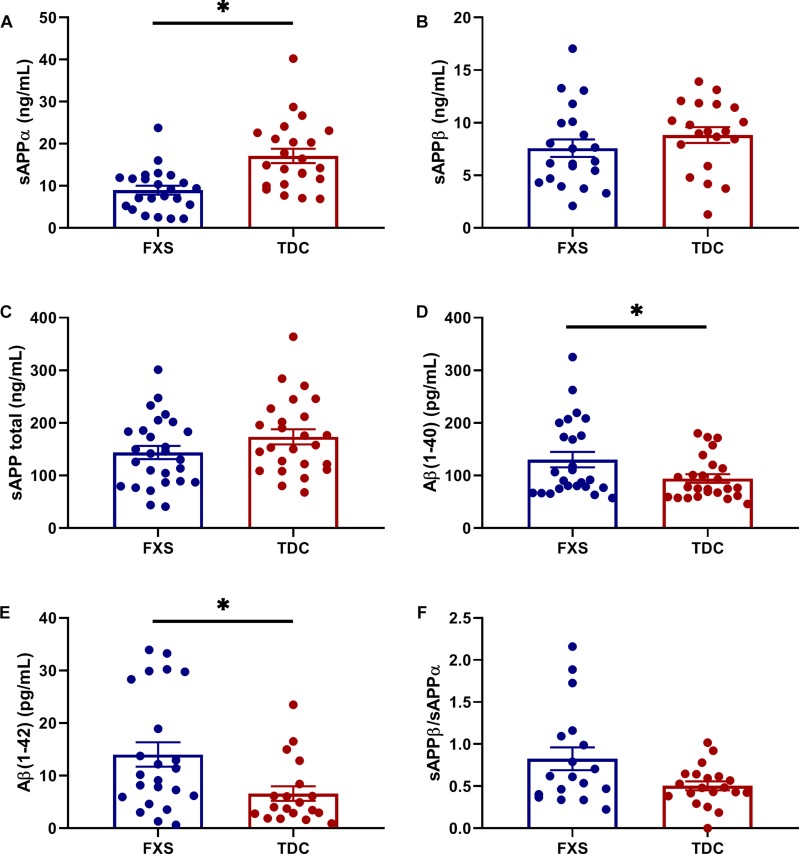
Fragile X syndrome (FXS) is the most common inherited form of intellectual disability and is associated with increased risk for autism spectrum disorder (ASD), anxiety, ADHD, and epilepsy. While our understanding of FXS pathophysiology has improved, a lack of validated blood-based biomarkers of disease continues to impede bench-to-bedside efforts. To meet this demand, there is a growing effort to discover a reliable biomarker to inform treatment discovery and evaluate treatment target engagement. Such a marker, amyloid-beta precursor protein (APP), has shown potential dysregulation in the absence of fragile X mental retardation protein (FMRP) and may therefore be associated with FXS pathophysiology. While APP is best understood in the context of Alzheimer disease, there is a growing body of evidence suggesting the molecule and its derivatives play a broader role in regulating neuronal hyperexcitability, a well-characterized phenotype in FXS. To evaluate the viability of APP as a peripheral biological marker in FXS, we conducted an exploratory ELISA-based evaluation of plasma APP-related species involving 27 persons with FXS (mean age: 22.0 ± 11.5) and 25 age- and sex-matched persons with neurotypical development (mean age: 21.1 ± 10.7). Peripheral levels of both Aβ(1-40) and Aβ(1-42) were increased, while sAPPα was significantly decreased in persons with FXS as compared to control participants. These results suggest that dysregulated APP processing, with potential preferential β-secretase processing, may be a readily accessible marker of FXS pathophysiology.
脆性X综合征(FXS)是最常见的遗传性智力障碍形式,与自闭症谱系障碍(ASD)、焦虑症、注意力缺陷多动障碍(ADHD)和癫痫的风险增加有关。虽然我们对FXS病理生理学的理解有所提高,但缺乏经过验证的基于血液的疾病生物标志物仍然阻碍了从实验室到临床的研究进展。为了满足这一需求,人们越来越努力地去发现一种可靠的生物标志物,以指导治疗方法的探索并评估治疗靶点的作用。这样一种标志物,即淀粉样前体蛋白(APP),已显示在缺乏脆性X智力低下蛋白(FMRP)的情况下存在潜在的失调,因此可能与FXS病理生理学相关。虽然APP在阿尔茨海默病的背景下最为人所知,但越来越多的证据表明,该分子及其衍生物在调节神经元过度兴奋方面发挥着更广泛的作用,而神经元过度兴奋是FXS中一个特征明确的表型。为了评估APP作为FXS外周生物标志物的可行性,我们对27名FXS患者(平均年龄:22.0±11.5岁)和25名年龄及性别匹配的神经发育正常者(平均年龄:21.1±10.7岁)进行了基于酶联免疫吸附测定(ELISA)的血浆APP相关物质的探索性评估。与对照组相比,FXS患者外周血中Aβ(1-40)和Aβ(1-42)水平均升高,而sAPPα水平显著降低。这些结果表明,APP加工失调,可能存在β-分泌酶优先加工,可能是FXS病理生理学一个易于检测的标志物。