Hendriksen Rene S, Bortolaia Valeria, Tate Heather, Tyson Gregory H, Aarestrup Frank M, McDermott Patrick F
European Union Reference Laboratory for Antimicrobial Resistance, World Health Organisation, Collaborating Center for Antimicrobial Resistance and Genomics in Food borne Pathogens, FAO Reference Laboratory for Antimicrobial Resistance, National Food Institute, Technical University of Denmark, Lyngby, Denmark.
Center for Veterinary Medicine, Office of Research, United States Food and Drug Administration, Laurel, MD, United States.
Front Public Health. 2019 Sep 4;7:242. doi: 10.3389/fpubh.2019.00242. eCollection 2019.
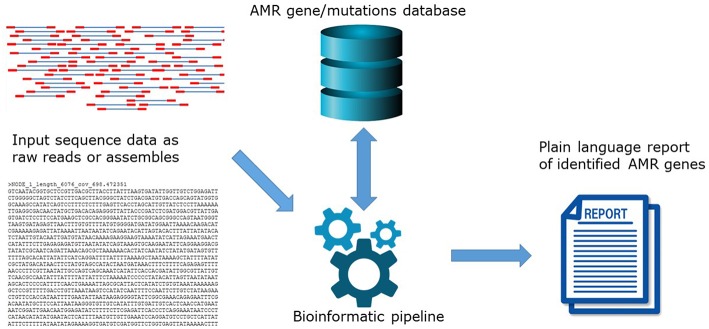
The recent advancements in rapid and affordable DNA sequencing technologies have revolutionized diagnostic microbiology and microbial surveillance. The availability of bioinformatics tools and online accessible databases has been a prerequisite for this. We conducted a scientific literature review and here we present a description of examples of available tools and databases for antimicrobial resistance (AMR) detection and provide future perspectives and recommendations. At least 47 freely accessible bioinformatics resources for detection of AMR determinants in DNA or amino acid sequence data have been developed to date. These include, among others but not limited to, ARG-ANNOT, CARD, SRST2, MEGARes, Genefinder, ARIBA, KmerResistance, AMRFinder, and ResFinder. Bioinformatics resources differ for several parameters including type of accepted input data, presence/absence of software for search within a database of AMR determinants that can be specific to a tool or cloned from other resources, and for the search approach employed, which can be based on mapping or on alignment. As a consequence, each tool has strengths and limitations in sensitivity and specificity of detection of AMR determinants and in application, which for some of the tools have been highlighted in benchmarking exercises and scientific articles. The identified tools are either available at public genome data centers, from GitHub or can be run locally. NCBI and European Nucleotide Archive (ENA) provide possibilities for online submission of both sequencing and accompanying phenotypic antimicrobial susceptibility data, allowing for other researchers to further analyze data, and develop and test new tools. The advancement in whole genome sequencing and the application of online tools for real-time detection of AMR determinants are essential to identify control and prevention strategies to combat the increasing threat of AMR. Accessible tools and DNA sequence data are expanding, which will allow establishing global pathogen surveillance and AMR tracking based on genomics. There is however, a need for standardization of pipelines and databases as well as phenotypic predictions based on the data.
快速且经济实惠的DNA测序技术的最新进展彻底改变了诊断微生物学和微生物监测。生物信息学工具和在线可访问数据库的可用性是实现这一目标的先决条件。我们进行了一项科学文献综述,在此介绍用于抗菌药物耐药性(AMR)检测的现有工具和数据库的示例,并提供未来展望和建议。迄今为止,已开发出至少47种可免费访问的生物信息学资源,用于检测DNA或氨基酸序列数据中的AMR决定因素。其中包括但不限于ARG-ANNOT、CARD、SRST2、MEGARes、Genefinder、ARIBA、KmerResistance、AMRFinder和ResFinder。生物信息学资源在几个参数方面存在差异,包括接受的输入数据类型、是否存在可在特定于某个工具或从其他资源克隆的AMR决定因素数据库中进行搜索的软件,以及所采用的搜索方法,该方法可以基于映射或比对。因此,每种工具在检测AMR决定因素的敏感性和特异性以及应用方面都有优势和局限性,其中一些工具的优势和局限性已在基准测试和科学文章中得到强调。已识别的工具可在公共基因组数据中心获取、从GitHub获取或可在本地运行。美国国立医学图书馆(NCBI)和欧洲核苷酸档案库(ENA)提供了在线提交测序数据和伴随的表型抗菌药物敏感性数据的可能性,使其他研究人员能够进一步分析数据,并开发和测试新工具。全基因组测序的进展以及用于实时检测AMR决定因素的在线工具的应用对于确定控制和预防策略以应对AMR日益增加的威胁至关重要。可访问的工具和DNA序列数据正在不断扩展,这将有助于建立基于基因组学的全球病原体监测和AMR追踪。然而,需要对流程和数据库以及基于数据的表型预测进行标准化。