Buking Supatana, Suedomi Yusuke, Nacapricha Duangjai, Kaneta Takashi
Flow Innovation-Research for Science and Technology Laboratories (FIRST Labs) and Department of Chemistry and Center of Excellence for Innovation in Chemistry, Faculty of Science, Mahidol University, Bangkok 10400, Thailand.
Department of Chemistry, Graduate School of Natural Science and Technology, Okayama University, Okayama 700-8530, Japan.
ACS Omega. 2019 Sep 3;4(12):15249-15254. doi: 10.1021/acsomega.9b02226. eCollection 2019 Sep 17.
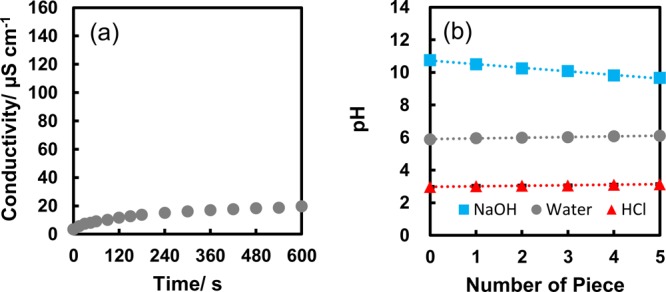
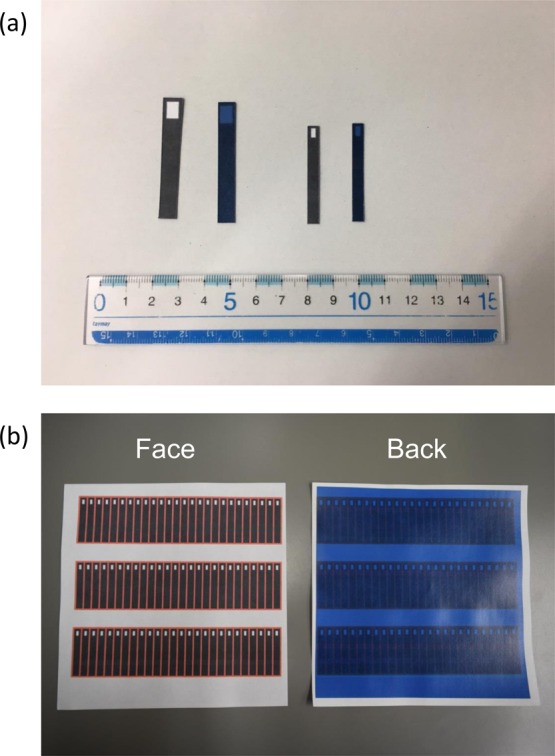
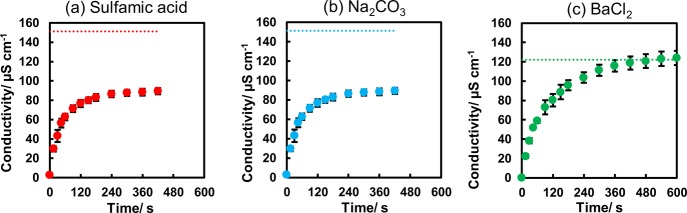
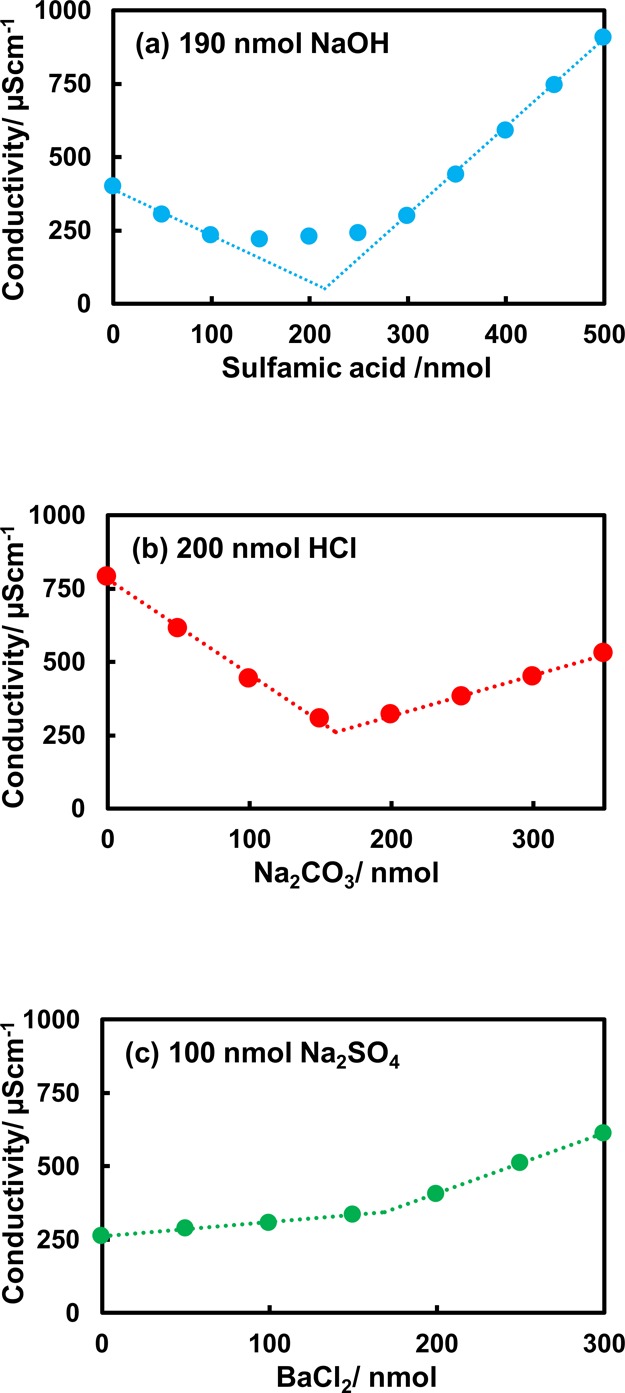
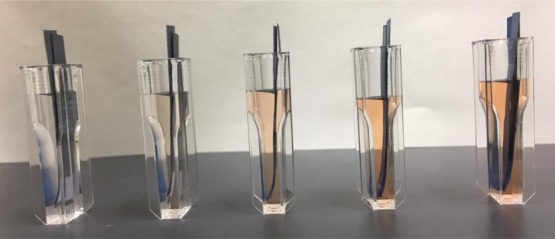
Reagent-deposited pieces of paper were characterized by the use of a compact conductometer, a compact pH sensor, and a conventional spectrophotometer to assess their suitability for use as reagent containers. The pieces of paper were fabricated by wax printing to form a limited hydrophilic area to which a consistent volume of an aqueous reagent could be added. The pieces of paper without the reagent increased the conductivity of water gradually because of the release of sodium salts, whereas pH of NaOH decreased because of the acidity of the functional groups in the paper. Three reagents, sulfamic acid as an acid, NaCO as a base, and BaCl as a metal salt, were deposited on the pieces of paper to evaluate their ability to release from the pieces of paper. Sulfamic acid and NaCO were released in quantities of 58 and 73% into water after 420 s, whereas 100% of BaCl was released after 480 s. The conductometric titrations of NaOH, HCl, and NaSO, and the spectrophotometry of Fe were examined using the pieces of paper that contained sulfamic acid, NaCO, BaCl, and 1,10-phenanthroline. Titrations using the pieces of paper suggested that the reagents were quantitatively released into the titrant, which resulted in a linear relationship between the endpoints and the equivalent points. In 120 s of soaking time, 60-70% of the reagents were released. The spectrophotometric measurements of Fe indicated that when an excess amount of the reagents was deposited onto the pieces of paper, they nonetheless sufficiently fulfilled the role of a reagent container.
通过使用紧凑型电导率仪、紧凑型pH传感器和传统分光光度计来表征涂覆试剂的纸片,以评估它们作为试剂容器的适用性。这些纸片通过蜡印法制造,形成一个有限的亲水区,可向其中添加恒定体积的水性试剂。未添加试剂的纸片由于钠盐的释放而逐渐增加水的电导率,而NaOH的pH值由于纸中官能团的酸性而降低。将三种试剂,即作为酸的氨基磺酸、作为碱的碳酸钠和作为金属盐的氯化钡,沉积在纸片上,以评估它们从纸片上释放的能力。420秒后,氨基磺酸和碳酸钠分别有58%和73%释放到水中,而480秒后氯化钡100%释放。使用含有氨基磺酸、碳酸钠、氯化钡和1,10-菲咯啉的纸片对NaOH、HCl和Na₂SO₄进行电导滴定,并对铁进行分光光度测定。使用纸片进行的滴定表明,试剂被定量释放到滴定剂中,这导致终点和等当点之间呈线性关系。在浸泡120秒时,60 - 70%的试剂被释放。铁的分光光度测量表明,当将过量的试剂沉积在纸片上时,它们仍然充分发挥了试剂容器的作用。