Frankham Charlotte, Richardson Thomas, Maguire Nick
School of Psychology, University of Southampton, Southampton, SO17 1BJ, UK.
Ealing Early Intervention Service, West London NHS Trust, Cherington House, Cherington Road, Hanwell, W7 3HL, UK.
Community Ment Health J. 2020 Apr;56(3):404-415. doi: 10.1007/s10597-019-00467-9. Epub 2019 Sep 24.
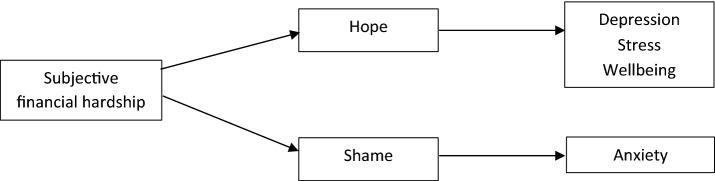
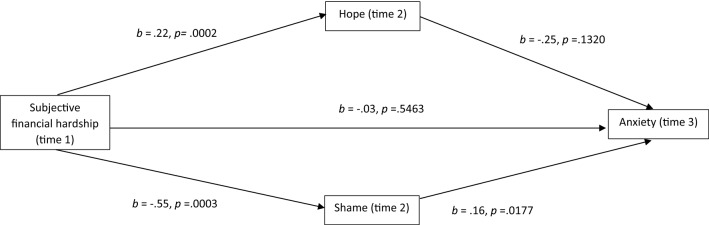
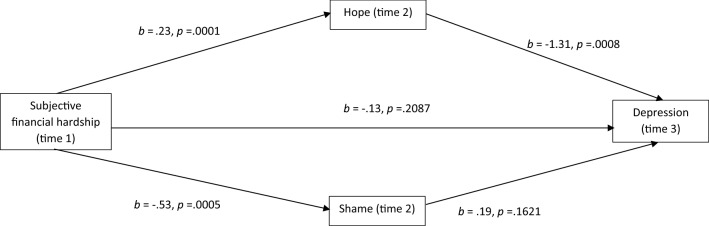
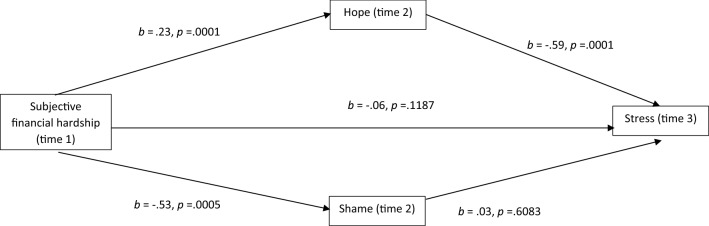
In a longitudinal study of 104 participants, the psychological factors of economic locus of control, self-esteem, hope and shame were explored for their impact on the relationship between financial hardship and mental health. Participants completed measures of financial hardship, the psychological factors and measures of mental health three times at three-monthly intervals. A hierarchical regression analyses indicated that subjective financial hardship, hope and shame significantly predicted mental health outcomes. Mediation analyses demonstrated that hope mediated the relationship between subjective financial hardship and depression, stress and wellbeing; that shame mediated the relationship between subjective financial hardship and anxiety; and that neither shame nor hope mediated the relationship between subjective financial hardship and suicide ideation.
在一项针对104名参与者的纵向研究中,探讨了经济控制点、自尊、希望和羞耻感等心理因素对经济困难与心理健康之间关系的影响。参与者每隔三个月完成一次经济困难、心理因素和心理健康的测量。分层回归分析表明,主观经济困难、希望和羞耻感显著预测了心理健康结果。中介分析表明,希望在主观经济困难与抑郁、压力和幸福感之间起中介作用;羞耻感在主观经济困难与焦虑之间起中介作用;羞耻感和希望均未在主观经济困难与自杀意念之间起中介作用。