Department of Nephrology, Xixi Hospital of Hangzhou (Hangzhou XIXI Affiliated Hospital of Zhejiang Chinese Medical University) , Hangzhou , Zhejiang Province , People's Republic of China.
Ren Fail. 2019 Nov;41(1):899-906. doi: 10.1080/0886022X.2019.1665547.
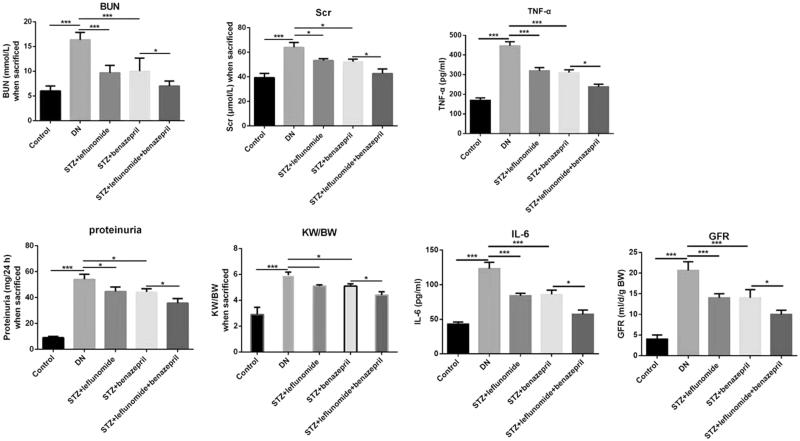
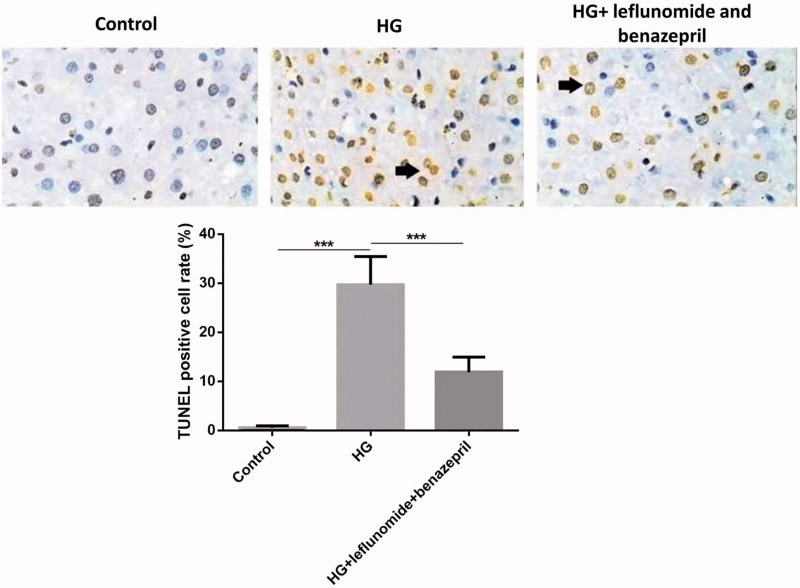
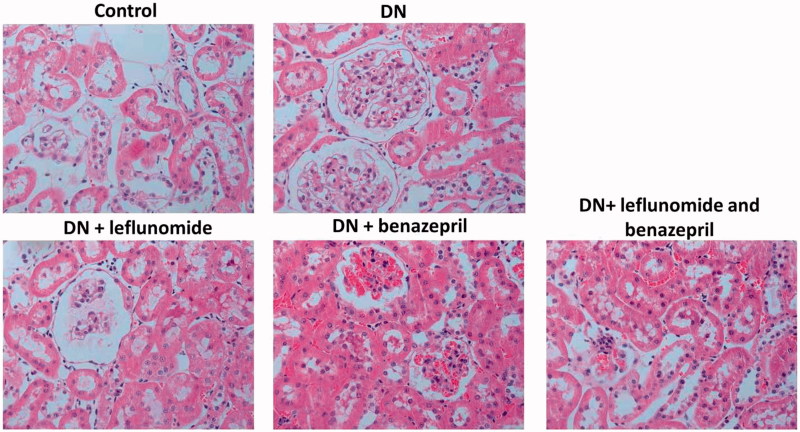
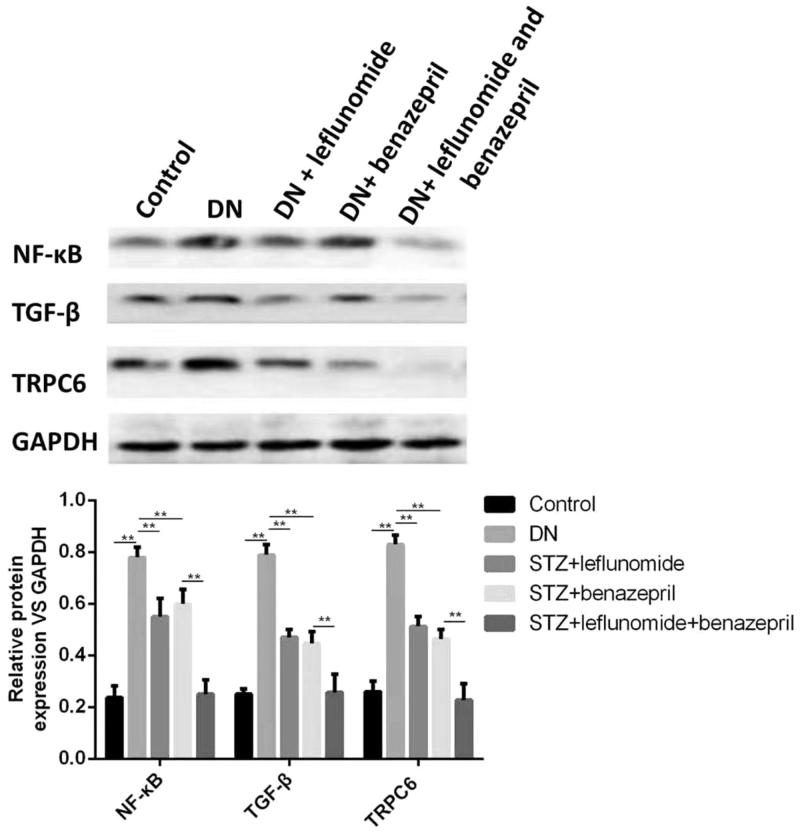
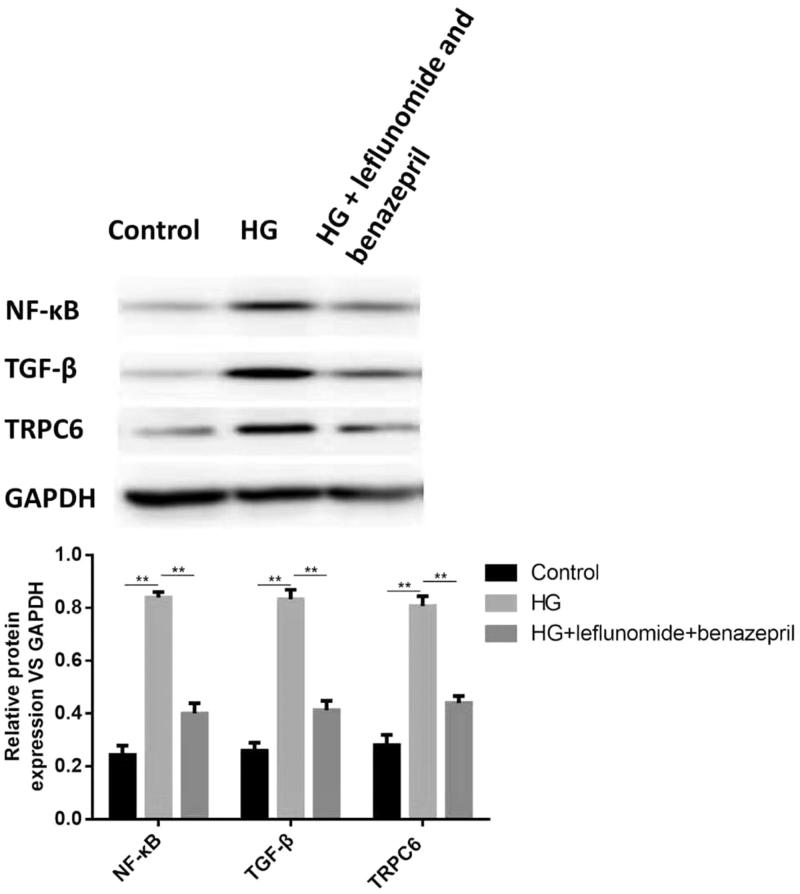
To investigate effects of combination use of leflunomide and benazepril on diabetic nephropathy (DN) both and . The streptozotocin (STZ) induced Sprague-Dawley rats were treated with leflunomide (15 mg/kg/d), benazepril (15 mg/kg/d) or both the two drugs. Fasting blood glucose (FBG) and renal function indexes including blood urea nitrogen (BUN), serum creatinine (Scr), and proteinuria and kidney/body weight ratio (KW/BW) were measured. HE staining was used for histological analysis. The rat glomerular mesangial cells (RMCs) were treated with high-glucose (150 mg/ml) and the leflunomide and benazepril with both concentrations of 50 μmol/l were used to treat the high-glucose induced cells. TUNEL assay was used for measurement of cell apoptosis. Western blotting was conducted to determine expression of nuclear factor Kappa B (NF-κB), transforming growth factor-β (TGF-β) and transient receptor potential canonical 6 (TRPC6). The body weight was significantly lower and all indexes of FBG, BUN, Scr, proteinuria and KW/BW ratio, GFR, as well as inflammatory factors TNF-α and IL-6 were significantly increased in the DN group after STZ treatment for 4 weeks. The treatment with leflunomide, benazepril or the both dramatically reduced the above effects induced by STZ, and the alteration was the most significant in the combination group. Treatment of leflunomide and benazepril significantly reduced expression levels of NF-κB, TGF-β and TRPC6 in renal tissues of DN rats as well as in high-glucose induced RMCs. It was also observed leflunomide and benazepril reduced high-glucose induced cell apoptosis of RMCs. The combination use of leflunomide and benazepril could improve the renal function and reduce the renal injury of DN rats and could reduce the levels of NF-κb, TGF-β and TRPC6 in both DN rats and high-glucose induced RMCs.
探讨来氟米特(LEF)联合贝那普利(BEN)对糖尿病肾病(DN)的影响。方法:采用链脲佐菌素(STZ)诱导 Sprague-Dawley 大鼠,给予 LEF(15mg/kg/d)、BEN(15mg/kg/d)或两种药物联合治疗。测定空腹血糖(FBG)和肾功能指标,包括血尿素氮(BUN)、血清肌酐(Scr)、蛋白尿和肾体比(KW/BW)。采用 HE 染色进行组织学分析。用高糖(150mg/ml)处理大鼠肾小球系膜细胞(RMCs),并用 50μmol/L 的 LEF 和 BEN 处理高糖诱导的细胞。采用 TUNEL 法检测细胞凋亡。采用 Western blot 法检测核因子κB(NF-κB)、转化生长因子-β(TGF-β)和瞬时受体电位经典型 6(TRPC6)的表达。
与正常对照组相比,DN 组大鼠在 STZ 处理 4 周后体重明显下降,FBG、BUN、Scr、蛋白尿和 KW/BW 比值、肾小球滤过率(GFR)以及炎症因子 TNF-α和 IL-6 均明显升高。LEF、BEN 或两者联合治疗均显著降低了 STZ 引起的上述变化,联合治疗组的变化最为显著。LEF 和 BEN 治疗可显著降低 DN 大鼠肾组织中 NF-κB、TGF-β和 TRPC6的表达水平,以及高糖诱导的 RMCs中 NF-κB、TGF-β和 TRPC6的表达水平,还可减少高糖诱导的 RMCs的细胞凋亡。
LEF 联合 BEN 可改善糖尿病肾病大鼠的肾功能,减轻肾脏损伤,降低 DN 大鼠和高糖诱导的 RMCs中 NF-κB、TGF-β和 TRPC6的水平。