Universidade Nova de Lisboa, Global Health and Tropical Medicine Centre, Instituto de Higiene e Medicina Tropical, Lisboa, Portugal.
Institut Pasteur de la Guyane, Vectopole Amazonien Emile Abonnenc, Vector Control and Adaptation Unit, Cayenne, France.
Mem Inst Oswaldo Cruz. 2019 Sep 23;114:e190120. doi: 10.1590/0074-02760190120. eCollection 2019.
In recent years, South America has suffered the burden of continuous high impact outbreaks of dengue, chikungunya and Zika. Aedes aegypti is the main mosquito vector of these arboviruses and its control is the only solution to reduce transmission.
In order to improve vector control it is essential to study mosquito population genetics in order to better estimate the population structures and the geneflow among them.
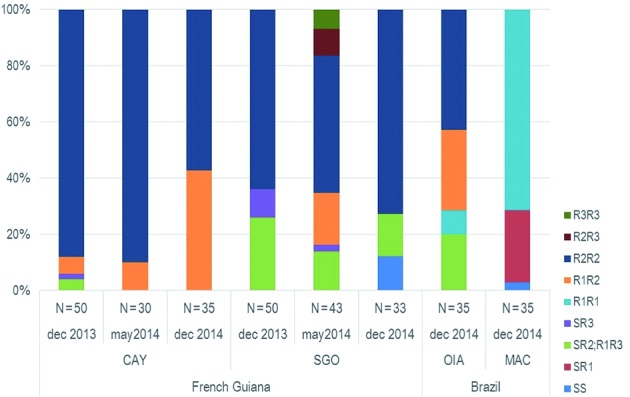
We have analysed microsatellites and knockdown resistance (kdr) mutations from a trans-border region in Amazonia between the state of Amapá (Brazil) and French Guiana (overseas territory of France), to provide further knowledge on these issues. These two countries have followed distinct vector control policies since last century. For population genetic analyses we evaluated variability in 13 well-established microsatellites loci in Ae. aegypti from French Guiana (Saint Georges and Cayenne) and Brazil (Oiapoque and Macapá). The occurrence and frequency of kdr mutations in these same populations were accessed by TaqMan genotype assays for the sites 1016 (Val/Ile) and 1534 (Phe/Cys).
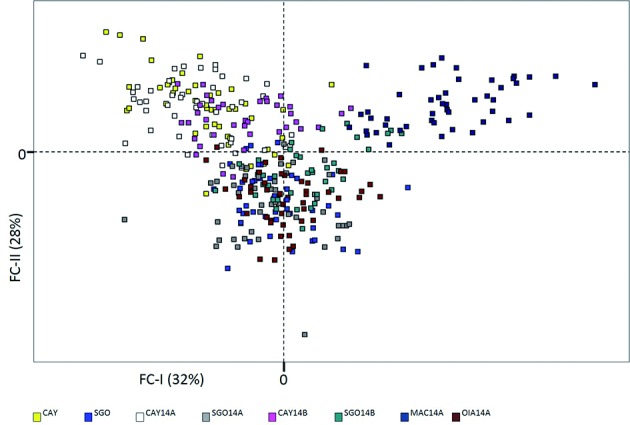
We have detected high levels of gene flow between the closest cross-border samples of Saint-Georges and Oiapoque. These results suggest one common origin of re-colonisation for the populations of French Guiana and Oiapoque in Brazil, and a different source for Macapá, more similar to the other northern Brazilian populations. Genotyping of the kdr mutations revealed distinct patterns for Cayenne and Macapá associated with their different insecticide use history, and an admixture zone between these two patterns in Saint Georges and Oiapoque, in accordance with population genetic results.
The present study highlights the need for regional-local vector surveillance and transnational collaboration between neighboring countries to assess the impact of implemented vector control strategies, promote timely actions and develop preparedness plans.
近年来,南美洲持续遭受登革热、基孔肯雅热和寨卡病毒的高强度暴发。埃及伊蚊是这些虫媒病毒的主要传播媒介,控制其传播是减少病毒传播的唯一途径。
为了改善病媒控制,研究蚊虫种群遗传学至关重要,以便更好地估计种群结构和种群间的基因流动。
我们分析了位于巴西阿马帕州(Amapá)和法属圭亚那(法国海外领地)之间亚马逊跨境地区的蚊种群的微卫星和击倒抗性(kdr)突变,以提供有关这些问题的进一步知识。这两个国家自上世纪以来一直采取不同的病媒控制政策。为了进行种群遗传分析,我们评估了法属圭亚那(圣乔治和卡宴)和巴西(奥亚波克和马卡帕)的埃及伊蚊 13 个成熟微卫星基因座的变异性。通过 TaqMan 基因分型测定法评估了这些相同种群中 1016 (Val/Ile)和 1534 (Phe/Cys)位点 kdr 突变的发生和频率。
我们在圣乔治和奥亚波克最接近的跨境样本中检测到高水平的基因流。这些结果表明,法属圭亚那和巴西奥亚波克的种群有一个共同的重新殖民起源,而马卡帕的起源则不同,与其他北部巴西种群更为相似。kdr 突变的基因分型揭示了卡宴和马卡帕的不同模式,这与它们不同的杀虫剂使用历史有关,而在圣乔治和奥亚波克,这两种模式之间存在一个混合区,这与种群遗传结果一致。
本研究强调了需要进行区域-地方病媒监测和邻国之间的跨国合作,以评估实施病媒控制策略的影响,及时采取行动,并制定备灾计划。