From the Department of Cardiology, Biomedical Engineering, Erasmus MC, Rotterdam, the Netherlands (A.H., E.M.J.H., K.v.G., K.V.d.H., A.F.W.v.d.S., J.J.W.).
Department of Internal Medicine, Laboratory of Vascular Medicine, Division of Pharmacology, Vascular & Metabolic Disease (S.d.H., L.v.d.Z., K.D., J.R.v.L., M.T.M.), Erasmus MC, Rotterdam, the Netherlands.
Arterioscler Thromb Vasc Biol. 2019 Nov;39(11):2338-2352. doi: 10.1161/ATVBAHA.119.313246. Epub 2019 Sep 26.
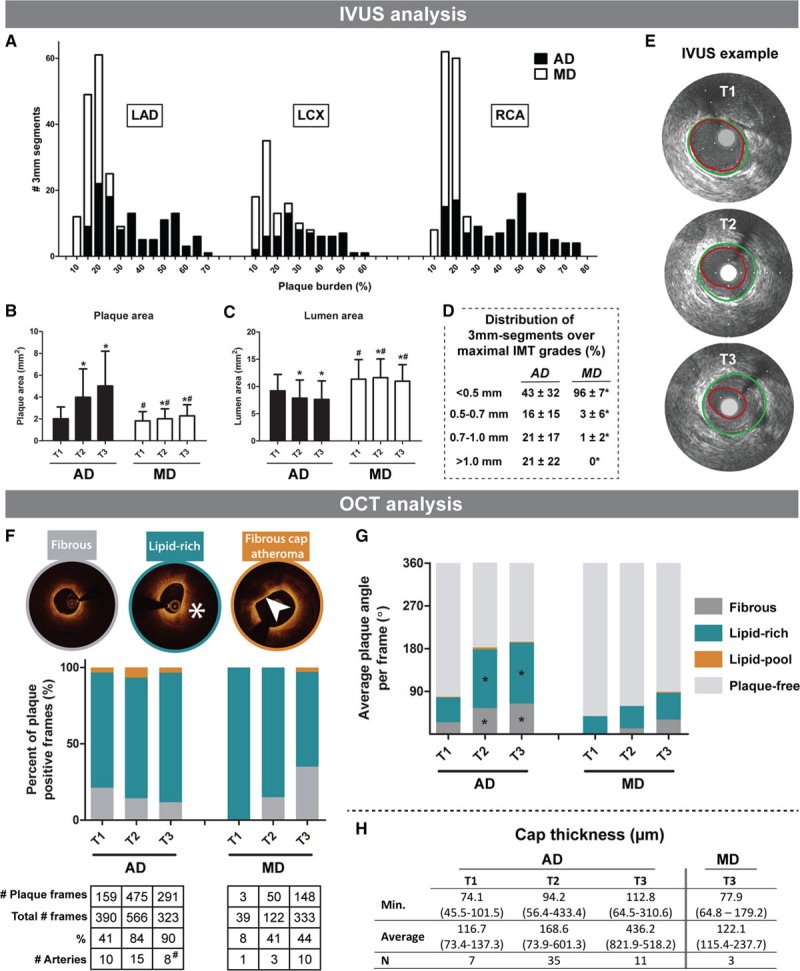
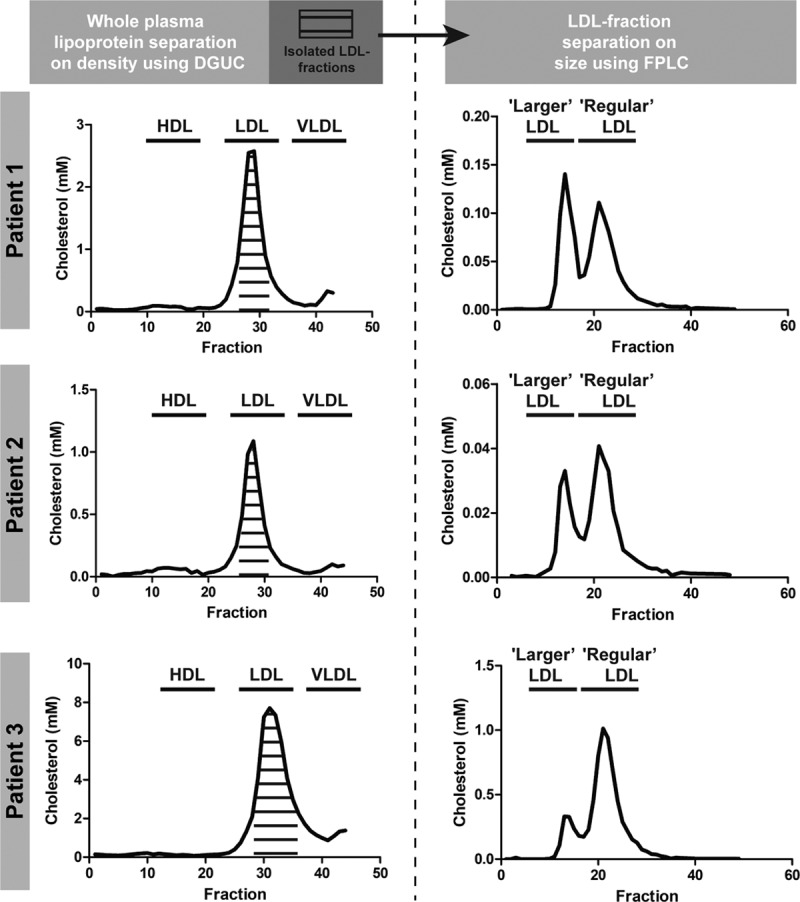
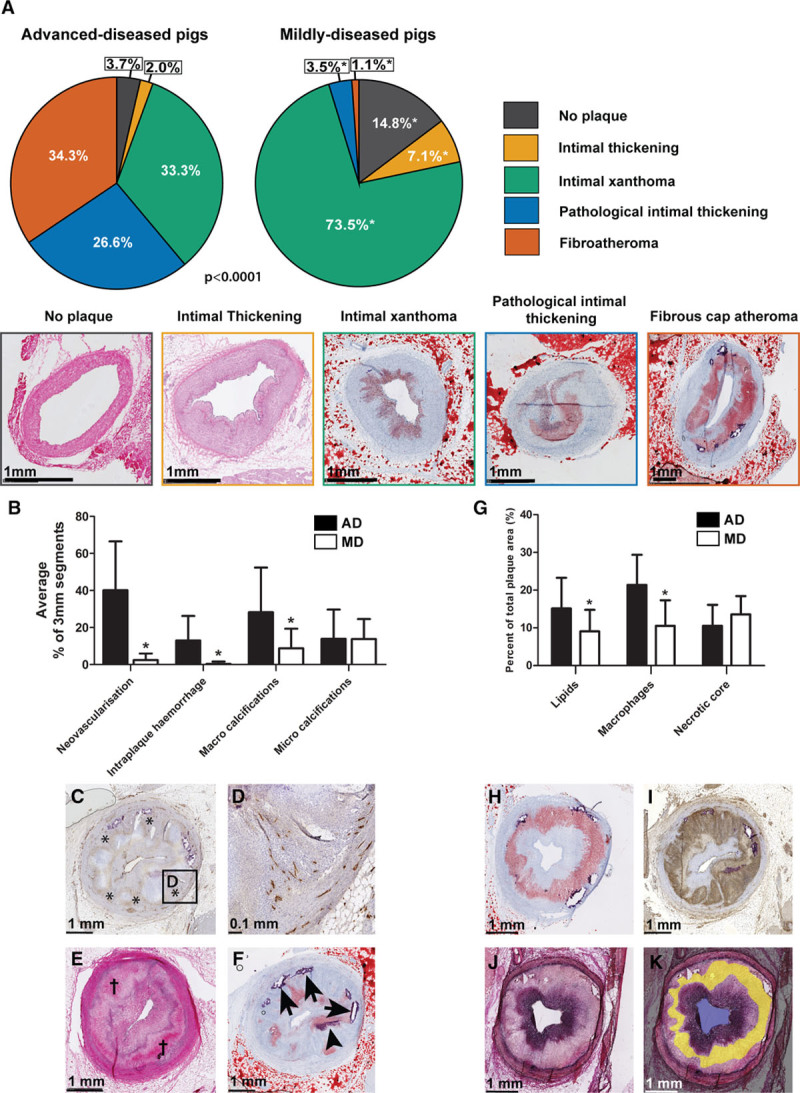
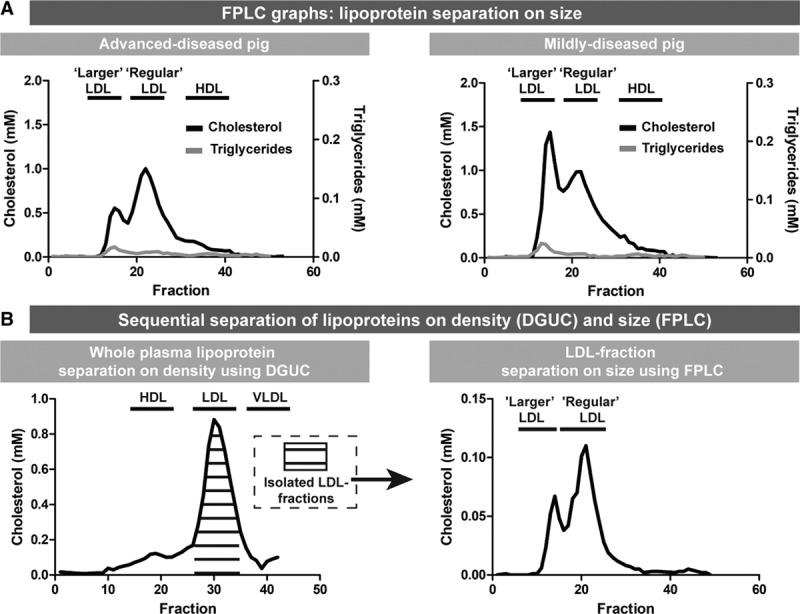
In an adult porcine model of familial hypercholesterolemia (FH), coronary plaque development was characterized. To elucidate the underlying mechanisms of the observed inter-individual variation in disease severity, detailed lipoprotein profiles were determined. Approach and Results: FH pigs (3 years old, homozygous R84C mutation) received an atherogenic diet for 12 months. Coronary atherosclerosis development was monitored using serial invasive imaging and histology. A pronounced difference was observed between mildly diseased pigs which exclusively developed early lesions (maximal plaque burden, 25% [23%-34%]; n=5) and advanced-diseased pigs (n=5) which developed human-like, lumen intruding plaques (maximal plaque burden, 69% [57%-77%]) with large necrotic cores, intraplaque hemorrhage, and calcifications. Advanced-diseased pigs and mildly diseased pigs displayed no differences in conventional risk factors. Additional plasma lipoprotein profiling by size-exclusion chromatography revealed 2 different LDL (low-density lipoprotein) subtypes: regular and larger LDL. Cholesterol, sphingosine-1-phosphate, ceramide, and sphingomyelin levels were determined in these LDL-subfractions using standard laboratory techniques and high-pressure liquid chromatography mass-spectrometry analyses, respectively. At 3 months of diet, regular LDL of advanced-diseased pigs contained relatively more cholesterol (LDL-C; regular/larger LDL-C ratio 1.7 [1.3-1.9] versus 0.8 [0.6-0.9]; =0.008) than mildly diseased pigs, while larger LDL contained more sphingosine-1-phosphate, ceramides, and sphingomyelins. Larger and regular LDL was also found in plasma of 3 patients with homozygous FH with varying LDL-C ratios.
In our adult FH pig model, inter-individual differences in atherosclerotic disease severity were directly related to the distribution of cholesterol and sphingolipids over a distinct LDL profile with regular and larger LDL shortly after the diet start. A similar LDL profile was detected in patients with homozygous FH.
在家族性高胆固醇血症(FH)的成年猪模型中,对冠状动脉斑块的发展进行了特征描述。为了阐明观察到的疾病严重程度的个体间差异的潜在机制,确定了详细的脂蛋白谱。方法和结果:FH 猪(3 岁,杂合 R84C 突变)接受致动脉粥样硬化饮食 12 个月。使用连续的侵袭性成像和组织学监测冠状动脉粥样硬化的发展。在轻度患病的猪中观察到明显的差异,这些猪仅发展为早期病变(最大斑块负担,25%[23%-34%];n=5),而进展性疾病的猪(n=5)则发展为具有人类样管腔侵入性斑块(最大斑块负担,69%[57%-77%]),伴有大的坏死核心、斑块内出血和钙化。进展性疾病的猪和轻度患病的猪在传统危险因素方面没有差异。通过大小排阻色谱法对额外的血浆脂蛋白谱进行分析,发现 2 种不同的 LDL(低密度脂蛋白)亚型:常规和较大的 LDL。使用标准实验室技术和高压液相色谱质谱分析分别测定这些 LDL 亚组分中的胆固醇、鞘氨醇-1-磷酸、神经酰胺和鞘磷脂水平。在饮食的 3 个月时,进展性疾病猪的常规 LDL 中含有相对更多的胆固醇(LDL-C;常规/较大 LDL-C 比值 1.7[1.3-1.9]比 0.8[0.6-0.9];=0.008),而较大的 LDL 中含有更多的鞘氨醇-1-磷酸、神经酰胺和鞘磷脂。在 3 名具有不同 LDL-C 比值的纯合 FH 患者的血浆中也发现了较大和常规的 LDL。结论:在我们的成年 FH 猪模型中,动脉粥样硬化疾病严重程度的个体间差异与饮食开始后不久特定 LDL 谱中胆固醇和神经鞘脂的分布直接相关,具有常规和较大的 LDL。在纯合 FH 患者中检测到类似的 LDL 谱。