Department of Geriatric and General Medicine, Osaka University Graduate School of Medicine, 2-2 Yamadaoka, Suita, Osaka, 565-0871, Japan.
Division of Nephrology, Endocrinology and Vascular Medicine, Department of Medicine, Tohoku University School of Medicine, 2-1 Seiryo-machi, Aoba, Sendai, Miyagi, 980-8575, Japan.
Hypertens Res. 2019 Dec;42(12):1932-1941. doi: 10.1038/s41440-019-0314-7. Epub 2019 Sep 25.
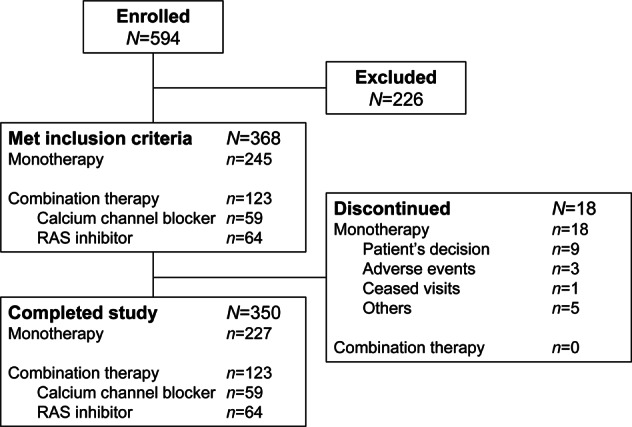
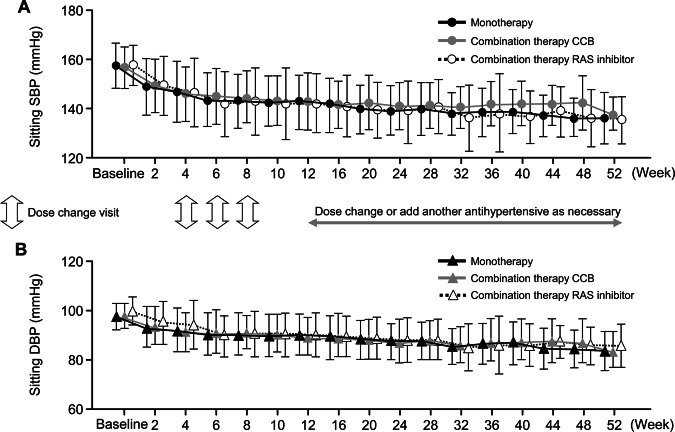
This study investigated the long-term antihypertensive effects of esaxerenone, a novel nonsteroidal mineralocorticoid receptor blocker, alone or in combination with a calcium channel blocker (CCB) or a renin-angiotensin system (RAS) inhibitor, in Japanese patients with essential hypertension. Patients were treated with esaxerenone starting at 2.5 mg/day increasing to 5 mg/day if required to achieve blood pressure (BP) targets as a monotherapy or with a CCB or RAS inhibitor. After the first 12 weeks of treatment, an additional antihypertensive agent could be added if required to achieve the target BP; the total treatment period was 28 or 52 weeks. The primary endpoint was a change from baseline in sitting BP. Of the 368 enrolled patients, 245 received monotherapy, and 59 and 64, respectively, took a CCB or RAS inhibitor concurrently. Mean changes from baseline in sitting systolic/diastolic BP (95% confidence intervals) at weeks 12, 28 and 52 were -16.1 (-17.3, -14.9)/-7.7 (-8.4, -6.9), -18.9 (-20.2, -17.7)/-9.9 (-10.7, -9.2), and -23.1 (-25.0, -21.1)/-12.5 (-13.6, -11.3) mmHg, respectively (all P < 0.0001 vs baseline). Similar BP reductions at these weeks were observed between all patient subgroups stratified by age, and the observed decreases in 24-h ambulatory BP were consistent with the efficacy observed in sitting BP. Esaxerenone was also well-tolerated with a rate of hyperkalemia at 5.4% (serum potassium ≥5.5 mEq/L), indicating a good safety profile for treatment over the long-term or in combination with a CCB or RAS inhibitor. In conclusion, esaxerenone may be a promising treatment option for patients with hypertension.
这项研究调查了新型非甾体类盐皮质激素受体阻滞剂 esaxerenone 在日本原发性高血压患者中的长期降压效果,其可单独使用或与钙通道阻滞剂(CCB)或肾素-血管紧张素系统(RAS)抑制剂联合使用。患者起始接受 esaxerenone 治疗,剂量为 2.5mg/天,如果需要则增加至 5mg/天,以达到血压(BP)目标,作为单药治疗或与 CCB 或 RAS 抑制剂联合使用。在治疗的前 12 周后,如果需要达到目标 BP,可加用额外的降压药物;总治疗期为 28 或 52 周。主要终点是与基线相比坐位 BP 的变化。在 368 名入组患者中,245 名接受单药治疗,分别有 59 名和 64 名患者同时服用 CCB 或 RAS 抑制剂。治疗 12、28 和 52 周时,与基线相比,坐位收缩压/舒张压的平均变化(95%置信区间)分别为-16.1(-17.3,-14.9)/ -7.7(-8.4,-6.9)、-18.9(-20.2,-17.7)/ -9.9(-10.7,-9.2)和-23.1(-25.0,-21.1)/-12.5(-13.6,-11.3)mmHg(均 P<0.0001 与基线相比)。根据年龄分层的所有患者亚组在这些周的 BP 降低相似,观察到的 24 小时动态血压降低与坐位 BP 的疗效一致。 esaxerenone 也具有良好的耐受性,高钾血症发生率为 5.4%(血清钾≥5.5mEq/L),表明其在长期治疗或与 CCB 或 RAS 抑制剂联合使用时具有良好的安全性。总之,esaxerenone 可能是高血压患者的一种有前途的治疗选择。