Shi Jianfei, Han Xin, Wang Jinfeng, Han Guangjie, Zhao Man, Duan Xiaoling, Mi Lili, Li Ning, Yin Xiaolei, Shi Huacun, Li Cuizhen, Gao Jintan, Xu Jinsheng, Yin Fei
Department of Gastroenterology and Hepatology, The Fourth Hospital of Hebei Medical University, Shijiazhuang, Hebei 050019, P.R. China.
Department of Tuberculosis, Hebei Chest Hospital, Shijiazhuang, Hebei 050041, P.R. China.
Exp Ther Med. 2019 Oct;18(4):2583-2591. doi: 10.3892/etm.2019.7875. Epub 2019 Aug 9.
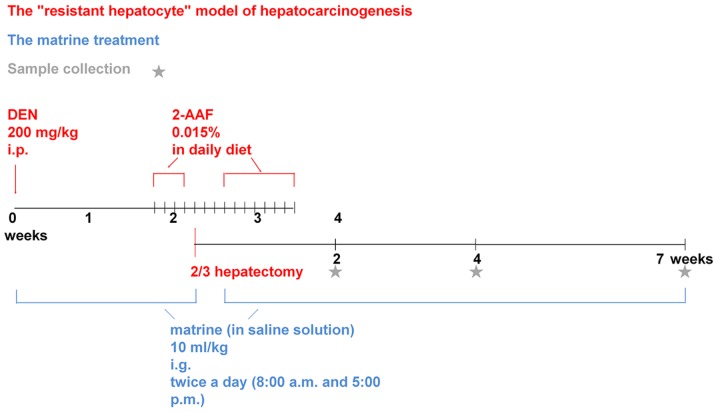
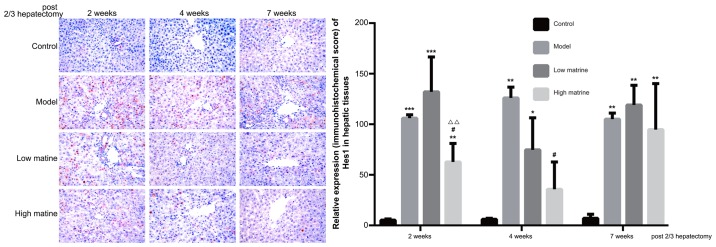
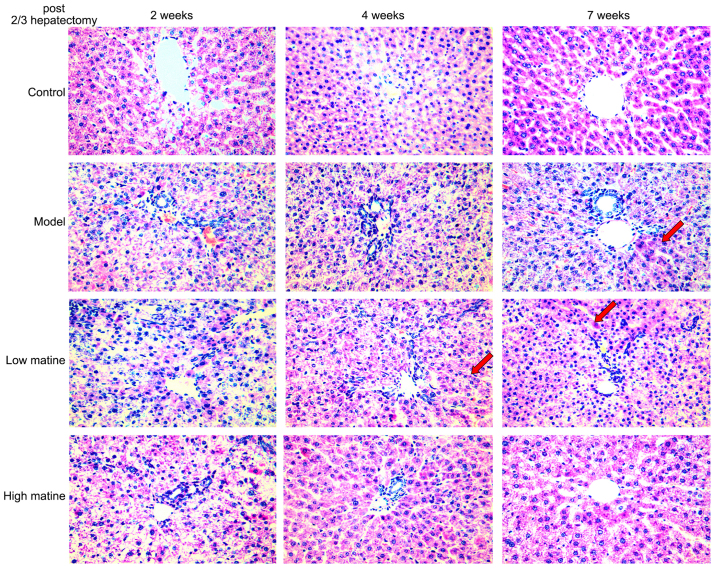
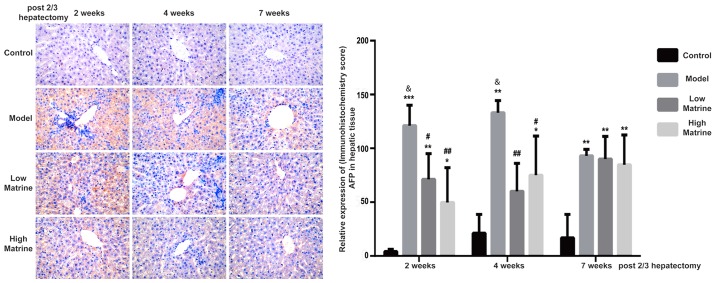
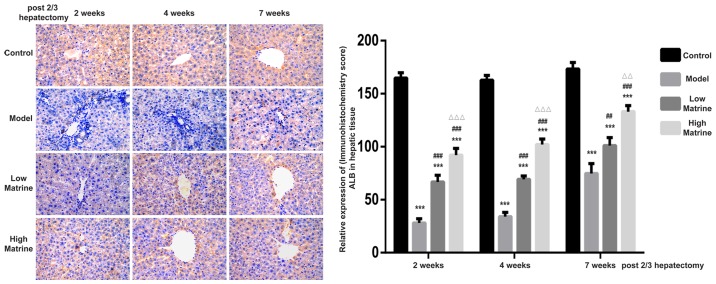
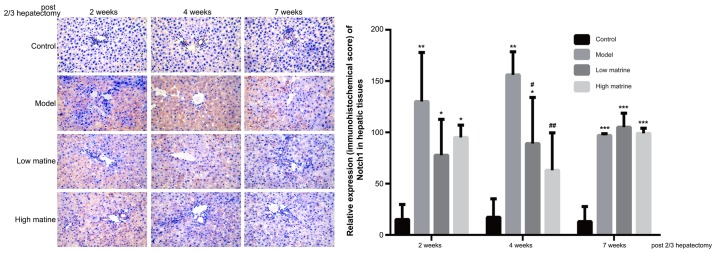
Matrine (C15H24N2O) is an alkaloid extracted from the Chinese herb that has anti-fibrotic and anti-cancer properties. The aim of the present study was to determine the chemopreventive effect of matrine on the development of primary hepatocellular carcinoma (HCC) and its possible association with the suppression of the Notch signaling pathway. The rats were randomly divided into four groups: Control, model, low-dose matrine and high-dose matrine groups. The model was established by combining a partial hepatectomy with diethylnitrosamine (DEN) + 2-acetylaminofluorene (2-AAF). Low- and high-dose matrine groups received intragastric administration of matrine (0.25 and 2.5 g/l of matrine, respectively). DEN + 2-AAF injections and hepatectomy were not performed in the control group. All rats were sacrificed 2, 4 and 7 weeks after hepatectomy. HCC-like histopathological lesions were detected using hematoxylin and eosin staining. The expression levels of α-1-fetoprotein (AFP), albumin (ALB), Notch1 and Hes1 were analyzed using immunohistochemistry. Hepatic lobule structure loss, liver tissue necrosis and inflammatory cell infiltration, and edema degeneration were observed in the model group. By contrast, hepatocyte cord structure was restored and hepatocyte edema degeneration was significantly reduced after 7 weeks of treatment with matrine. In addition, compared with the model group, matrine reduced the expression of AFP, increased the expression of ALB and reduced the expression of Notch1 and Hes1 (only for high-dose matrine; all P<0.05). The findings suggested that matrine could prevent the early development of HCC-like lesions in a rat model, possibly by modulating Notch pathway activation.
苦参碱(C15H24N2O)是从一种具有抗纤维化和抗癌特性的中草药中提取的生物碱。本研究的目的是确定苦参碱对原发性肝细胞癌(HCC)发生发展的化学预防作用及其与Notch信号通路抑制的可能关联。将大鼠随机分为四组:对照组、模型组、低剂量苦参碱组和高剂量苦参碱组。通过部分肝切除术联合二乙基亚硝胺(DEN)+2-乙酰氨基芴(2-AAF)建立模型。低剂量和高剂量苦参碱组分别给予苦参碱灌胃(分别为0.25和2.5 g/l苦参碱)。对照组不进行DEN + 2-AAF注射和肝切除术。所有大鼠在肝切除术后2、4和7周处死。采用苏木精-伊红染色检测HCC样组织病理学病变。采用免疫组织化学分析α-1-甲胎蛋白(AFP)、白蛋白(ALB)、Notch1和Hes1的表达水平。模型组观察到肝小叶结构破坏、肝组织坏死及炎性细胞浸润和水肿变性。相比之下,苦参碱治疗7周后肝细胞索结构恢复,肝细胞水肿变性明显减轻。此外,与模型组相比,苦参碱降低了AFP的表达,增加了ALB的表达,并降低了Notch1和Hes1的表达(仅高剂量苦参碱组;所有P<0.05)。研究结果表明,苦参碱可能通过调节Notch通路激活来预防大鼠模型中HCC样病变的早期发展。