Ponti Federico, Plazzi Andrea, Guglielmi Giuseppe, Marchesini Giulio, Bazzocchi Alberto
Diagnostic and Interventional Radiology, IRCCS Istituto Ortopedico Rizzoli, Bologna, Italy.
Unit of Metabolic Diseases & Clinical Dietetics, University of Bologna. Sant'Orsola - Malpighi Hospital, Via G. Massarenti 9, Bologna, Italy.
BJR Case Rep. 2019 Mar 14;5(3):20170078. doi: 10.1259/bjrcr.20170078. eCollection 2019 Sep.
The amount of lean and fat tissues in different body compartments is likely to drive the cardiovascular risk. The longitudinal effects of changes of lean and fat mass, particularly following weight loss programs, cannot be reliably identified by the sole measurement of anthropometry. We discuss this problem on the basis of data collected in obese females with the use of dual-energy X-ray absorptiometry (DXA), anthropometry and laboratory.
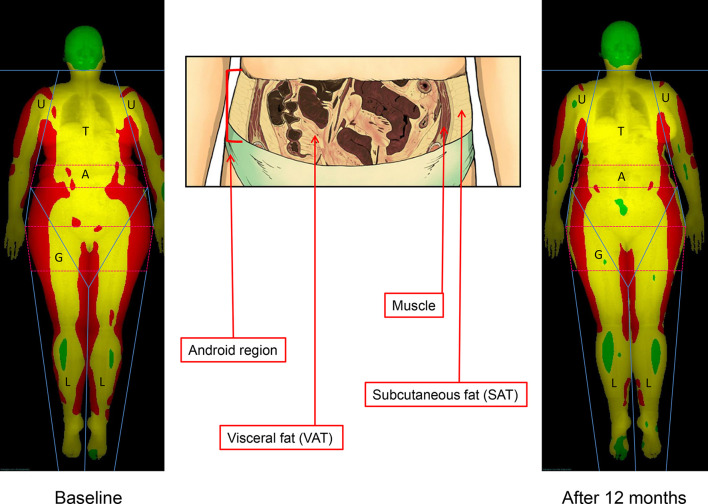
We present longitudinal data in six obese females (three pairs-weight stable, weight loss, weight increase) assigned to a medical treatment. All patients underwent whole-body scan (Lunar iDXA, GE Healthcare, WI) and laboratory analysis (blood fasting glucose, total low-density lipoprotein and high-density lipoprotein cholesterol, triglycerides) before treatment and after 12 months. Fat mass and non-bone lean mass were assessed at whole-body and regional levels. Android visceral adipose tissue was estimated by a recently validated software.
The most common anthropometric measures (body mass index, waist circumference) were totally ineffective in documenting the changes in body composition in 12 month follow-up, whereas DXA could detect regional changes, which were paralleled in part by changes in biochemical indices.
Serial DXA measurements could provide a comprehensive assessment of body compartments, independent of changes in classic anthropometry (body mass index and waist circumference), identifying a significant redistribution of lean and fat mass and providing clues to explain changes in cardiovascular risk profile.
不同身体部位的瘦组织和脂肪组织数量可能会影响心血管风险。仅通过人体测量法无法可靠地确定瘦体重和脂肪量变化的纵向影响,尤其是在减肥计划之后。我们基于使用双能X线吸收法(DXA)、人体测量法和实验室检测收集的肥胖女性数据来讨论这个问题。
我们展示了六名接受医学治疗的肥胖女性(三对——体重稳定、体重减轻、体重增加)的纵向数据。所有患者在治疗前和12个月后均接受了全身扫描(Lunar iDXA,GE医疗保健公司,威斯康星州)和实验室分析(空腹血糖、总低密度脂蛋白和高密度脂蛋白胆固醇、甘油三酯)。在全身和区域水平评估脂肪量和非骨瘦体重。通过最近验证的软件估计腹部内脏脂肪组织。
在12个月的随访中,最常用的人体测量指标(体重指数、腰围)在记录身体成分变化方面完全无效,而DXA可以检测到区域变化,部分变化与生化指标的变化平行。
连续的DXA测量可以提供对身体各部位的全面评估,独立于经典人体测量指标(体重指数和腰围)的变化,识别瘦体重和脂肪量的显著重新分布,并为解释心血管风险状况的变化提供线索。