Ahualli Silvia, Orozco-Barrera Sergio, Fernández María Del Mar, Delgado Ángel V, Iglesias Guillermo R
Department of Applied Physics, Faculty of Science, University of Granada, 18071 Granada, Spain.
Department of Fluidic and Energy Science, Central America University, (01)168 San Salvador, El Salvador.
Polymers (Basel). 2019 Sep 25;11(10):1556. doi: 10.3390/polym11101556.
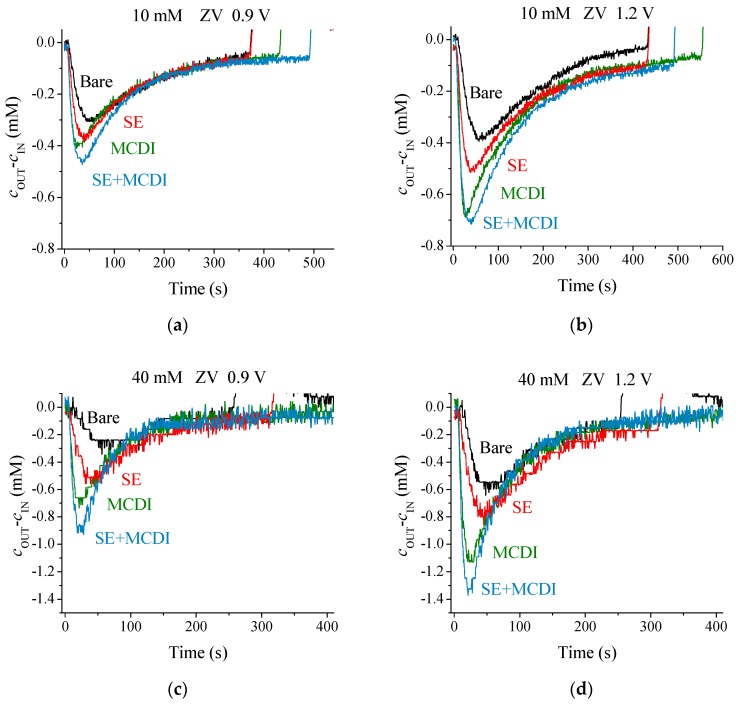
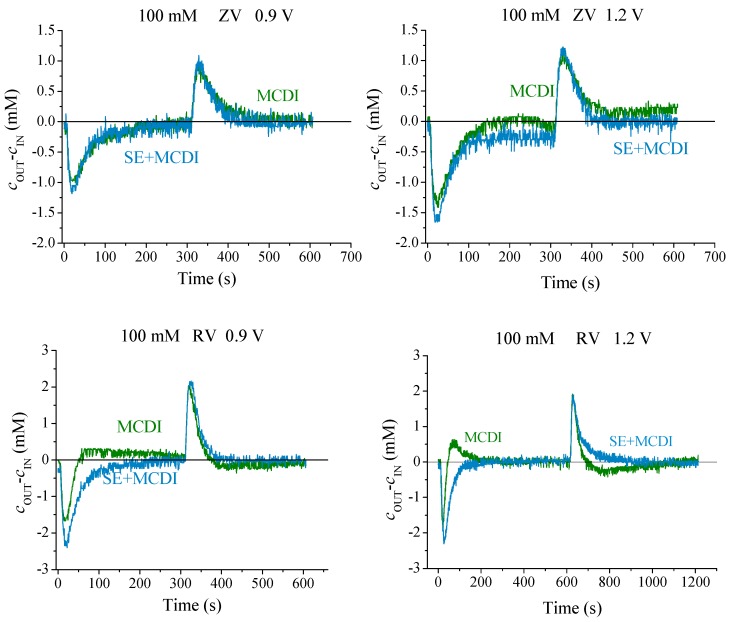
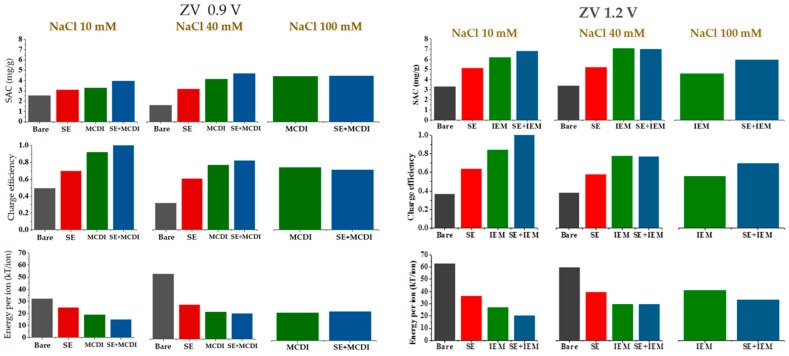
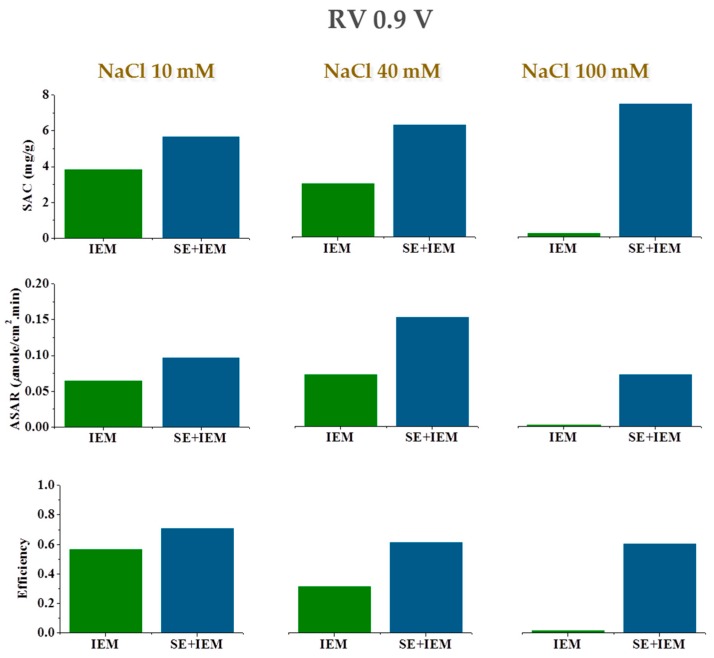
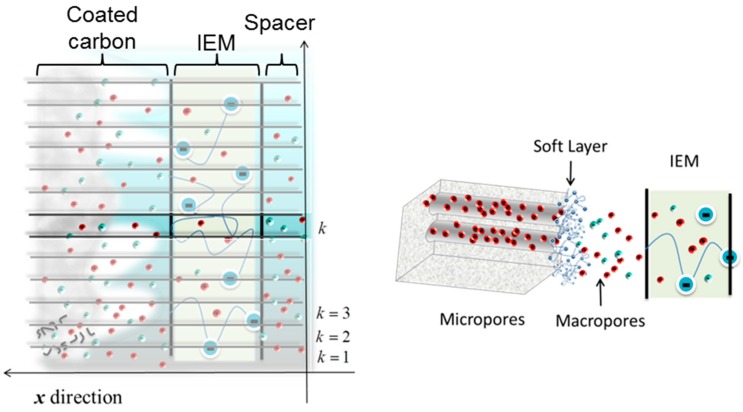
The responsible use of water, as well as its reuse and purification, has been a major problem for decades now. In this work, we study a method for adsorbing ions from aqueous solutions on charged interfaces using highly porous electrodes. This water purification process is based on the electric double layer concept, using the method known as capacitive deionization (CDI): If we pump salty solutions through the volume comprised between two porous electrodes while applying a potential difference to them, ions present in the solution are partially removed and trapped on the electrode surfaces. It has been well established that the use of carbon electrodes in combination with ion exchange membranes (membrane-CDI) improves the efficiency of the method above that achieved with bare activated carbon. Another approach that has been tested is based on coating the carbon with polyelectrolyte layers, converting them into "soft electrodes" (SEs). Here we investigate the improvement found when combining SEs with membranes, and it is shown that the amount of ions adsorbed and the ratio between ions removed and electrons transported reach superior values, also associated with a faster kinetics of the process. The method is applied to the partial desalination of up to 100 mM NaCl solutions, something hardly achievable with bare or membrane-covered electrodes. A theoretical model is presented for the ion transport in the presence of both the membrane and the polyelectrolyte coating.
几十年来,合理用水以及水的再利用和净化一直是个大问题。在这项工作中,我们研究了一种利用高度多孔电极从水溶液中吸附离子到带电界面上的方法。这种水净化过程基于双电层概念,采用称为电容去离子化(CDI)的方法:如果我们在两个多孔电极之间施加电位差的同时,将含盐溶液泵入其间的空间,溶液中的离子就会被部分去除并捕获在电极表面。已经证实,将碳电极与离子交换膜结合使用(膜 - CDI)比使用裸活性炭能提高该方法的效率。另一种经过测试的方法是在碳上涂覆聚电解质层,将其转化为“软电极”(SEs)。在这里,我们研究了将SEs与膜结合时所发现的改进情况,结果表明,吸附的离子量以及去除的离子与传输的电子之间的比率达到了更高的值,这也与该过程更快的动力学相关。该方法应用于高达100 mM NaCl溶液的部分脱盐,这是裸电极或覆盖膜的电极几乎无法实现的。本文提出了一个在存在膜和聚电解质涂层的情况下离子传输的理论模型。