Department of Epidemiology, Erasmus MC University Medical Center, Rotterdam, the Netherlands.
Department of Radiology and Nuclear Medicine, Erasmus MC University Medical Center, Rotterdam, the Netherlands.
Headache. 2020 Jan;60(1):90-100. doi: 10.1111/head.13651. Epub 2019 Sep 26.
To investigate the association of migraine genetic variants with cerebral blood flow (CBF).
Migraine is a common disorder with many genetic and non-genetic factors affecting its occurrence. The exact pathophysiological mechanisms underlying the disease remain unclear, but are known to involve hemodynamic and vascular disruptions. Recent genome-wide association studies have identified 44 genetic variants in 38 genetic loci that affect the risk of migraine, which provide the opportunity to further disentangle these mechanisms.
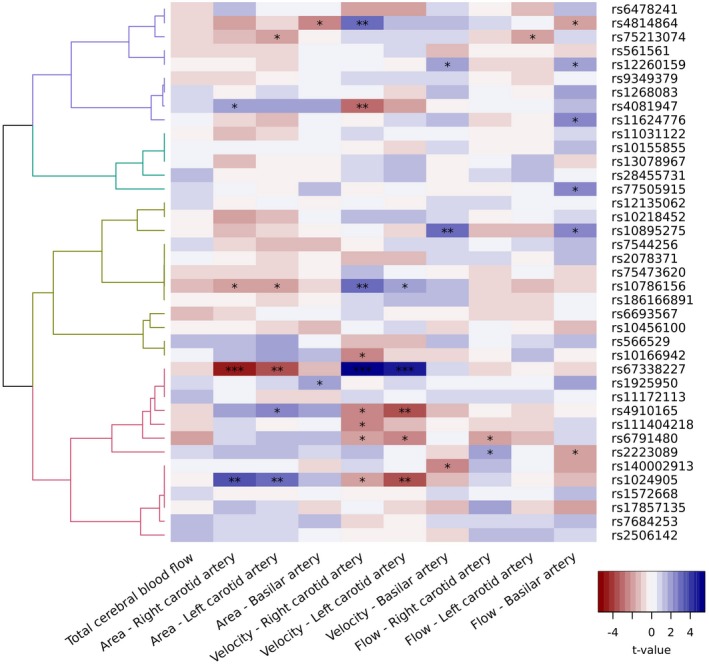
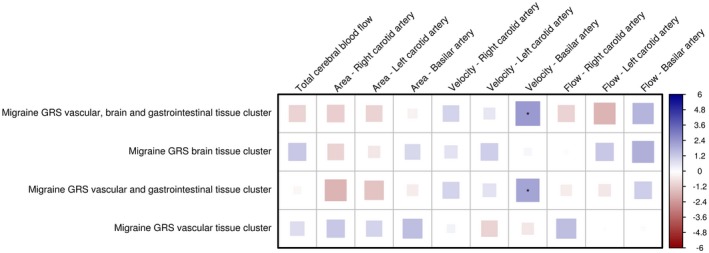
We included 4665 participants of the population-based Rotterdam Study (mean age 65.0 ± 10.9 years, 55.6% women). Cross-sectional area (mm ), flow velocity (mm/s), and blood flow (mL/min) were measured in both carotids and the basilar artery using 2-dimensional phase-contrast magnetic resonance imaging. We analyzed 43 previously identified migraine variants separately and calculated a genetic risk score (GRS). To assess the association with CBF, we used linear regression models adjusted for age, sex, and total brain volume. Hierarchical clustering was performed based on the associations with CBF measures and tissue enrichment.
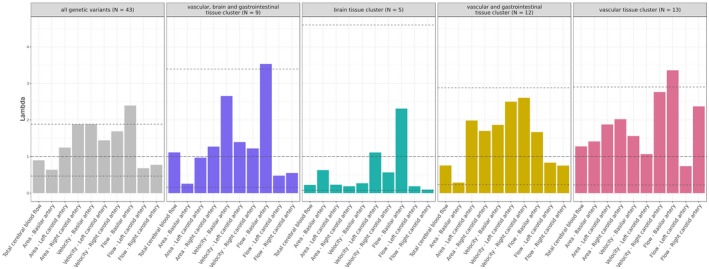
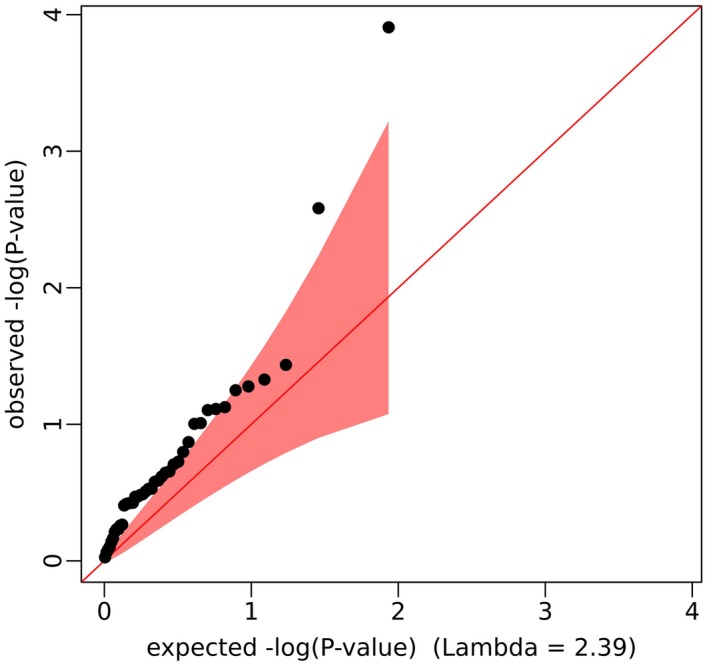
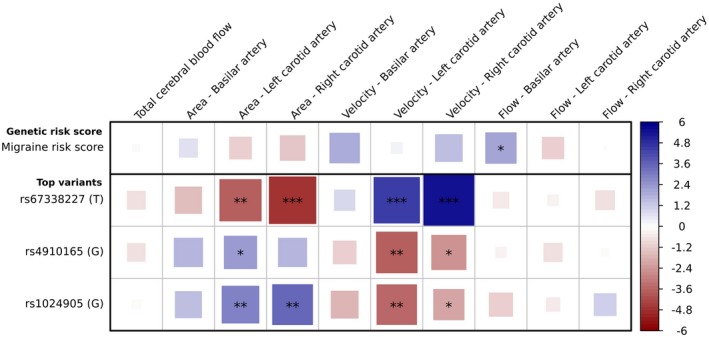
The rs67338227 risk allele was associated with higher flow velocity and smaller cross-sectional area in the carotids (P = 3.7 × 10 ). Other variants were related to CBF with opposite directions of effect, but not significantly after multiple testing adjustments (P < 1.4 × 10 ). The migraine GRS was not associated with CBF after multiple testing corrections. Migraine risk variants were found to be enriched for flow in the basilar artery (λ = 2.39).
These findings show that genetic migraine risk is complexly associated with alterations in cerebral hemodynamics.
探讨偏头痛遗传变异与脑血流(CBF)的关系。
偏头痛是一种常见疾病,其发生受许多遗传和非遗传因素的影响。该病的确切病理生理机制尚不清楚,但已知涉及血液动力学和血管紊乱。最近的全基因组关联研究确定了 38 个遗传位点中的 44 个遗传变异,这些变异影响偏头痛的风险,这为进一步阐明这些机制提供了机会。
我们纳入了基于人群的鹿特丹研究的 4665 名参与者(平均年龄 65.0±10.9 岁,55.6%为女性)。使用二维相位对比磁共振成像测量双侧颈内动脉和基底动脉的横截面积(mm)、流速(mm/s)和血流量(mL/min)。我们分别分析了 43 个先前确定的偏头痛变异,并计算了遗传风险评分(GRS)。为了评估与 CBF 的关联,我们使用了调整年龄、性别和总脑容量的线性回归模型。根据与 CBF 测量值和组织富集的关联进行了层次聚类。
rs67338227 风险等位基因与颈内动脉流速升高和横截面积减小相关(P=3.7×10)。其他变异与 CBF 相关,但在多次测试调整后无统计学意义(P<1.4×10)。偏头痛 GRS 在多次测试校正后与 CBF 无关。偏头痛风险变异被发现与基底动脉血流增加有关(λ=2.39)。
这些发现表明,遗传偏头痛风险与脑血液动力学改变复杂相关。