Dolan Hankiz, Alden Dana L, Friend John M, Lee Ping Yein, Lee Yew Kong, Ng Chirk Jenn, Abdullah Khatijah Lim, Trevena Lyndal
School of Public Health, The University of Sydney, New South Wales, Australia.
University of Hawai'i, Honolulu, Hawaii.
MDM Policy Pract. 2019 Sep 20;4(2):2381468319871018. doi: 10.1177/2381468319871018. eCollection 2019 Jul-Dec.
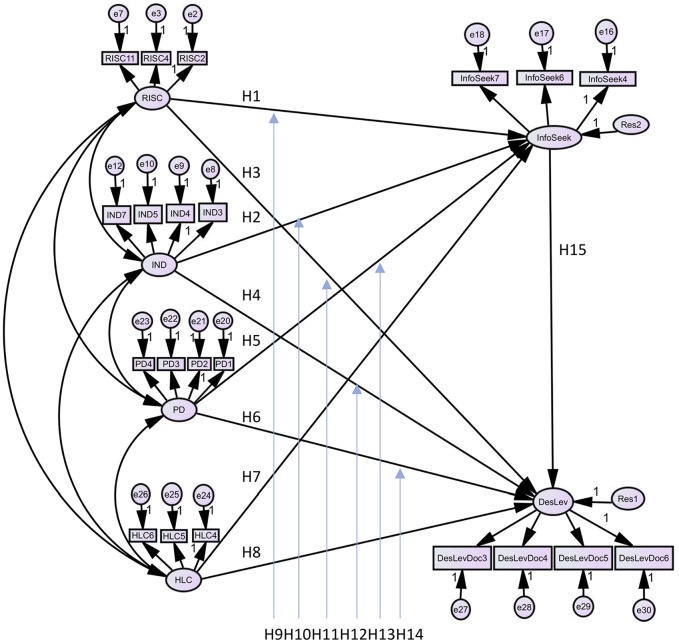
To explore and compare the influences of individual-level cultural values and personal attitudinal values on the desire for medical information and self-involvement in decision making in Australia and China. A total of 288 and 291 middle-aged adults from Australia and China, respectively, completed an online survey examining cultural and personal values, and their desired level of self-influence on medical decision making. Structural equation modeling was used to test 15 hypotheses relating to the effects of cultural and personal antecedents on the individual desire for influence over medical decision making. Similar factors in both Australia and China (total variance explained: Australia 29%; China 35%) predicted desire for medical information, with interdependence (unstandardized path coefficient β = 0.102, = 0.014; β = 0.215, = 0.001), independence (β = 0.244, < 0.001; β = 0.123, = 0.037), and health locus of control (β = -0.140, = 0.018; β = -0.138, = 0.007) being significant and positive predictors. A desire for involvement in decisions was only predicted by power distance, which had an opposite effect of being negative for Australia and positive for China (total variance explained: Australia 11%; China 5%; β = 0.294, < 0.001; China: β = -0.190, = 0.043). National culture moderated the effect of independence on desire for medical information, which was stronger in Australia than China ( score = 1.687, < 0.05). Study results demonstrate that in both countries, desire for medical information can be influenced by individual-level cultural and personal values, suggesting potential benefits of tailoring health communication to personal mindsets to foster informed decision making. The desired level of self-involvement in decision making was relatively independent of other cultural and personal values in both countries, suggesting caution against cultural stereotypes. Study findings also suggest that involvement preferences in decision making should be considered separately from information needs at the clinical encounter.
探索并比较个人层面的文化价值观和个人态度价值观对澳大利亚和中国民众医疗信息需求以及自我参与医疗决策程度的影响。分别来自澳大利亚和中国的288名和291名中年成年人完成了一项在线调查,该调查考察了文化和个人价值观,以及他们在医疗决策中期望的自我影响程度。采用结构方程模型检验了15个关于文化和个人因素对个人医疗决策影响力需求影响的假设。澳大利亚和中国的相似因素(总方差解释率:澳大利亚29%;中国35%)预测了对医疗信息的需求,其中相互依存性(非标准化路径系数β = 0.102,p = 0.014;β = 0.215,p = 0.001)、独立性(β = 0.244,p < 0.001;β = 0.123,p = 0.037)和健康控制点(β = -0.140,p = 0.018;β = -0.138,p = 0.007)是显著且正向的预测因素。只有权力距离预测了参与决策的意愿,其对澳大利亚的影响为负,对中国的影响为正(总方差解释率:澳大利亚11%;中国5%;β = 0.294,p < 0.001;中国:β = -0.190,p = 0.043)。国家文化调节了独立性对医疗信息需求的影响,在澳大利亚比在中国更强(z得分 = 1.687,p < 0.05)。研究结果表明,在两国,对医疗信息的需求都可能受到个人层面文化和个人价值观的影响,这表明根据个人思维模式调整健康传播以促进明智决策可能具有潜在益处。在两国,决策中期望的自我参与程度相对独立于其他文化和个人价值观,这表明应警惕文化刻板印象。研究结果还表明,在临床诊疗中,决策中的参与偏好应与信息需求分开考虑。