Department of Psychology, University of York, York, UK.
Division of Psychology and language Sciences, UCL, London, UK.
Dev Sci. 2020 May;23(3):e12906. doi: 10.1111/desc.12906. Epub 2019 Oct 20.
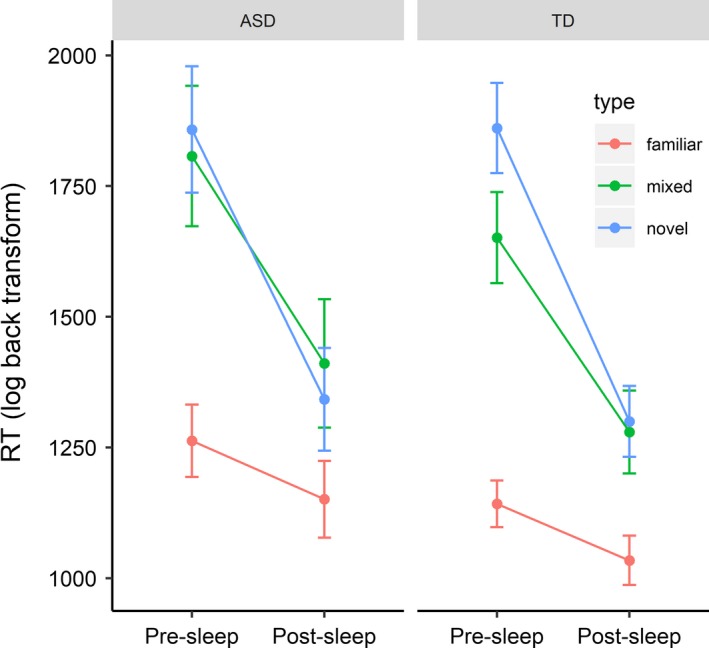
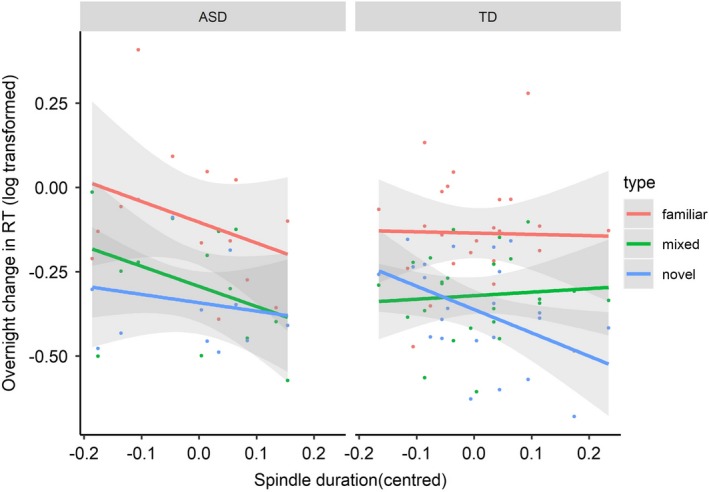
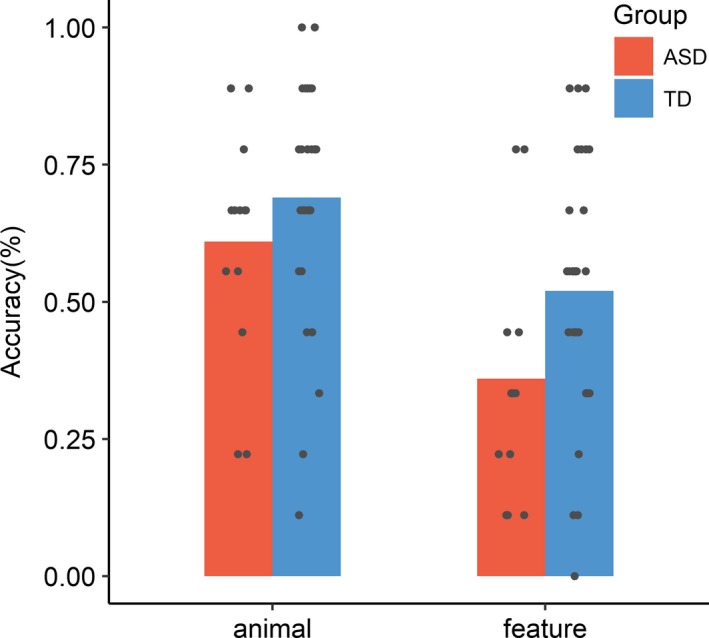
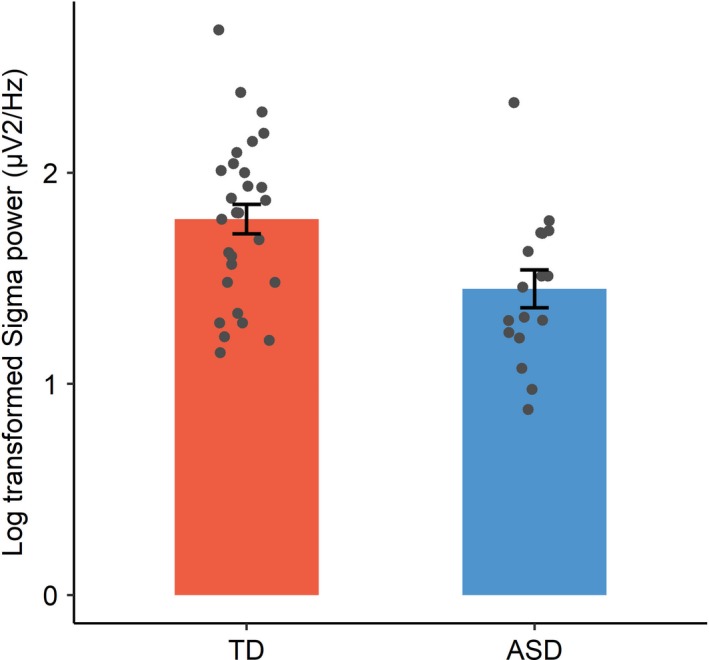
Sleep is known to support the neocortical consolidation of declarative memory, including the acquisition of new language. Autism spectrum disorder (ASD) is often characterized by both sleep and language learning difficulties, but few studies have explored a potential connection between the two. Here, 54 children with and without ASD (matched on age, nonverbal ability and vocabulary) were taught nine rare animal names (e.g., pipa). Memory was assessed via definitions, naming and speeded semantic decision tasks immediately after learning (pre-sleep), the next day (post-sleep, with a night of polysomnography between pre- and post-sleep tests) and roughly 1 month later (follow-up). Both groups showed comparable performance at pre-test and similar levels of overnight change on all tasks; but at follow-up children with ASD showed significantly greater forgetting of the unique features of the new animals (e.g., pipa is a flat frog). Children with ASD had significantly lower central non-rapid eye movement (NREM) sigma power. Associations between spindle properties and overnight changes in speeded semantic decisions differed by group. For the TD group, spindle duration predicted overnight changes in responses to novel animals but not familiar animals, reinforcing a role for sleep in the stabilization of new semantic knowledge. For the ASD group, sigma power and spindle duration were associated with improvements in responses to novel and particularly familiar animals, perhaps reflecting more general sleep-associated improvements in task performance. Plausibly, microstructural sleep atypicalities in children with ASD and differences in how information is prioritized for consolidation may lead to cumulative consolidation difficulties, compromising the quality of newly formed semantic representations in long-term memory.
睡眠已知可以支持新皮层的陈述性记忆巩固,包括新语言的习得。自闭症谱系障碍(ASD)通常表现为睡眠和语言学习困难,但很少有研究探索两者之间的潜在联系。在这里,54 名患有和不患有 ASD 的儿童(按年龄、非言语能力和词汇量匹配)学习了九个稀有动物的名称(例如,pipá)。记忆通过定义、命名和快速语义决策任务进行评估,在学习后立即(睡眠前)、第二天(睡眠后,在睡眠前和睡眠后测试之间有一晚上多导睡眠图)和大约 1 个月后(随访)进行评估。两组在预测试中表现出相当的表现,并且在所有任务上的夜间变化水平相似;但在随访中,患有 ASD 的儿童对新动物的独特特征表现出明显更大的遗忘(例如,pipá 是一种扁平的青蛙)。患有 ASD 的儿童的中央非快速眼动(NREM)西格玛功率明显较低。纺锤体特性与快速语义决策的夜间变化之间的关联因组而异。对于 TD 组,纺锤体持续时间预测了对新动物的反应的夜间变化,但对熟悉动物的反应则没有,这加强了睡眠在稳定新语义知识方面的作用。对于 ASD 组,西格玛功率和纺锤体持续时间与对新的和特别是熟悉的动物的反应的改善有关,这可能反映了睡眠相关的一般任务表现的改善。可能,患有 ASD 的儿童的微观结构睡眠异常以及信息如何被优先考虑用于巩固的差异可能导致累积巩固困难,从而损害长期记忆中新形成的语义表示的质量。