Ennab Wael, Mustafa Sheeraz, Wei Quanwei, Lv Zengpeng, Kavita Ngekure M X, Ullah Saif, Shi Fangxiong
College of Animal Science and Technology, Nanjing Agricultural University, Nanjing 210095, China.
Animals (Basel). 2019 Sep 27;9(10):736. doi: 10.3390/ani9100736.
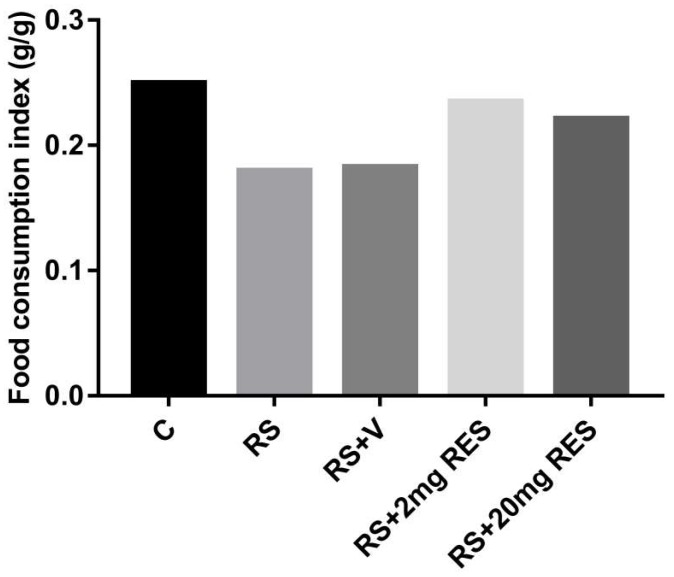
The objectives were to investigate whether restraint stress (which is known as a mixture of psychologic and physical stress) exerts negative effects on the stomach and spleen, and whether the phenolic compound resveratrol (RES) exerts any protective roles. Fifty adult male mice were divided into five groups, with 10 mice per group as follows: control (C), restraint stress (RS), RS with vehicle (RS + V), RS with 2 mg/kg of resveratrol (RS + 2 mg RES), and RS with 20 mg/kg of resveratrol (RS + 20 mg RES). Mice were restrained in conical centrifuge tubes for 4 h daily to establish the RS model. RS + 2 mg RES, RS + 20 mg RES, and RS + V groups were given an oral dose of resveratrol or vehicle for 15 consecutive days, while the control group was not exposed to restraint stress. Herein, we showed that restraint stress decreased body weight and food and water consumption in stressed groups RS and RS + V compared to controls, while the groups treated with resveratrol showed improvements. Moreover, restraint stress caused acute damage to the morphology of gastric cells and reduced the quantitative distribution of parietal cells along with their decreased size and diameter, pointing to gastritis or ulcer. Furthermore, the antibody against the apoptosis-inducing factor (AIF) was highly attached in the RS groups. Splenic size, weight, and length were also greatly augmented in the stressed groups compared to the controls, while these phenomena were not observed in the RS + 2 mg RES group. Our findings proved significant ameliorating effects of resveratrol against restraint stress in adult male mice.
本研究旨在探讨束缚应激(一种已知的心理和生理应激混合体)是否会对胃和脾脏产生负面影响,以及酚类化合物白藜芦醇(RES)是否具有任何保护作用。将50只成年雄性小鼠分为五组,每组10只,分组如下:对照组(C)、束缚应激组(RS)、束缚应激加赋形剂组(RS + V)、束缚应激加2 mg/kg白藜芦醇组(RS + 2 mg RES)和束缚应激加20 mg/kg白藜芦醇组(RS + 20 mg RES)。每天将小鼠置于锥形离心管中束缚4小时以建立束缚应激模型。RS + 2 mg RES组、RS + 20 mg RES组和RS + V组连续15天口服白藜芦醇或赋形剂,而对照组未接受束缚应激。在此,我们发现与对照组相比,束缚应激使应激组RS和RS + V的体重、食物和水消耗量降低,而用白藜芦醇处理的组则有所改善。此外,束缚应激导致胃细胞形态发生急性损伤,壁细胞数量分布减少,同时其大小和直径减小,提示胃炎或溃疡。此外,凋亡诱导因子(AIF)抗体在RS组中高度附着。与对照组相比,应激组的脾脏大小、重量和长度也显著增加,而在RS + 2 mg RES组中未观察到这些现象。我们的研究结果证明白藜芦醇对成年雄性小鼠的束缚应激具有显著的改善作用。