• 文献检索
  • 文档翻译
  • 深度研究
  • 学术资讯
  • Suppr Zotero 插件Zotero 插件
  • 邀请有礼
  • 套餐&价格
  • 历史记录
应用&插件
Suppr Zotero 插件Zotero 插件浏览器插件Mac 客户端Windows 客户端微信小程序
定价
高级版会员购买积分包购买API积分包
服务
文献检索文档翻译深度研究API 文档MCP 服务
关于我们
关于 Suppr公司介绍联系我们用户协议隐私条款
关注我们

Suppr 超能文献

核心技术专利:CN118964589B侵权必究
粤ICP备2023148730 号-1Suppr @ 2026

文献检索

告别复杂PubMed语法,用中文像聊天一样搜索,搜遍4000万医学文献。AI智能推荐,让科研检索更轻松。

立即免费搜索

文件翻译

保留排版,准确专业,支持PDF/Word/PPT等文件格式,支持 12+语言互译。

免费翻译文档

深度研究

AI帮你快速写综述,25分钟生成高质量综述,智能提取关键信息,辅助科研写作。

立即免费体验

波塞冬3组和4组的管理策略

Management Strategies for POSEIDON Groups 3 and 4.

作者信息

Haahr Thor, Dosouto Carlos, Alviggi Carlo, Esteves Sandro C, Humaidan Peter

机构信息

Department of Clinical Medicine, Aarhus University, Aarhus, Denmark.

The Fertility Clinic Skive, Skive Regional Hospital, Skive, Denmark.

出版信息

Front Endocrinol (Lausanne). 2019 Sep 11;10:614. doi: 10.3389/fendo.2019.00614. eCollection 2019.

DOI:10.3389/fendo.2019.00614
PMID:31572298
原文链接:https://pmc.ncbi.nlm.nih.gov/articles/PMC6749147/
Abstract

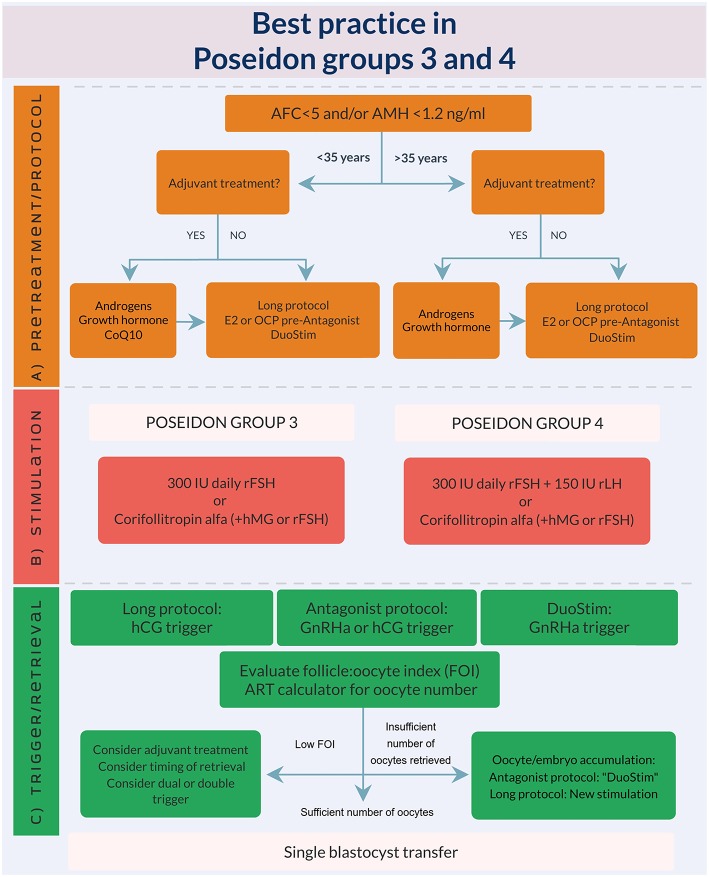
In the POSEIDON classification, patients belonging to groups 3 and 4 share the same common feature of a poor ovarian reserve which independently of age renders them at high risk of a poor reproductive outcome. Overall, POSEIDON groups 1-4 constitute approximately 47% of patients attending assisted reproductive technology (ART) treatment. With the increasing delay in childbearing, POSEIDON group 4 seems to increase in numbers now in some centers constituting more than 50% of the total POSEIDON population, whereas group 3 patients constitute approximately 10%. Both POSEIDON groups 3 and 4 patients require special attention as regards pre-treatment strategy, ovarian stimulation, adjuvant treatment, and ovulation trigger strategy in order to optimize the probability of having at least one euploid blastocyst for transfer. Although more evidence is needed, recent advances seem to have increased the reproductive outcomes in the poor prognosis patient. The key to success is individualization in all steps of ART treatment. Herein, we review the recent evidence for the management of POSEIDON groups 3 and 4.

摘要

在波塞冬分类中,3组和4组患者具有相同的共同特征,即卵巢储备功能差,这使得他们无论年龄大小,生殖结局不良的风险都很高。总体而言,波塞冬1 - 4组约占接受辅助生殖技术(ART)治疗患者的47%。随着生育延迟的增加,目前在一些中心,波塞冬4组患者数量似乎有所增加,占波塞冬总人群的比例超过50%,而3组患者约占10%。为了优化获得至少一个可移植整倍体囊胚的概率,波塞冬3组和4组患者在治疗前策略、卵巢刺激、辅助治疗和排卵触发策略方面都需要特别关注。尽管还需要更多证据,但最近的进展似乎提高了预后不良患者的生殖结局。成功的关键在于ART治疗所有步骤的个体化。在此,我们综述了波塞冬3组和4组管理的最新证据。
https://cdn.ncbi.nlm.nih.gov/pmc/blobs/0f7e/6749147/aa17f8c87f5b/fendo-10-00614-g0003.jpg
https://cdn.ncbi.nlm.nih.gov/pmc/blobs/0f7e/6749147/df485bebc9bc/fendo-10-00614-g0001.jpg
https://cdn.ncbi.nlm.nih.gov/pmc/blobs/0f7e/6749147/87e9750f89a4/fendo-10-00614-g0002.jpg
https://cdn.ncbi.nlm.nih.gov/pmc/blobs/0f7e/6749147/aa17f8c87f5b/fendo-10-00614-g0003.jpg
https://cdn.ncbi.nlm.nih.gov/pmc/blobs/0f7e/6749147/df485bebc9bc/fendo-10-00614-g0001.jpg
https://cdn.ncbi.nlm.nih.gov/pmc/blobs/0f7e/6749147/87e9750f89a4/fendo-10-00614-g0002.jpg
https://cdn.ncbi.nlm.nih.gov/pmc/blobs/0f7e/6749147/aa17f8c87f5b/fendo-10-00614-g0003.jpg

相似文献

1
Management Strategies for POSEIDON Groups 3 and 4.波塞冬3组和4组的管理策略
Front Endocrinol (Lausanne). 2019 Sep 11;10:614. doi: 10.3389/fendo.2019.00614. eCollection 2019.
2
Future Perspectives of POSEIDON Stratification for Clinical Practice and Research.POSEIDON分层在临床实践和研究中的未来展望
Front Endocrinol (Lausanne). 2019 Jul 11;10:439. doi: 10.3389/fendo.2019.00439. eCollection 2019.
3
The POSEIDON Criteria and Its Measure of Success Through the Eyes of Clinicians and Embryologists.从临床医生和胚胎学家的视角看POSEIDON标准及其成功衡量指标
Front Endocrinol (Lausanne). 2019 Nov 20;10:814. doi: 10.3389/fendo.2019.00814. eCollection 2019.
4
Bologna vs. POSEIDON criteria as predictors of the likelihood of obtaining at least one euploid embryo in poor ovarian response: an analysis of 6,889 cycles.博洛尼亚标准与波塞冬标准作为预测卵巢反应不良患者获得至少一个整倍体胚胎可能性的指标:一项对6889个周期的分析
Fertil Steril. 2023 Sep;120(3 Pt 2):605-614. doi: 10.1016/j.fertnstert.2023.05.007. Epub 2023 May 13.
5
Ovarian Reserve Markers to Identify Poor Responders in the Context of Poseidon Classification.在波塞冬分类背景下用于识别低反应者的卵巢储备标志物
Front Endocrinol (Lausanne). 2019 May 8;10:281. doi: 10.3389/fendo.2019.00281. eCollection 2019.
6
The novel POSEIDON stratification of 'Low prognosis patients in Assisted Reproductive Technology' and its proposed marker of successful outcome.辅助生殖技术中“低预后患者”的新型波塞冬分层及其成功结局的提议标志物。
F1000Res. 2016 Dec 23;5:2911. doi: 10.12688/f1000research.10382.1. eCollection 2016.
7
Novel approaches for diagnosis and management of low prognosis patients in assisted reproductive technology: the POSEIDON concept.用于辅助生殖技术中低预后患者的诊断和管理的新方法:POSEIDON 概念。
Panminerva Med. 2019 Mar;61(1):24-29. doi: 10.23736/S0031-0808.18.03511-5. Epub 2018 Jul 18.
8
Low Prognosis by the POSEIDON Criteria in Women Undergoing Assisted Reproductive Technology: A Multicenter and Multinational Prevalence Study of Over 13,000 Patients.POSEIDON 标准预测行辅助生殖技术的女性预后不良:一项超过 13000 例患者的多中心、多国患病率研究。
Front Endocrinol (Lausanne). 2021 Mar 12;12:630550. doi: 10.3389/fendo.2021.630550. eCollection 2021.
9
Androgens Profile in Blood Serum and Follicular Fluid of Women With Poor Ovarian Response During Controlled Ovarian Stimulation Reveals Differences Amongst POSEIDON Stratification Groups: A Pilot Study.控制性卵巢刺激过程中卵巢反应不良女性血清和卵泡液中的雄激素谱揭示了波塞冬分层组之间的差异:一项初步研究。
Front Endocrinol (Lausanne). 2019 Jul 16;10:458. doi: 10.3389/fendo.2019.00458. eCollection 2019.
10
POSEIDON groups and their distinct reproductive outcomes: Effectiveness and cost-effectiveness insights from real-world data research.波塞冬组及其不同的生殖结局:来自真实世界数据研究的有效性和成本效益见解。
Best Pract Res Clin Obstet Gynaecol. 2022 Dec;85(Pt B):159-187. doi: 10.1016/j.bpobgyn.2022.05.003. Epub 2022 May 19.

引用本文的文献

1
Effects of maternal poor ovarian response on the reproductive endocrine profiles of the next generation: a prospective cohort study in China.母亲卵巢反应不良对下一代生殖内分泌特征的影响:一项中国的前瞻性队列研究。
Hum Reprod Open. 2025 Mar 28;2025(2):hoaf019. doi: 10.1093/hropen/hoaf019. eCollection 2025.
2
The Effectiveness of the GnRH Agonist/Antagonist Protocols for Different Poseidon Subgroups of Poor Ovarian Responders.促性腺激素释放激素激动剂/拮抗剂方案对不同波塞冬亚组卵巢低反应者的有效性
J Clin Med. 2025 Mar 17;14(6):2026. doi: 10.3390/jcm14062026.
3
In Vitro Fertilization Outcomes in Donor Oocyte Cycles Compared to the Autologous Cycles in the Poseidon 4 Group of Poor Ovarian Responders.

本文引用的文献

1
Human growth hormone for poor responders: a randomized placebo-controlled trial provides no evidence for improved live birth rate.对于反应不良者使用人生长激素:一项随机安慰剂对照试验并未提供改善活产率的证据。
Reprod Biomed Online. 2019 Jun;38(6):908-915. doi: 10.1016/j.rbmo.2019.02.003. Epub 2019 Feb 27.
2
A Novel Predictive Model to Estimate the Number of Mature Oocytes Required for Obtaining at Least One Euploid Blastocyst for Transfer in Couples Undergoing Fertilization/Intracytoplasmic Sperm Injection: The ART Calculator.一种新型预测模型,用于估计在接受体外受精/卵胞浆内单精子注射的夫妇中获得至少一个可用于移植的整倍体囊胚所需的成熟卵母细胞数量:辅助生殖技术计算器。
Front Endocrinol (Lausanne). 2019 Feb 28;10:99. doi: 10.3389/fendo.2019.00099. eCollection 2019.
3
与波塞冬4组卵巢反应不良患者的自体周期相比,供体卵母细胞周期的体外受精结局
Medicina (Kaunas). 2025 Feb 10;61(2):303. doi: 10.3390/medicina61020303.
4
Pharmacogenomic of LH and its receptor: are we ready for clinical practice?促黄体生成素及其受体的药物基因组学:我们准备好应用于临床实践了吗?
Reprod Biol Endocrinol. 2025 Feb 25;23(Suppl 1):29. doi: 10.1186/s12958-025-01359-2.
5
Analysis of the day 3 transfer strategy for POSEIDON patients.POSEIDON患者第3天移植策略分析。
JBRA Assist Reprod. 2025 Feb 21;29(2):298-305. doi: 10.5935/1518-0557.20240111.
6
Could the use of agonist protocols benefit patients who do not respond well to human reproduction treatment?激动剂方案的使用能否使对人类生殖治疗反应不佳的患者受益?
JBRA Assist Reprod. 2024 Dec 2;28(4):624-628. doi: 10.5935/1518-0557.20240057.
7
Prevalence of the Gene Premutation in Young Women with a Diminished Ovarian Reserve Included in an IVF Program: Implications for Clinical Practice.在接受 IVF 项目的卵巢储备功能减退的年轻女性中,基因前突变的流行情况:对临床实践的影响。
Genes (Basel). 2024 Aug 1;15(8):1008. doi: 10.3390/genes15081008.
8
The cumulative live birth rate and cost-effectiveness of the clomiphene and gonadotropin cotreatment protocol versus the mid-luteal GnRH agonist protocol in women over 35 years old.对于 35 岁以上的女性,氯米酚和促性腺激素联合治疗方案与黄体中期 GnRH 激动剂方案相比的累积活产率和成本效益。
Sci Rep. 2024 Jun 5;14(1):12894. doi: 10.1038/s41598-024-63842-x.
9
Efficacy and safety of recombinant human granulocyte colony-stimulating factor in patients with poor ovarian response: protocol for a multicentre, randomised, controlled trial.重组人粒细胞集落刺激因子治疗卵巢低反应患者的有效性和安全性:一项多中心、随机、对照试验方案。
BMJ Open. 2023 Dec 30;13(12):e074135. doi: 10.1136/bmjopen-2023-074135.
10
Maternal and neonatal complications after IVF/ICSI-fresh embryo transfer in low-prognosis women under the POSEIDON criteria: a retrospective cohort study.POSEIDON 标准下低预后女性行体外受精/卵胞浆内单精子注射-新鲜胚胎移植后的母婴并发症:一项回顾性队列研究。
BMC Pregnancy Childbirth. 2023 Dec 12;23(1):855. doi: 10.1186/s12884-023-06176-2.
Does double trigger (GnRH-agonist + hCG) improve outcome in poor responders undergoing IVF-ET cycle? A pilot study.双重扳机(GnRH 激动剂+hCG)是否能改善 IVF-ET 周期中反应不良患者的结局?一项初步研究。
Gynecol Endocrinol. 2019 Jul;35(7):628-630. doi: 10.1080/09513590.2019.1576621. Epub 2019 Feb 27.
4
Dual stimulation using corifollitropin alfa in 54 Bologna criteria poor ovarian responders - a case series.使用戈那瑞林在 54 项 Bologna 标准的卵巢低反应患者中进行双重刺激:一项病例系列研究。
Reprod Biomed Online. 2019 May;38(5):677-682. doi: 10.1016/j.rbmo.2019.01.007. Epub 2019 Jan 22.
5
The role of recombinant LH in women with hypo-response to controlled ovarian stimulation: a systematic review and meta-analysis.重组 LH 在卵巢刺激反应低下的女性中的作用:系统评价和荟萃分析。
Reprod Biol Endocrinol. 2019 Feb 6;17(1):18. doi: 10.1186/s12958-019-0460-4.
6
Advances in ovulation trigger strategies.排卵触发策略的进展。
Panminerva Med. 2019 Mar;61(1):42-51. doi: 10.23736/S0031-0808.18.03537-1.
7
Cumulative live birth rate prognosis based on the number of aspirated oocytes in previous ART cycles.基于前次辅助生殖技术(ART)周期中抽吸的卵母细胞数量预测累积活产率。
Hum Reprod. 2019 Jan 1;34(1):171-180. doi: 10.1093/humrep/dey341.
8
GnRH agonist long protocol versus GnRH antagonist protocol for various aged patients with diminished ovarian reserve: A retrospective study.促性腺激素释放激素激动剂长方案与拮抗剂方案在不同年龄卵巢储备功能减退患者中的应用:一项回顾性研究。
PLoS One. 2018 Nov 7;13(11):e0207081. doi: 10.1371/journal.pone.0207081. eCollection 2018.
9
Understanding Ovarian Hypo-Response to Exogenous Gonadotropin in Ovarian Stimulation and Its New Proposed Marker-The Follicle-To-Oocyte (FOI) Index.了解卵巢刺激中外源性促性腺激素的卵巢低反应及其新提出的标志物——卵泡与卵母细胞(FOI)指数。
Front Endocrinol (Lausanne). 2018 Oct 17;9:589. doi: 10.3389/fendo.2018.00589. eCollection 2018.
10
Dosage of exogenous gonadotropins is not associated with blastocyst aneuploidy or live-birth rates in PGS cycles in Chinese women.在中国女性的 PGS 周期中,外源性促性腺激素的剂量与囊胚非整倍体或活产率无关。
Hum Reprod. 2018 Oct 1;33(10):1875-1882. doi: 10.1093/humrep/dey270.