Capoci Isis Regina Grenier, Sakita Karina Mayumi, Faria Daniella Renata, Rodrigues-Vendramini Franciele Abigail Vilugron, Arita Glaucia Sayuri, de Oliveira Admilton Gonçalves, Felipe Maria Sueli, Maigret Bernard, Bonfim-Mendonça Patricia de Souza, Kioshima Erika Seki, Svidzinski Terezinha Inez Estivalet
Department of Clinical Analysis and Biomedicine, The State University of Maringá, Maringá, Brazil.
Laboratory of Electron Microscopy and Microanalysis, State University of Londrina, Londrina, Brazil.
Front Microbiol. 2019 Sep 12;10:2130. doi: 10.3389/fmicb.2019.02130. eCollection 2019.
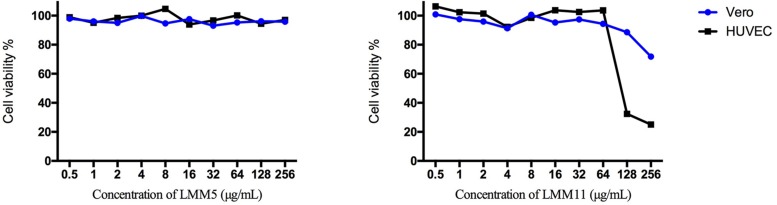
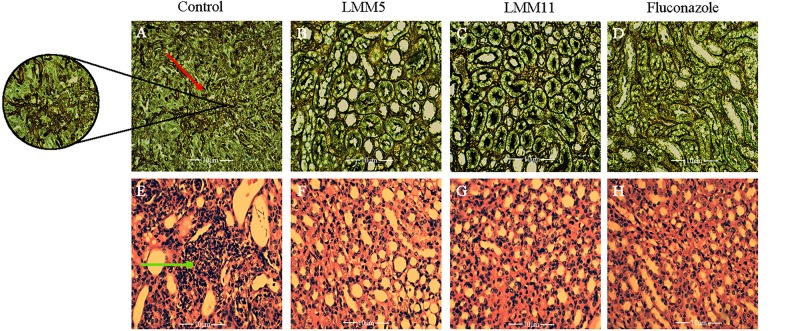
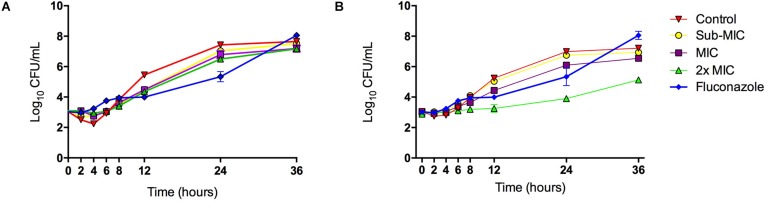
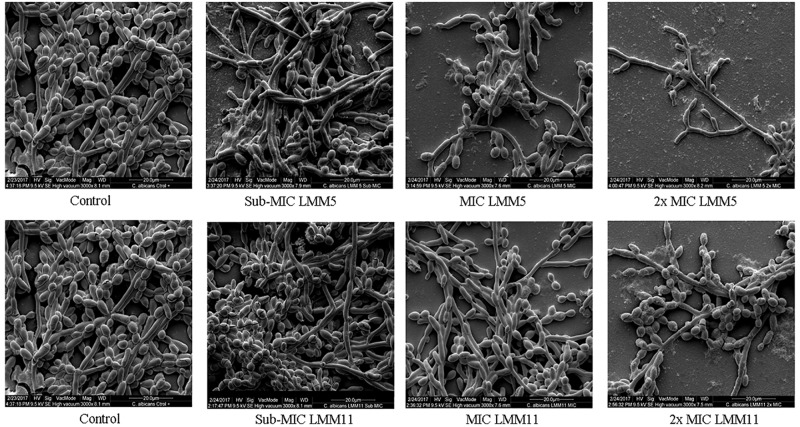
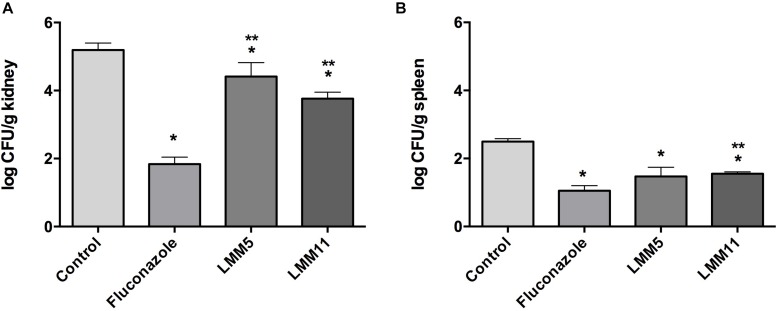
infections have become a serious public health problem with high mortality rates, especially in immunocompromised patients, since is the major opportunistic pathogen responsible for systemic or invasive candidiasis. Commercially available antifungal agents are restricted and fungal resistance to such drugs has increased; therefore, the development of a more specific antifungal agent is necessary. Using assays for antifungal activity, here we report that two new compounds of 1,3,4-oxadiazoles class (LMM5 and LMM11), which were discovered by methodologies as possible thioredoxin reductase inhibitors, were effective against . Both compounds had antifungal activity with MIC 32 μg/ml. Cytotoxicity demonstrated that LMM5 and LMM11 were non-toxic in the cell lines evaluated. The kinetic of the time-kill curve suggested a fungistatic profile and showed an inhibitory effect of LMM5 and LMM11 in 12 h that remained for 24 and 36 h, which is better than fluconazole. In the murine systemic candidiasis model by , the two compounds significantly reduced the renal and spleen fungal burden. According to the SEM and TEM images, we hypothesize that the mechanism of action of LMM5 and LMM11 is directly related to the inhibition of the enzyme thioredoxin reductase and internally affect the fungal cell. In view of all and results, LMM5 and LMM11 are effective therapeutic candidates for the development of new antifungal drugs addressing the treatment of human infections caused by .
感染已成为一个严重的公共卫生问题,死亡率很高,尤其是在免疫功能低下的患者中,因为[病原体名称]是导致系统性或侵袭性念珠菌病的主要机会性病原体。市售抗真菌剂有限,且真菌对这类药物的耐药性有所增加;因此,开发更具特异性的抗真菌剂很有必要。通过抗真菌活性测定,我们在此报告,通过[发现方法]发现的两种新型1,3,4-恶二唑类化合物(LMM5和LMM11)作为可能的硫氧还蛋白还原酶抑制剂,对[病原体名称]有效。这两种化合物均具有抗真菌活性,最低抑菌浓度(MIC)为32μg/ml。细胞毒性试验表明,LMM5和LMM11在所评估的细胞系中无毒。时间-杀菌曲线动力学表明其具有抑菌特性,并显示LMM5和LMM11在12小时内具有抑制作用,且这种作用持续24小时和36小时,优于氟康唑。在[病原体名称]所致的小鼠系统性念珠菌病模型中,这两种化合物显著降低了肾脏和脾脏中的真菌负荷。根据扫描电子显微镜(SEM)和透射电子显微镜(TEM)图像,我们推测LMM5和LMM11的作用机制与抑制硫氧还蛋白还原酶直接相关,并在内部影响真菌细胞。鉴于所有这些[实验]和[结果],LMM5和LMM11是开发针对由[病原体名称]引起的人类感染治疗的新型抗真菌药物的有效治疗候选物。