Dougall William C, Roman Aguilera Amelia, Smyth Mark J
Immunology in Cancer and Infection Laboratory QIMR Berghofer Medical Research Institute Herston Qld Australia.
Clin Transl Immunology. 2019 Sep 27;8(10):e01081. doi: 10.1002/cti2.1081. eCollection 2019.
The addition of RANKL/RANK blockade to immune checkpoint inhibitors (ICIs) such as anti-PD-1/PD-L1 and anti-CTLA4 antibodies is associated with increased anti-tumor immunity in mice. Recent retrospective clinical studies in patients with advanced melanoma and lung cancer suggest the addition of anti-RANKL antibody to ICI increases the overall response rate relative to ICI treatment alone. Based on this rationale, we developed a novel bispecific antibody (BsAb) co-targeting RANKL and PD-1.
We characterized target binding and functional activity of the anti-RANKL/PD-1 BsAb in cell-based assays. Anti-tumor activity was confirmed in experimental lung metastasis models and in mice with established subcutaneously transplanted tumors.
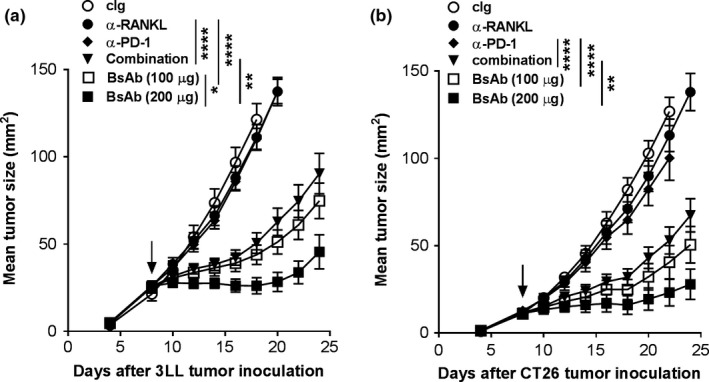
The anti-RANKL/PD-1 BsAb retained binding to both RANKL and PD-1 and blocked the interaction with respective counter-structures RANK and PD-L1. The inhibitory effect of anti-RANKL/PD-1 BsAb was confirmed by demonstrating a complete block of RANKL-dependent osteoclast formation. Monotherapy activity of anti-RANKL/PD-1 BsAb was observed in anti-PD-1 resistant tumors and, when combined with anti-CTLA-4 mAb, increased anti-tumor responses. An equivalent or superior anti-tumor response was observed with the anti-RANKL/PD-1 BsAb compared with the combination of parental anti-RANKL plus anti-PD-1 antibodies depending upon the tumor model.
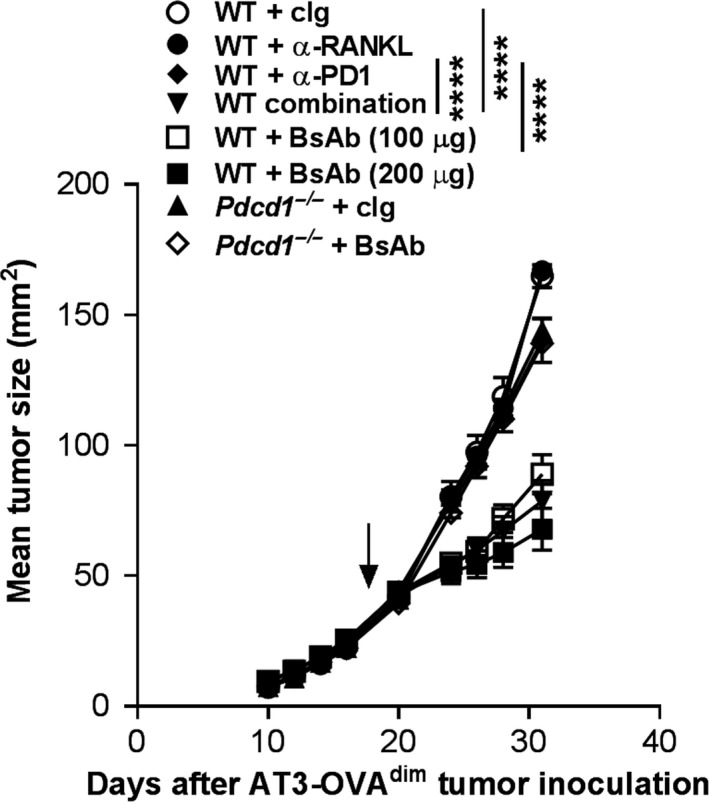
Mechanistically, the anti-tumor activity of anti-RANKL/PD-1 BsAb required CD8T cells, host PD-1 and IFNγ. Targeting RANKL and PD-1 simultaneously within the tumor microenvironment (TME) improved anti-tumor efficacy compared with combination of two separate mAbs.
In summary, the bispecific anti-RANKL/PD-1 antibody demonstrates potent tumor growth inhibition in settings of ICI resistance and represents a novel modality for clinical development in advanced cancer.
在抗PD-1/PD-L1和抗CTLA4抗体等免疫检查点抑制剂(ICI)中添加RANKL/RANK阻断剂,可增强小鼠的抗肿瘤免疫力。最近针对晚期黑色素瘤和肺癌患者的回顾性临床研究表明,在ICI中添加抗RANKL抗体相对于单独使用ICI治疗可提高总体缓解率。基于这一原理,我们开发了一种新型双特异性抗体(BsAb),它同时靶向RANKL和PD-1。
我们在基于细胞的试验中对抗RANKL/PD-1 BsAb的靶点结合和功能活性进行了表征。在实验性肺转移模型和已建立皮下移植瘤的小鼠中证实了其抗肿瘤活性。
抗RANKL/PD-1 BsAb保留了与RANKL和PD-1的结合,并阻断了与各自对应结构RANK和PD-L1的相互作用。通过证明完全阻断RANKL依赖性破骨细胞形成,证实了抗RANKL/PD-1 BsAb的抑制作用。在抗PD-1耐药肿瘤中观察到了抗RANKL/PD-1 BsAb的单药活性,并且当与抗CTLA-4单克隆抗体联合使用时,增强了抗肿瘤反应。根据肿瘤模型的不同,与亲本抗RANKL加抗PD-1抗体联合使用相比,抗RANKL/PD-1 BsAb观察到了等效或更好的抗肿瘤反应。
从机制上讲,抗RANKL/PD-1 BsAb的抗肿瘤活性需要CD8T细胞、宿主PD-1和IFNγ。与两种单独的单克隆抗体联合使用相比,在肿瘤微环境(TME)中同时靶向RANKL和PD-1可提高抗肿瘤疗效。
总之,双特异性抗RANKL/PD-1抗体在ICI耐药情况下显示出强大的肿瘤生长抑制作用,代表了晚期癌症临床开发的一种新方式。