Medical Oncology Department, Campus Bio-Medico University, Roma, Italy.
Medical Oncology Department, Campus Bio-Medico University, Roma, Italy
J Immunother Cancer. 2022 Sep;10(9). doi: 10.1136/jitc-2022-005136.
The advent of immune checkpoint inhibitors (ICIs) have led to a paradigm change in the management of metastatic renal cell carcinoma (mRCC), nevertheless, the benefit of treatment is confined to a limited proportion of patients. Therefore, the identification of predictive biomarkers for response to ICIs represents an unmet clinical need. Here, we performed a large-scale plasma proteomic profile of patients with mRCC, treated with nivolumab, to identify soluble molecules potentially associated with clinical benefit.
We analyzed the levels of 507 soluble molecules in the pretreatment plasma of 16 patients with mRCC (discovery set) who received nivolumab therapy as a single agent. The ELISA assay was performed to confirm the protein level of candidate biomarkers associated to clinical benefit in 15 patients with mRCC (validation set). Survival curves of complete cohort were estimated by the Kaplan-Meier method and compared with the log-rank test.
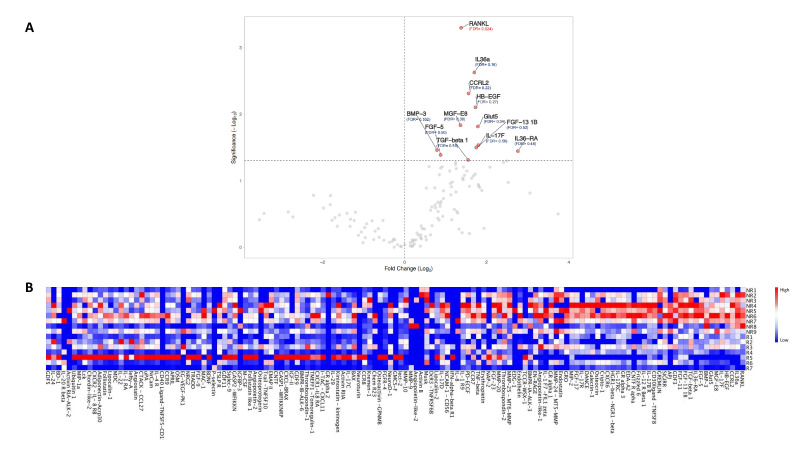
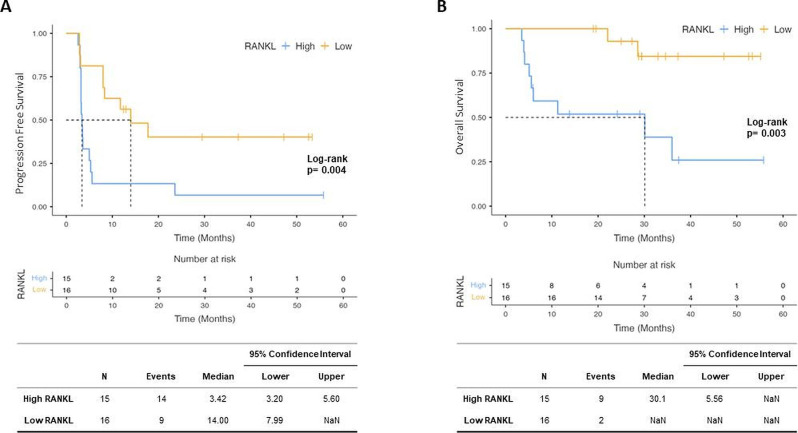
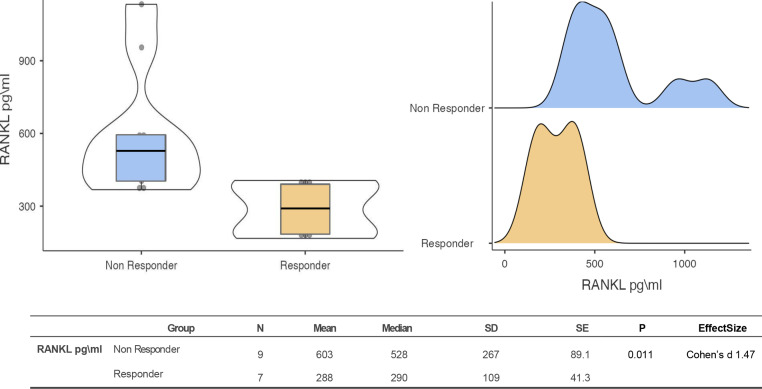
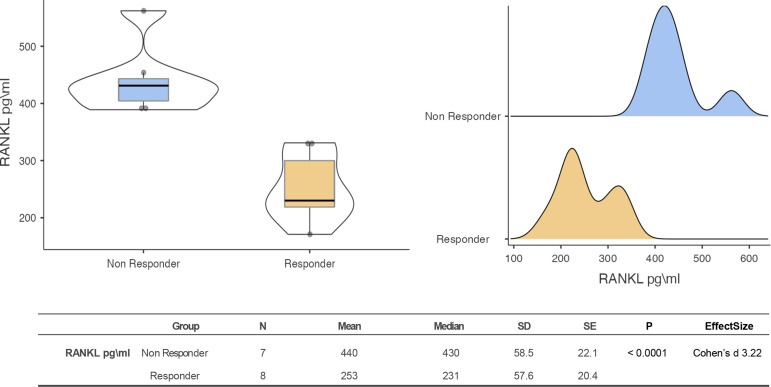
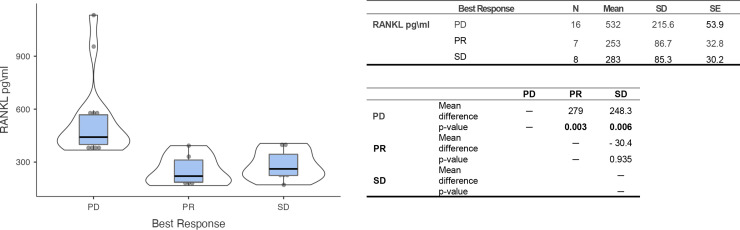
Out of 507 screened molecules, 135 factors were selected as expressed above background and 12 of them were significantly overexpressed in patients who did not benefit from treatment (non-responders (NR)) compared with responders (R) group. After multiplicity adjustment, receptor activator of nuclear factor kappa-Β ligand (RANKL) was the only molecule that retained the statistical significance (false discovery rate: 0.023). RANKL overexpression in NR patients was confirmed both in discovery (median NR: 528 pg/mL vs median R: 288 pg/mL, p=0.011) and validation set (median NR: 440 pg/mL vs median R: 253 pg/mL, p<0.001). Considering the complete cohort of patients (discovery+validation set), significantly higher RANKL levels were found in patients who primarily progressed from treatment compared with those who had a partial response (p=0.003) or stable disease (p=0.006). Moreover, patients with low RANKL levels had significant improvements in progression-free survival (median 14.0 months vs 3.4 months, p=0.004) and overall survival (median not reached vs 30.1 months, p=0.003).
Our exploratory study suggests RANKL as a novel independent biomarker of response and survival in patients with mRCC treated with nivolumab.
免疫检查点抑制剂(ICIs)的出现改变了转移性肾细胞癌(mRCC)的治疗模式,但治疗的获益仅限于有限比例的患者。因此,确定预测对 ICI 反应的生物标志物是一个未满足的临床需求。在这里,我们对接受纳武单抗单药治疗的 16 例 mRCC 患者的预处理血浆进行了大规模的血浆蛋白质组谱分析,以鉴定可能与临床获益相关的可溶性分子。
我们分析了 16 例接受纳武单抗单药治疗的 mRCC 患者(发现集)的预处理血浆中 507 种可溶性分子的水平。使用 ELISA 检测来确认与 mRCC 患者临床获益相关的候选生物标志物的蛋白水平(验证集 15 例)。通过 Kaplan-Meier 方法估计全队列的生存曲线,并通过对数秩检验进行比较。
在筛选的 507 种分子中,有 135 种因子的表达高于背景水平,其中 12 种在未从治疗中获益的患者(无反应者(NR))中显著过表达,与有反应者(R)组相比。经过多重调整后,核因子κB 受体激活物配体(RANKL)是唯一保留统计学意义的分子(假发现率:0.023)。在发现集(NR 中位数:528 pg/ml vs R 中位数:288 pg/ml,p=0.011)和验证集(NR 中位数:440 pg/ml vs R 中位数:253 pg/ml,p<0.001)中均证实了 NR 患者中 RANKL 的过表达。考虑到患者的完整队列(发现+验证集),与部分缓解(p=0.003)或疾病稳定(p=0.006)的患者相比,从治疗中主要进展的患者中发现 RANKL 水平显著升高。此外,RANKL 水平较低的患者在无进展生存期(中位数 14.0 个月 vs 3.4 个月,p=0.004)和总生存期(中位数未达到 vs 30.1 个月,p=0.003)方面均有显著改善。
我们的探索性研究表明,RANKL 是接受纳武单抗治疗的 mRCC 患者的一种新的反应和生存的独立生物标志物。