Division of Cancer Prevention and Control, Centers for Disease Control and Prevention, Albuquerque, New Mexico.
New Mexico Tumor Registry, University of New Mexico Comprehensive Cancer Center, Albuquerque, New Mexico.
Cancer Epidemiol Biomarkers Prev. 2019 Oct;28(10):1604-1611. doi: 10.1158/1055-9965.EPI-19-0288.
Cancer incidence rates for American Indian and Alaska Native (AI/AN) populations vary by geographic region in the United States. The purpose of this study is to examine cancer incidence rates and trends in the AI/AN population compared with the non-Hispanic white population in the United States for the years 2010 to 2015.
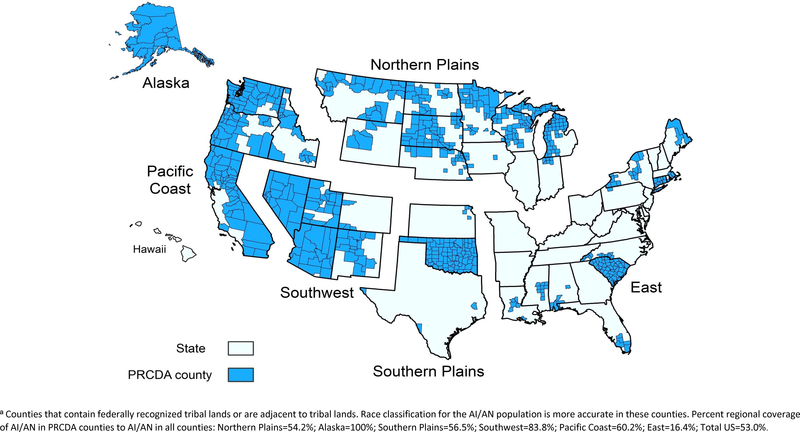
Cases diagnosed during 2010 to 2015 were identified from population-based cancer registries and linked with the Indian Health Service (IHS) patient registration databases to describe cancer incidence rates in non-Hispanic AI/AN persons compared with non-Hispanic whites (whites) living in IHS purchased/referred care delivery area counties. Age-adjusted rates were calculated for the 15 most common cancer sites, expressed per 100,000 per year. Incidence rates are presented overall as well as by region. Trends were estimated using joinpoint regression analyses.
Lung and colorectal cancer incidence rates were nearly 20% to 2.5 times higher in AI/AN males and nearly 20% to nearly 3 times higher in AI/AN females compared with whites in the Northern Plains, Southern Plains, Pacific Coast, and Alaska. Cancers of the liver, kidney, and stomach were significantly higher in the AI/AN compared with the white population in all regions. We observed more significant decreases in cancer incidence rates in the white population compared with the AI/AN population.
Findings demonstrate the importance of examining cancer disparities between AI/AN and white populations. Disparities have widened for lung, female breast, and liver cancers.
These findings highlight opportunities for targeted public health interventions to reduce AI/AN cancer incidence.
美国印第安人和阿拉斯加原住民(AI/AN)人群的癌症发病率因地理位置而异。本研究的目的是检查 2010 年至 2015 年期间 AI/AN 人群与美国非西班牙裔白人人群的癌症发病率和趋势。
从基于人群的癌症登记处确定 2010 年至 2015 年期间诊断出的病例,并将其与印第安卫生服务(IHS)患者登记数据库相关联,以描述非西班牙裔 AI/AN 人与居住在 IHS 购买/转介护理提供地区的白人(白人)的癌症发病率。计算了 15 个最常见癌症部位的年龄调整发病率,每年每 10 万人表示。总体和按地区呈现发病率。使用连接点回归分析估计趋势。
在北平原、南平原、太平洋沿岸和阿拉斯加,AI/AN 男性的肺癌和结直肠癌发病率几乎高出 20%至 2.5 倍,AI/AN 女性的肺癌和结直肠癌发病率几乎高出 20%至近 3 倍。在所有地区,AI/AN 人群的肝癌、肾癌和胃癌发病率明显高于白人。与 AI/AN 人群相比,我们观察到白人癌症发病率的下降更为显著。
研究结果表明,检查 AI/AN 和白人之间癌症差异的重要性。肺癌、女性乳腺癌和肝癌的差异有所扩大。
这些发现突出了针对 AI/AN 癌症发病率的有针对性公共卫生干预措施的机会。