Odani Satomi, Armour Brian S, Graffunder Corinne M, Garrett Bridgette E, Agaku Israel T
Office on Smoking and Health, National Center for Chronic Disease Prevention and Health Promotion, CDC.
MMWR Morb Mortal Wkly Rep. 2017 Dec 22;66(50):1374-1378. doi: 10.15585/mmwr.mm6650a2.
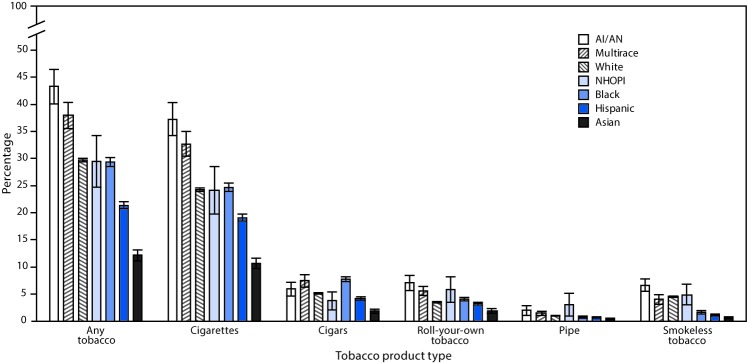
An overarching goal of Healthy People 2020 is to achieve health equity, eliminate disparities, and improve health among all groups.* Although significant progress has been made in reducing overall commercial tobacco product use, disparities persist, with American Indians or Alaska Natives (AI/ANs) having one of the highest prevalences of cigarette smoking among all racial/ethnic groups (1,2). Variations in cigarette smoking among AI/ANs have been documented by sex and geographic location (3), but not by other sociodemographic characteristics. Furthermore, few data exist on use of tobacco products other than cigarettes among AI/ANs (4). CDC analyzed self-reported current (past 30-day) use of five tobacco product types among AI/AN adults from the 2010-2015 National Survey on Drug Use and Health (NSDUH); results were compared with six other racial/ethnic groups (Hispanic; non-Hispanic white [white]; non-Hispanic black [black]; non-Hispanic Native Hawaiian or other Pacific Islander [NHOPI]; non-Hispanic Asian [Asian]; and non-Hispanic multirace [multirace]). Prevalence of current tobacco product use was significantly higher among AI/ANs than among non-AI/ANs combined for any tobacco product, cigarettes, roll-your-own tobacco, pipes, and smokeless tobacco. Among AI/ANs, prevalence of current use of any tobacco product was higher among males, persons aged 18-25 years, those with less than a high school diploma, those with annual family income <$20,000, those who lived below the federal poverty level, and those who were never married. Addressing the social determinants of health and providing evidence-based, population-level, and culturally appropriate tobacco control interventions could help reduce tobacco product use and eliminate disparities in tobacco product use among AI/ANs (1).
《健康人民2020》的首要目标是实现健康公平、消除差异并改善所有群体的健康状况。*尽管在减少总体商业烟草产品使用方面已取得显著进展,但差异依然存在,美国印第安人或阿拉斯加原住民(AI/ANs)在所有种族/族裔群体中的吸烟率位居前列(1,2)。AI/ANs群体内部吸烟情况在性别和地理位置方面存在差异已有记录(3),但在其他社会人口学特征方面的差异尚无记录。此外,关于AI/ANs群体使用除香烟以外其他烟草产品的数据也很少(4)。美国疾病控制与预防中心(CDC)分析了2010 - 2015年全国药物使用和健康调查(NSDUH)中AI/AN成年人自我报告的当前(过去30天)对五种烟草产品类型的使用情况;结果与其他六个种族/族裔群体(西班牙裔;非西班牙裔白人[白人];非西班牙裔黑人[黑人];非西班牙裔夏威夷原住民或其他太平洋岛民[NHOPI];非西班牙裔亚裔[亚裔];以及非西班牙裔多种族[多种族])进行了比较。对于任何烟草产品、香烟、自卷烟、烟斗和无烟烟草,AI/ANs群体当前烟草产品使用率显著高于非AI/ANs群体的合并使用率。在AI/ANs群体中,当前使用任何烟草产品的比例在男性中更高,在18 - 25岁的人群中更高,在高中文凭以下的人群中更高,在家庭年收入低于20,000美元的人群中更高,在生活在联邦贫困线以下的人群中更高,以及在从未结婚的人群中更高。解决健康的社会决定因素并提供基于证据、针对人群且符合文化特点的烟草控制干预措施,可能有助于减少烟草产品使用,并消除AI/ANs群体在烟草产品使用方面的差异(1)。