Department of Psychology, Djavad Mowafaghian Centre for Brain Health, University of British Columbia, Vancouver, BC, Canada.
Brain Behav. 2019 Oct;9(10):e01435. doi: 10.1002/brb3.1435. Epub 2019 Oct 1.
In the dentate gyrus of the rodent hippocampus, neurogenesis begins prenatally and continues to the end of life. Adult-born neurons often die in the first few weeks after mitosis, but those that survive to 1 month persist indefinitely. In contrast, neurons born at the peak of development are initially stable but can die later in adulthood. Physiological and pathological changes in the hippocampus may therefore result from both the addition of new neurons and the loss of older neurons. The extent of neuronal loss remains unclear since no studies have examined whether neurons born at other stages of development also undergo delayed cell death.
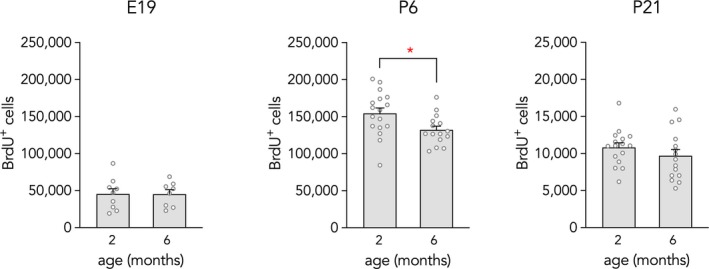
We used BrdU to label dentate granule cells that were born in male rats on embryonic day 19 (E19; before the developmental peak), postnatal day 6 (P6; peak), and P21 (after the peak). We quantified BrdU neurons in separate groups of rats at 2 and 6 months post-BrdU injection to estimate cell death in young adulthood.
Consistent with previous work, there was a 15% loss of P6-born neurons between 2 and 6 months of age. In contrast, E19- or P21-born neurons were stable throughout young adulthood.
Delayed death of P6-born neurons suggests these cells may play a unique role in hippocampal plasticity adulthood, for example, by contributing to the turnover of hippocampal memory. Their loss may also play a role in disorders that are characterized by hippocampal atrophy.
在啮齿动物海马的齿状回中,神经发生始于产前,并持续到生命结束。成年新生神经元通常在有丝分裂后的头几周内死亡,但那些存活到 1 个月的神经元则会无限期存活。相比之下,在发育高峰期出生的神经元最初是稳定的,但在成年后可能会死亡。因此,海马体的生理和病理变化可能既源于新神经元的增加,也源于旧神经元的丧失。由于没有研究检查在其他发育阶段出生的神经元是否也会发生延迟性细胞死亡,因此神经元丧失的程度仍不清楚。
我们使用 BrdU 标记在雄性大鼠胚胎第 19 天(E19;在发育高峰期之前)、出生后第 6 天(P6;高峰期)和 P21(高峰期后)出生的齿状回颗粒细胞。我们在 BrdU 注射后 2 个月和 6 个月对不同组大鼠中的 BrdU 神经元进行定量,以估计成年早期的细胞死亡情况。
与之前的工作一致,P6 出生的神经元在 2 至 6 个月龄之间有 15%的损失。相比之下,E19 或 P21 出生的神经元在整个成年早期都保持稳定。
P6 出生的神经元发生延迟性死亡表明这些细胞可能在成年海马体可塑性中发挥独特作用,例如通过参与海马体记忆的更替。它们的丧失也可能在以海马体萎缩为特征的疾病中发挥作用。