Department of Animal Science and Technology, Hebei Agricultural University, Baoding 071001, China.
College of Foreign Languages, Hebei Agricultural University, Baoding 071001, China.
Poult Sci. 2019 Dec 1;98(12):6677-6683. doi: 10.3382/ps/pez539.
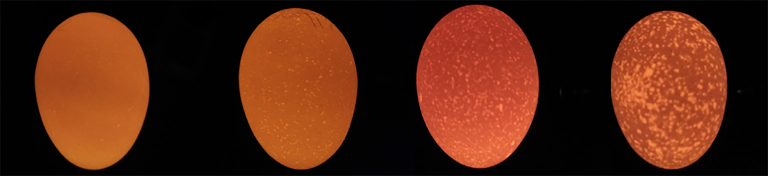
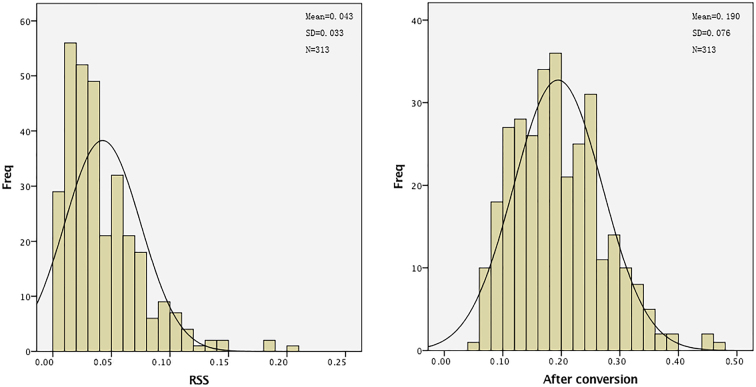
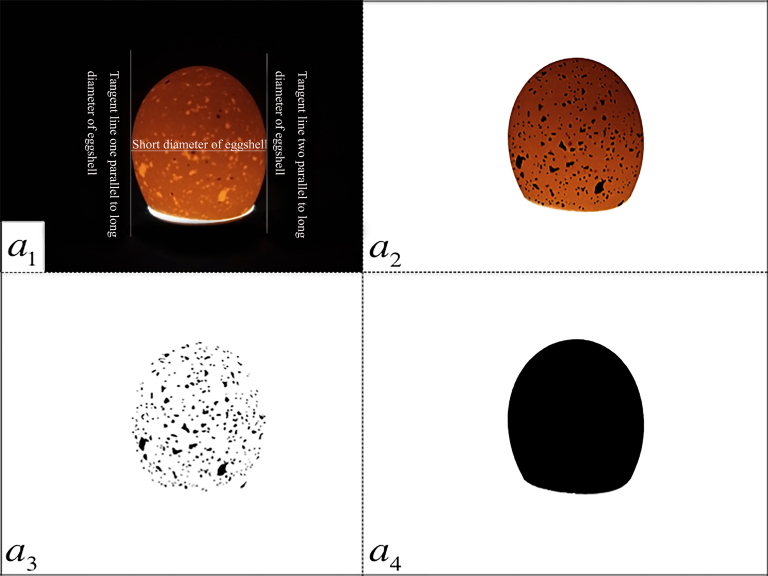
Scoring is a common method to evaluate eggshell translucency, and it mainly depends on the area and the density of translucent spots in eggshells. However, the lack of common scoring criteria and the difficulty of quantitatively measuring spots in eggshells impede effective comparisons between research papers and greatly hinder the progress of research on translucent eggshell. To make measurement of translucent eggshells more objective, we optimized the scoring method and compared it with 2 new methods: grayscale recognition and the colorimeter method. Briefly, a total of 354 eggs from 600, 395-day-old dwarf brown laying hens were collected and classified into 4 score groups according to their degree of translucency. This subjective process was repeated 5 times. Then, we captured the profile side of each egg using a camera and measured spot characteristics using grayscale recognition, which involved measuring the quantity of spots (QS), diameter of each spot (DS), average area of each spot (AAES), sum of spot areas (SUSA), sum of shell area (SUSHA), and ratio of SUSA to SUSHA (RSS) on the eggshell. Furthermore, the L, A, and B values of each egg at the sharp, middle, and blunt ends were separately measured using a colorimeter. As a result, average values of 31.31, 29.78, 29.81, and 9.08% of all eggs were divided into score levels 1, 2, 3, and 4 (from opaque to translucent), which correspond with RSS values of 1.34, 3.23, 6.21, and 11.89%, respectively. By grayscale recognition, QS, DS, AAES, SUSA, SUSHA, and RSS all increased along with increased translucency scores (P < 0.05). Using scoring, an egg with a specific RSS value was more easily assigned to a specific score level (50%) or adjacent score levels (50%). The L, A, and B values of eggshells in score level 1 were significantly different from those of eggshells in levels 3 or 4; however, there were no significant differences between any adjacent score levels. In summary, the present study explored objective reference metrics to measure eggshell translucency.
评分是评估蛋壳透光性的常用方法,主要依据蛋壳上透光斑点的面积和密度。然而,缺乏通用的评分标准和量化测量蛋壳斑点的难度,阻碍了研究论文之间的有效比较,极大地阻碍了对透光蛋壳的研究进展。为了使透光蛋壳的测量更加客观,我们优化了评分方法,并将其与 2 种新方法(灰度识别和比色计法)进行了比较。简而言之,从 600 只 395 日龄矮小型褐壳蛋鸡中收集了 354 枚鸡蛋,并根据其透光程度将其分为 4 个评分组。这个主观过程重复了 5 次。然后,我们使用相机拍摄每个鸡蛋的轮廓侧,并使用灰度识别测量斑点特征,包括测量斑点数量(QS)、每个斑点的直径(DS)、每个斑点的平均面积(AAES)、斑点总面积(SUSA)、蛋壳总面积(SUSHA)和 SUSA 与 SUSHA 的比值(RSS)。此外,使用比色计分别测量每个鸡蛋在锐端、中端和钝端的 L、A 和 B 值。结果,31.31%、29.78%、29.81%和 9.08%的鸡蛋平均分为 1、2、3 和 4 个评分等级(从不透明到半透明),分别对应 RSS 值为 1.34%、3.23%、6.21%和 11.89%。通过灰度识别,QS、DS、AAES、SUSA、SUSHA 和 RSS 均随着透光评分的增加而增加(P<0.05)。使用评分法,具有特定 RSS 值的鸡蛋更容易被分配到特定的评分等级(50%)或相邻的评分等级(50%)。评分等级 1 的蛋壳的 L、A 和 B 值与等级 3 或 4 的蛋壳值显著不同;然而,任何相邻的评分等级之间没有显著差异。总之,本研究探索了衡量蛋壳透光性的客观参考指标。