Minué-Lorenzo César, Olano-Espinosa Eduardo, Del Cura-González Isabel, Vizcaíno-Sánchez Jose M, Camarelles-Guillem Francisco, Granados-Garrido José A, Ruiz-Pacheco Margarita, Gámez-Cabero M Isabel, Martínez-Suberviola F Javier, Serrano-Serrano Encarnación
Perales del Río Health Center, Dirección Asistencial Centro, Servicio Madrileño de Salud, Madrid, Spain.
Los Castillos Health Center, Dirección Asistencial Oeste, Servicio Madrileño de Salud, Madrid, Spain.
Tob Induc Dis. 2019 Sep 5;17:64. doi: 10.18332/tid/111368. eCollection 2019.
Research has shown that financing drug therapy increases smoking abstinence rates, although most of these studies have been carried out in the private healthcare setting. The aim of this work is to assess the effect of subsidized pharmacological treatment on smoking cessation rates by the Spanish public healthcare system.
A pragmatic, randomized, clinical trial was performed by clusters. Randomization unit was the primary healthcare center and the analysis unit was the patient. Smokers consuming ≥10 cigarettes/day were randomly assigned to an intervention group that received financed pharmacological treatment or to a control group that followed usual care. The main outcome was self-reported or CO-confirmed continuous abstinence at 12 months. The main outcome, continuous abstinence rates (%), were compared between groups at 12 months post-intervention. A model was adjusted using mixed-effect logistic regression.
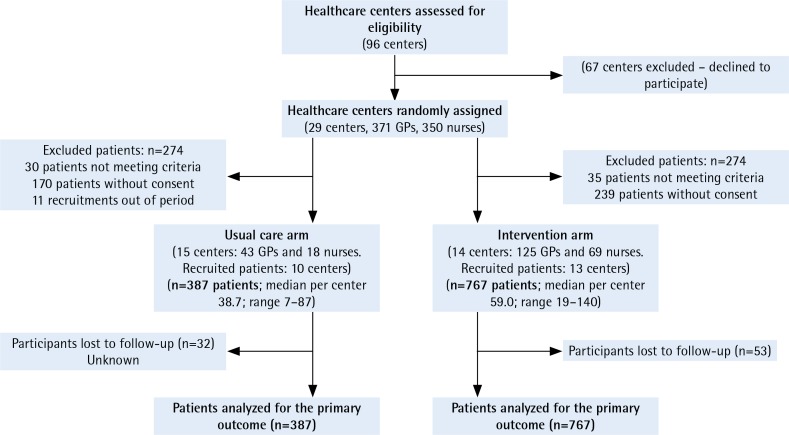
A total of 1154 patients were included from 23 healthcare centers. In the intention-to-treat analysis, self-reported abstinence after 12 months in the control and intervention groups, respectively, was 9.6% (37/387) and 15.4% (118/767) (gender-adjusted OR=1.75; 95% CI: 1.1-2.8); for CO-confirmed abstinence the corresponding values were 3.1% (12/387) and 6.4% (49/767) (gender-adjusted OR=1.72; 95% CI: 0.7-4.0). Pharmacological treatment use was 35.1% (136/387) in the control group, and 58.3% (447/767) in the intervention group (adjusted OR=4.25; 95% CI: 1.8-9.9).
Subsidizing pharmacological treatment for smoking cessation increases self-reported or CO-confirmed abstinence rates under realistic conditions in the primary care setting of the Spanish public health system.
研究表明,药物治疗资助可提高戒烟率,不过这些研究大多是在私立医疗环境中开展的。本研究旨在评估西班牙公共医疗系统提供的药物治疗补贴对戒烟率的影响。
开展了一项实用的整群随机临床试验。随机分组单位是基层医疗中心,分析单位是患者。每日吸烟量≥10支的吸烟者被随机分配至接受药物治疗资助的干预组或接受常规护理的对照组。主要结局是12个月时自我报告或经一氧化碳确认的持续戒烟情况。在干预后12个月时比较两组的主要结局,即持续戒烟率(%)。使用混合效应逻辑回归调整模型。
来自23个医疗中心的1154例患者纳入研究。在意向性分析中,对照组和干预组12个月时自我报告的戒烟率分别为9.6%(37/387)和15.4%(118/767)(经性别调整的比值比=1.75;95%置信区间:1.1 - 2.8);经一氧化碳确认的戒烟率相应值分别为3.1%(12/387)和6.4%(49/767)(经性别调整的比值比=1.72;95%置信区间:0.7 - 4.0)。对照组药物治疗使用率为35.1%(136/387),干预组为58.3%(447/767)(调整后的比值比=4.25;95%置信区间:1.8 - 9.9)。
在西班牙公共卫生系统的基层医疗环境中,为戒烟提供药物治疗补贴可提高自我报告或经一氧化碳确认的戒烟率。