School of Medicine and Health Sciences, University for Development Studies, Tamale, Ghana.
Tamale Teaching Hospital, Salaga Road, Tamale, Ghana.
World J Surg. 2020 Jan;44(1):3-11. doi: 10.1007/s00268-019-05210-9.
Congenital anomalies have risen to become the fifth leading cause of under-five mortality globally. The majority of deaths and disability occur in low- and middle-income countries including Ghana. This 3-year retrospective review aimed to define, for the first time, the characteristics and outcomes of neonatal surgical conditions in northern Ghana.
A retrospective study was conducted to include all admissions to the Tamale Teaching Hospital (TTH) neonatal intensive care unit (NICU) with surgical conditions between January 2014 and January 2017. Data were collected on demographics, diagnosis and outcomes. Descriptive analysis was performed on all data, and logistic regression was used to predict determinants of neonatal mortality. p < 0.05 was deemed significant.
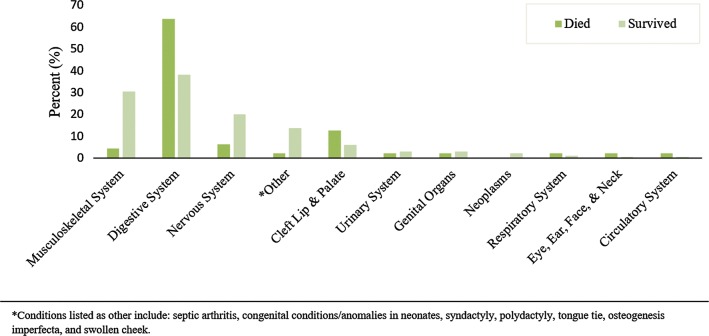
Three hundred and forty-seven neonates were included. Two hundred and sixty-one (75.2%) were aged 7 days or less at presentation, with males (n = 177, 52%) slightly higher than females (n = 165, 48%). The majority were delivered by spontaneous vaginal delivery (n = 247, 88%); 191 (58%) were born in hospital. Congenital anomalies accounted for 302 (87%) of the neonatal surgical cases and 45 (96%) deaths. The most common anomalies were omphalocele (n = 48, 13.8%), imperforate anus (n = 34, 9.8%), intestinal obstruction (n = 29, 8.4%), spina bifida (n = 26, 7.5%) and hydrocephalus (n = 19, 5.5%). The overall mortality rate was 13.5%. Two-thirds of the deaths (n = 30) from congenital anomalies were conditions involving the digestive system with gastroschisis having the highest mortality of 88%. Omphalocele (n = 11, 23.4%), gastroschisis (n = 7, 14.9%) and imperforate anus (n = 6, 12.8%) contributed to the most deaths. On multivariate analysis, low birthweight was significantly associated with mortality (OR 3.59, CI 1.4-9.5, p = 0.009).
Congenital anomalies are a major global health problem associated with high neonatal mortality in Ghana. The highest burden in terms of both caseload and mortality is attributed to congenital anomalies involving the digestive system, which should be targeted to improve outcomes.
先天性畸形已成为全球导致五岁以下儿童死亡的第五大主要原因。大多数死亡和残疾发生在包括加纳在内的低收入和中等收入国家。这项为期 3 年的回顾性研究旨在首次定义加纳北部新生儿外科疾病的特征和结局。
进行了一项回顾性研究,纳入了 2014 年 1 月至 2017 年 1 月期间在塔马利教学医院(TTH)新生儿重症监护病房(NICU)接受手术治疗的所有新生儿。收集人口统计学、诊断和结局数据。对所有数据进行描述性分析,并使用逻辑回归预测新生儿死亡率的决定因素。p<0.05 被认为具有统计学意义。
共纳入 347 名新生儿。261 名(75.2%)患儿在就诊时年龄为 7 天或以下,男性(n=177,52%)略高于女性(n=165,48%)。大多数患儿经自然阴道分娩(n=247,88%)分娩,191 名(58%)在医院分娩。先天性畸形占新生儿外科病例的 302 例(87%)和 45 例(96%)死亡病例。最常见的畸形是脐膨出(n=48,13.8%)、肛门闭锁(n=34,9.8%)、肠梗阻(n=29,8.4%)、脊柱裂(n=26,7.5%)和脑积水(n=19,5.5%)。总死亡率为 13.5%。三分之二(n=30)的先天性畸形死亡病例涉及消化系统,其中腹裂的死亡率最高,为 88%。脐膨出(n=11,23.4%)、腹裂(n=7,14.9%)和肛门闭锁(n=6,12.8%)导致的死亡人数最多。多变量分析显示,低出生体重与死亡率显著相关(OR 3.59,95%CI 1.4-9.5,p=0.009)。
先天性畸形是全球的一个主要健康问题,在加纳与新生儿高死亡率相关。在病例数和死亡率方面,负担最重的是涉及消化系统的先天性畸形,应针对这些畸形来改善结局。