Division of Physiology, Pharmacology and Neuroscience, School of Life Sciences, University of Nottingham Medical School, Queen's Medical Centre, Nottingham, UK.
Centre of Membrane Proteins and Receptors (COMPARE), University of Birmingham and University of Nottingham, The Midlands, UK.
SLAS Discov. 2020 Feb;25(2):186-194. doi: 10.1177/2472555219880475. Epub 2019 Oct 4.
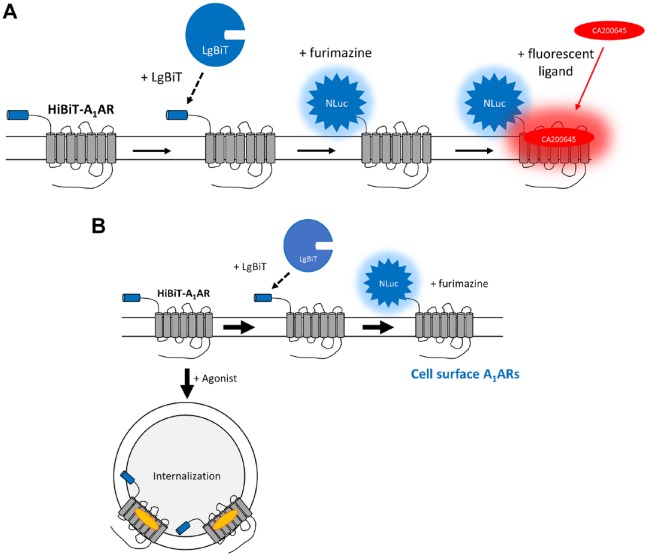
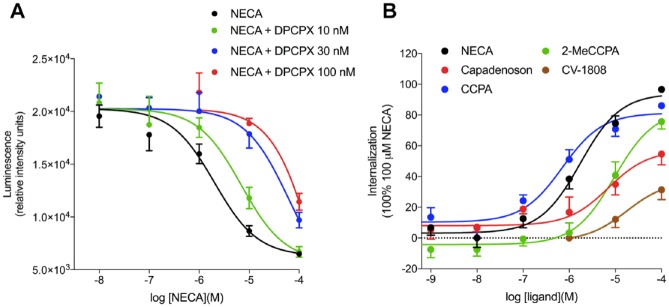
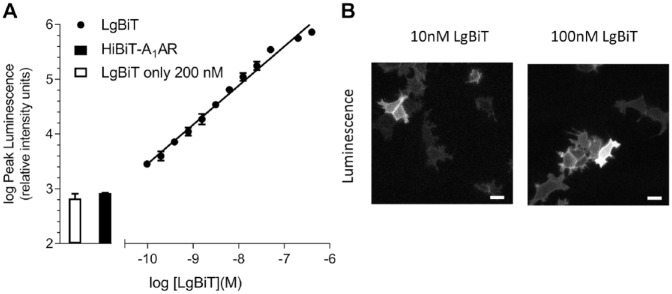
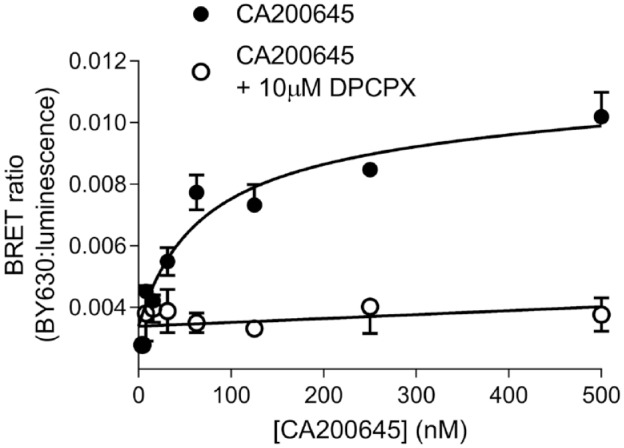
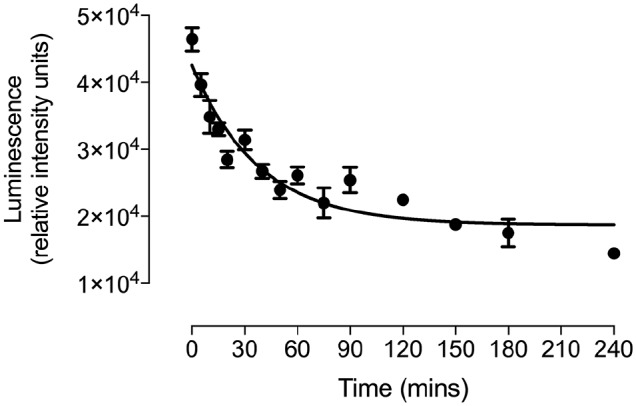
Receptor internalization in response to prolonged agonist treatment is an important regulator of G protein-coupled receptor (GPCR) function. The adenosine A receptor (AAR) is one of the adenosine receptor family of GPCRs, and evidence for its agonist-induced internalization is equivocal. The recently developed NanoBiT technology uses split NanoLuc Luciferase to monitor changes in protein interactions. We have modified the human AAR on the N-terminus with the small high-affinity HiBiT tag. In the presence of the large NanoLuc subunit (LgBiT), complementation occurs, reconstituting a full-length functional NanoLuc Luciferase. Here, we have used complemented luminescence to monitor the internalization of the AAR in living HEK293 cells. Agonist treatment resulted in a robust decrease in cell-surface luminescence, indicating an increase in AAR internalization. These responses were inhibited by the AAR-selective antagonist 1,3-dipropyl-8-cyclopentylxanthine (DPCPX), with an antagonist affinity that closely matched that measured using ligand binding with a fluorescent A receptor antagonist (CA200645). The agonist potencies for inducing AAR internalization were very similar to the affinities previously determined by ligand binding, suggesting little or no amplification of the internalization response. By complementing the HiBiT tag to exogenous purified LgBiT, it was also possible to perform NanoBRET ligand-binding experiments using HiBiT-AAR. This study demonstrates the use of NanoBiT technology to monitor internalization of the AAR and offers the potential to combine these experiments with NanoBRET ligand-binding assays.
受体对内源化的反应是一种重要的调节机制。G 蛋白偶联受体 (GPCR) 的功能。腺苷 A 受体 (AAR) 是腺苷受体家族的 GPCR 之一,其激动剂诱导的内吞作用的证据尚无定论。最近开发的 NanoBiT 技术使用分裂 NanoLuc 荧光素酶来监测蛋白质相互作用的变化。我们已经在人类 AAR 的 N 端修饰了具有高亲和力的 HiBiT 标签。在存在大的 NanoLuc 亚基 (LgBiT) 的情况下,互补发生,重新构成全长功能性 NanoLuc 荧光素酶。在这里,我们使用互补的发光来监测活 HEK293 细胞中 AAR 的内化。激动剂处理导致细胞表面发光显著减少,表明 AAR 内化增加。这些反应被 AAR 选择性拮抗剂 1,3-二丙基-8-环戊基黄嘌呤 (DPCPX) 抑制,其拮抗剂亲和力与使用荧光 A 受体拮抗剂 (CA200645) 进行配体结合测量非常匹配。诱导 AAR 内化的激动剂效力与以前通过配体结合确定的亲和力非常相似,这表明内化反应的放大作用很小或没有。通过将 HiBiT 标签与外源纯化的 LgBiT 互补,也可以使用 HiBiT-AAR 进行 NanoBRET 配体结合实验。这项研究表明,NanoBiT 技术可用于监测 AAR 的内化,并提供了将这些实验与 NanoBRET 配体结合测定相结合的潜力。