Division of Facial Plastic Surgery, Holcomb-Kreithen Plastic Surgery and MedSpa, Sarasota, Florida.
Department of Pathology, American PreClinical Services, Minneapolis, Minnesota.
Lasers Surg Med. 2020 Jan;52(1):23-32. doi: 10.1002/lsm.23167. Epub 2019 Oct 6.
Helium plasma skin regeneration (PSR) is a novel skin rejuvenation technology with significant differences compared with nitrogen PSR technology but that may exert similar skin tissue effects. Study objectives included a comparison of acute and chronic skin tissue changes among the two plasmas in a porcine animal model.
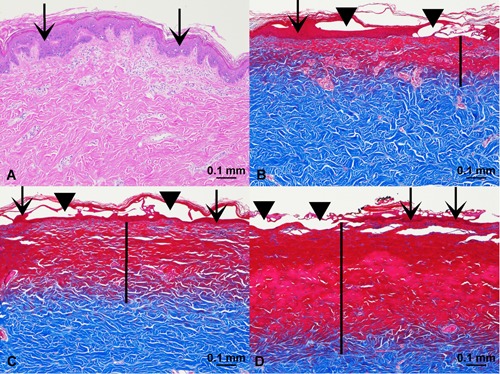
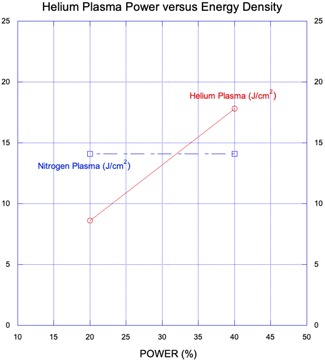
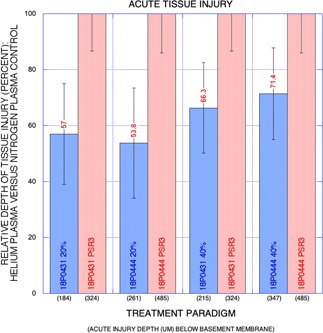
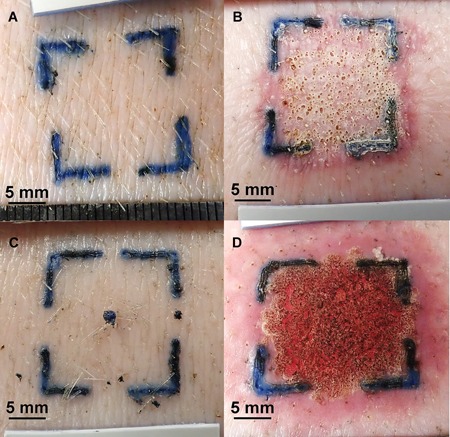
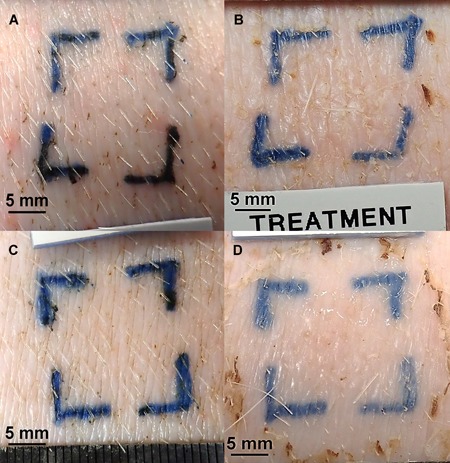
STUDY DESIGN/MATERIALS AND METHODS: In this study, both helium and nitrogen gas plasmas were used to treat the dorsal skin of Yorkshire cross mini pigs with 20% (8.6 J/cm ) and 40% (17.8 J/cm ) power helium plasma single pass treatment (4 liter gas flow, continuous energy delivery, and linear non-overlapping passes) compared with high energy nitrogen plasma double pass treatment (PSR3 @ 14.1 J/cm : 4.0 J, 2.5 Hz pulse rate, overlapping horizontal, and vertical passes). Acute and chronic skin contraction, maximum acute depth of injury and chronic reparative healing depth were assessed along with representative histopathology in each treatment paradigm.
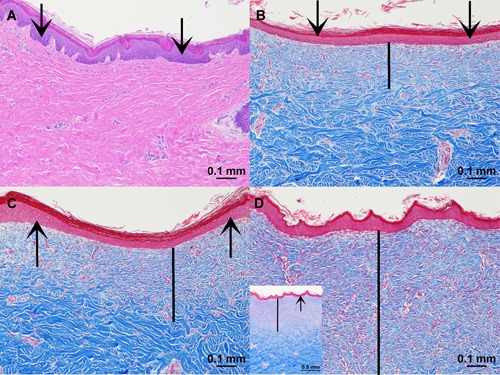
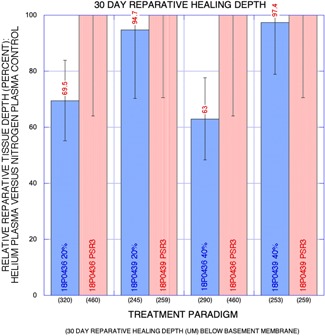
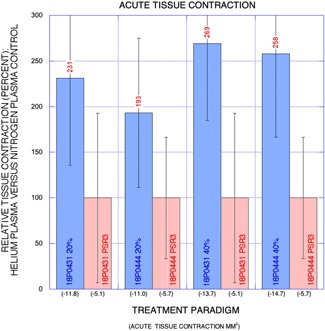
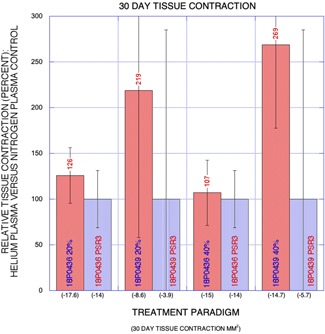
High-energy nitrogen plasma treatment exhibited greatest mean depth of acute tissue injury 4 hours post-treatment whereas helium plasma treatment exhibited greater acute skin tissue contraction. Then, 20% and 40% power helium plasma treatment results were each very similar among animals as a percentage of nitrogen plasma treatment results for both depths of acute tissue injury and acute skin tissue contraction. Mean depths of reparative tissue healing were similar among treatment paradigms 30 days after treatment with significant intra- and inter-animal variability observed within each treatment paradigm. Thirty-day mean skin tissue contraction was greater for helium plasma treatment; however, the data varied significantly between animals in all paradigms. Histopathologic tissue evaluation after 30 days showed similar findings among the treatment paradigms with epidermal hyperplasia, flattening of rete ridges and with regenerative granulation tissue expanding the superficial and papillary dermis.
This study demonstrates modestly reduced depth of the thermal effect, greater skin tissue contraction and similarity of acute and chronic histopathological findings for helium plasma when compared with nitrogen plasma in a porcine animal model. © 2019 The Authors. Lasers in Surgery and Medicine published by Wiley Periodicals, Inc.
氦等离子体皮肤再生(PSR)是一种新型的皮肤年轻化技术,与氮 PSR 技术有显著差异,但可能具有相似的皮肤组织效果。研究目的包括在猪动物模型中比较两种等离子体的急性和慢性皮肤组织变化。
研究设计/材料和方法:在这项研究中,氦气和氮气等离子体都被用于治疗约克郡十字迷你猪的背部皮肤,氦气等离子体单次处理的能量为 20%(8.6 J/cm)和 40%(17.8 J/cm),采用 4 升气体流量、连续能量输送和线性非重叠通道,与高能氮等离子体双次处理(PSR3@14.1 J/cm:4.0 J,2.5 Hz 脉冲率,水平和垂直重叠通道)进行比较。在每个处理模式中,评估急性和慢性皮肤收缩、最大急性损伤深度和慢性修复愈合深度,并进行代表性组织病理学检查。
高能氮等离子体处理在治疗后 4 小时表现出最大的平均急性组织损伤深度,而氦等离子体处理表现出更大的急性皮肤组织收缩。然后,20%和 40%功率氦等离子体处理结果在动物之间非常相似,与氮等离子体处理结果相比,急性组织损伤和急性皮肤组织收缩的深度百分比相似。治疗后 30 天,修复组织愈合的平均深度在各处理模式之间相似,每个处理模式内的个体内和个体间均存在显著的变异性。氦等离子体处理的 30 天平均皮肤组织收缩较大;然而,所有模式中的数据在动物之间差异显著。30 天的组织病理学评估显示,各处理模式之间的发现相似,包括表皮增生、网嵴平坦以及再生肉芽组织扩展到真皮浅层和乳头层。
本研究表明,在猪动物模型中,与氮等离子体相比,氦等离子体的热效应深度略有降低,皮肤组织收缩更大,急性和慢性组织病理学发现相似。