Mengesha Meresa Berwo, Adhanu Hadgay Hagos, Weldegeorges Desta Abraha, Assefa Natnael Etsay, Werid Weldu Mammo, Weldemariam Mulu Gebretsadik, Welay Fissaha Tekulu, Hidru Hagos Degefa, Gebru Tesfay Tsegay
Department of Midwifery, College of Medicine and Health Sciences, Adigrat University, P.O.BOX NO-50, Adigrat, Tigray, Ethiopia.
Department of Midwifery, College of Medicine and Health Sciences, Mekelle University, Mekelle, Tigray, Ethiopia.
BMC Res Notes. 2019 Oct 7;12(1):650. doi: 10.1186/s13104-019-4690-5.
This study aimed to determine the unfavorable outcomes and to assess factors contribute to the unfavorable management outcomes after cesarean deliveries in Ayder Specialized Comprehensive Hospital, Mekelle, Tigray, Ethiopia, 2017.
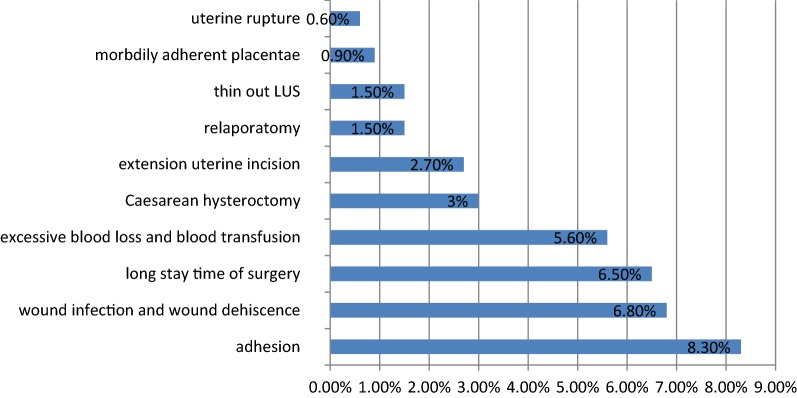
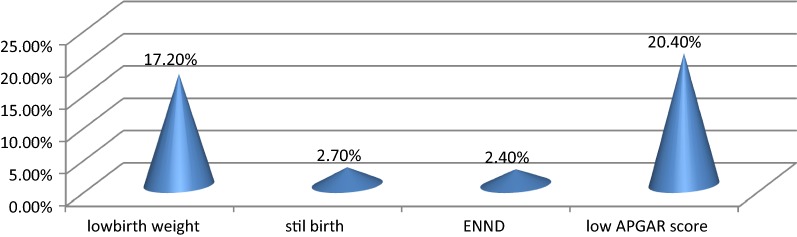
The unfavorable maternal management outcomes were Adhesion 28 (8.3%), excessive blood loss and blood transfusion 19 (5.6%), cesarean hysterectomy 10 (3%), relaparotomy 5 (1.5%), wound infection and wound dehiscence 23 (6.8%). Unfavorable fetal outcomes were were stillbirth 9 (2.6%), early neonatal death 8 (2.4%), low birth weight 58 (17.2%). women who did not book for Antenatal Care and having a history of previous cesarean delivery were found to be associated with unfavorable maternal outcomes and indications of cesarean delivery as obstructed labor was associated with unfavorable fetal outcomes.
本研究旨在确定2017年在埃塞俄比亚提格雷州梅凯勒市的艾德尔专科医院剖宫产术后的不良结局,并评估导致管理不良结局的因素。
不良的产妇管理结局包括粘连28例(8.3%)、失血过多及输血19例(5.6%)、剖宫产子宫切除术10例(3%)、再次剖腹术5例(1.5%)、伤口感染及伤口裂开23例(6.8%)。不良的胎儿结局包括死产9例(2.6%)、早期新生儿死亡8例(2.4%)、低出生体重58例(17.2%)。未进行产前检查且有剖宫产史的女性与不良的产妇结局相关,而剖宫产指征如梗阻性分娩与不良的胎儿结局相关。