Cho Pyung Goo, Ji Gyu Yeul, Yoon Young Sul, Shin Dong Ah
Department of Neurosurgery, Ajou University College of Medicine, Suwon, Korea.
Department of Neurosurgery, Cham Teun Teun Research Institute, Seoul, Korea.
J Korean Neurosurg Soc. 2019 Nov;62(6):681-690. doi: 10.3340/jkns.2019.0070. Epub 2019 Oct 8.
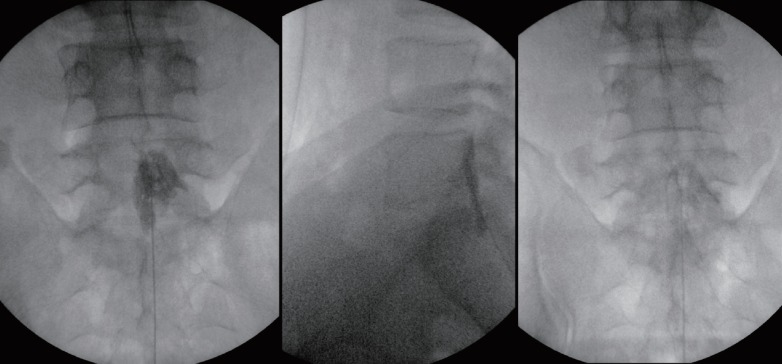
To determine whether the outcomes of percutaneous epidural neuroplasty (PEN) are influenced by the type of lumbar disc herniation (LDH) and evaluate the effectiveness of PEN in patients with single-level LDH.
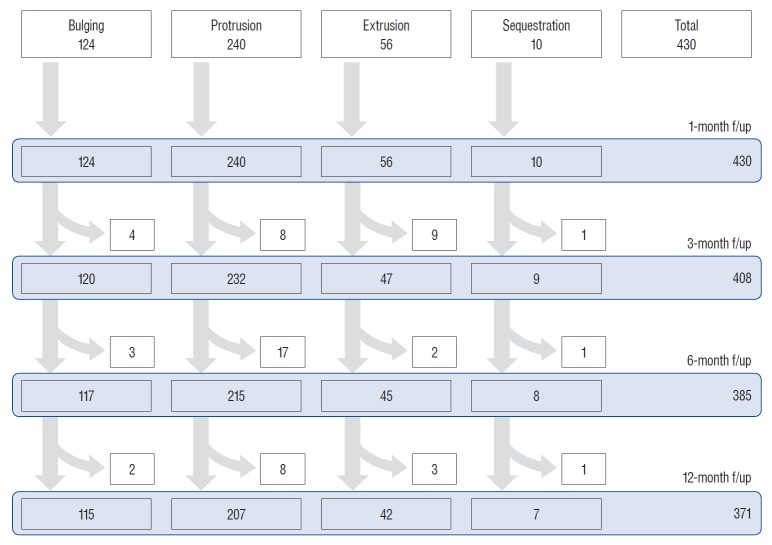
This study included 430 consecutive patients with single-level LDH who underwent PEN. Before treatment, the LDH type was categorized as bulging, protrusion, extrusion, and sequestration, while Pfirrmann grades were assigned according to imaging findings. Visual analog scale (VAS) scores for back and leg pain and success rates (Odom's criteria) were assessed at 1, 3, 6, and 12 months after treatment.
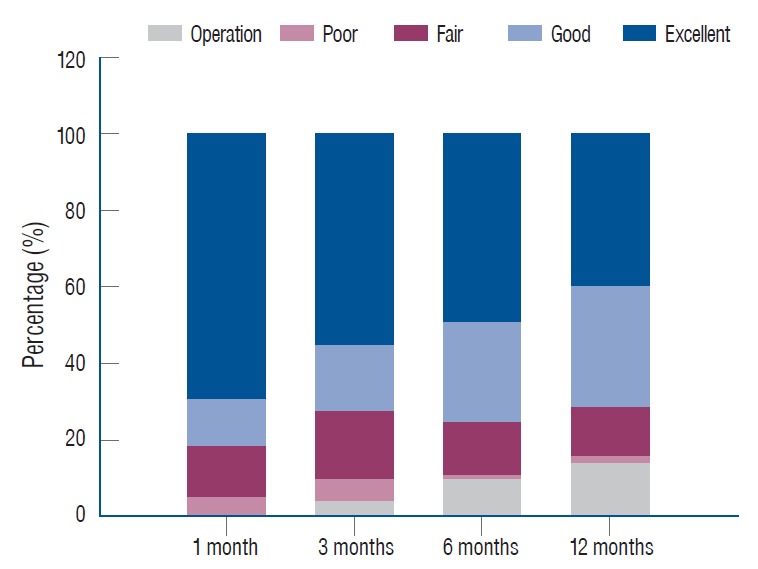
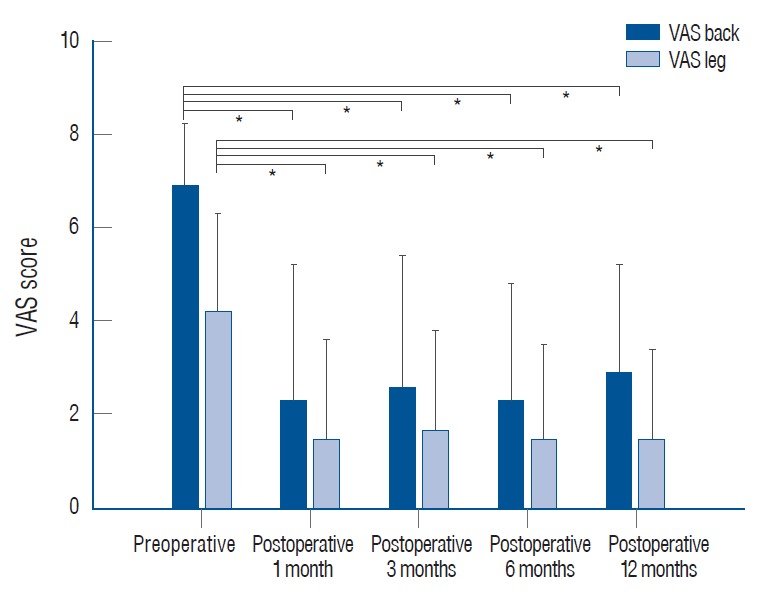
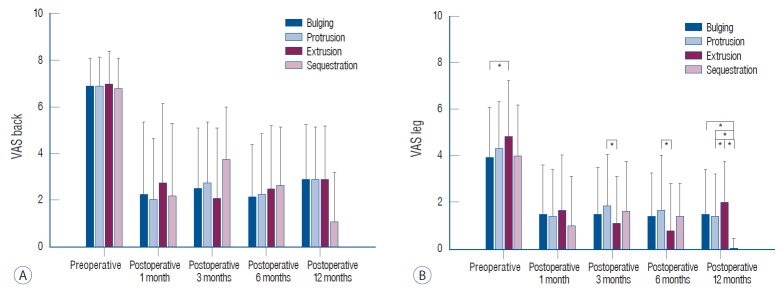
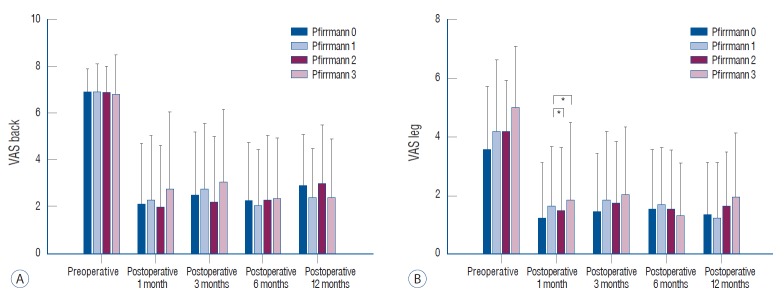
The mean preoperative VAS scores for back and leg pain were 6.90 and 4.23, respectively; these decreased after PEN as follows : 2.25 and 1.45, respectively, at 1 month; 2.61 and 1.68, respectively, at 3 months; 2.28 and 1.48, respectively, at 6 months; and 2.88 and 1.48, respectively, at 12 months (p<0.001). The decrease in VAS scores for leg pain was significantly greater in the extrusion and sequestration groups than in the other two groups (p<0.05); there were no other significant differences among groups. More than 70% patients exhibited good or excellent 12-month outcomes according to Odom's criteria. Subsequent surgery was required for 59 patients (13.7%), with a significantly higher rate in the extrusion (25.0%) and sequestration (30.0%) groups than in the bulging (7.3%) and protrusion (13.8%) groups (p<0.05). Nevertheless, subsequent surgery was not required for >70% patients with extrusion or sequestration. Patients with Pfirrmann grades 1-3 (14.0-21.5%) showed a significantly higher rate of subsequent surgery than those with Pfirrmann grade 0 (4.9%; p<0.05).
Our findings suggest that PEN is an effective treatment for back and leg pain caused by single-level LDH, with the outcomes remaining unaffected by the LDH type.
确定经皮硬膜外神经成形术(PEN)的疗效是否受腰椎间盘突出症(LDH)类型的影响,并评估PEN对单节段LDH患者的有效性。
本研究纳入了430例连续接受PEN治疗的单节段LDH患者。治疗前,将LDH类型分为膨出型、突出型、脱出型和游离型,同时根据影像学表现进行Pfirrmann分级。在治疗后1、3、6和12个月评估背部和腿部疼痛的视觉模拟量表(VAS)评分以及成功率(奥多姆标准)。
术前背部和腿部疼痛的平均VAS评分分别为6.90和4.23;PEN治疗后,1个月时分别降至2.25和1.45;3个月时分别降至2.28和1.48;6个月时分别降至2.28和1.48;12个月时分别降至2.88和1.48(p<0.001)。脱出型和游离型组腿部疼痛VAS评分的下降幅度明显大于其他两组(p<0.05);各组之间无其他显著差异。根据奥多姆标准,超过70%的患者在12个月时疗效良好或极佳。59例患者(13.7%)需要进行二次手术,脱出型(25.0%)和游离型(30.0%)组的二次手术率明显高于膨出型(7.3%)和突出型(13.8%)组(p<0.05)。然而,超过70%的脱出型或游离型患者无需进行二次手术。Pfirrmann分级为1-3级(14.0-21.5%)的患者二次手术率明显高于Pfirrmann分级为0级的患者(4.9%;p<0.05)。
我们的研究结果表明,PEN是治疗单节段LDH引起的背部和腿部疼痛的有效方法,其疗效不受LDH类型的影响。