Alzaabi Ashraf, Al-Kaabi Juma, Al-Maskari Fatma, Farhood Ahmed Faisal, Ahmed Luai A
Respiratory Medicine Division Zayed Military Hospital Abu Dhabi UAE.
Department of Internal Medicine, College of Medicine and Health Sciences United Arab Emirates University Al-Ain UAE.
Endocrinol Diabetes Metab. 2019 Jun 28;2(4):e00081. doi: 10.1002/edm2.81. eCollection 2019 Oct.
The aim of the study was to determine the prevalence of cardio-metabolic risk factors in men under 30 in the United Arab Emirates.
This cross-sectional observational study included 33 327 Emirati men aged 18-29 attending an obligatory standardized medical examination between May 2015 and February 2017. Body mass index, fasting blood glucose, total cholesterol, triglycerides and blood pressure were assessed.
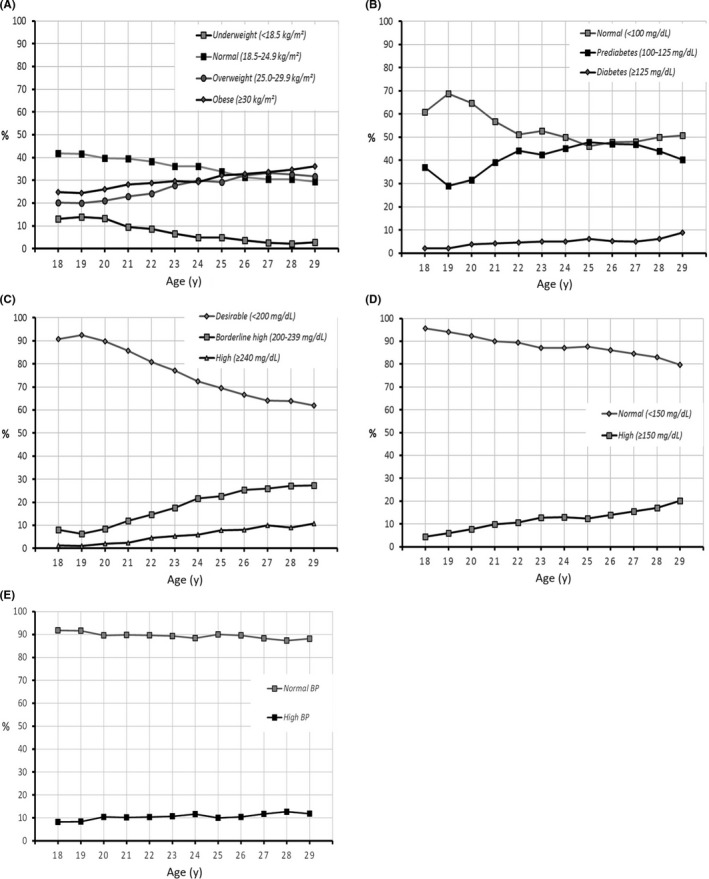
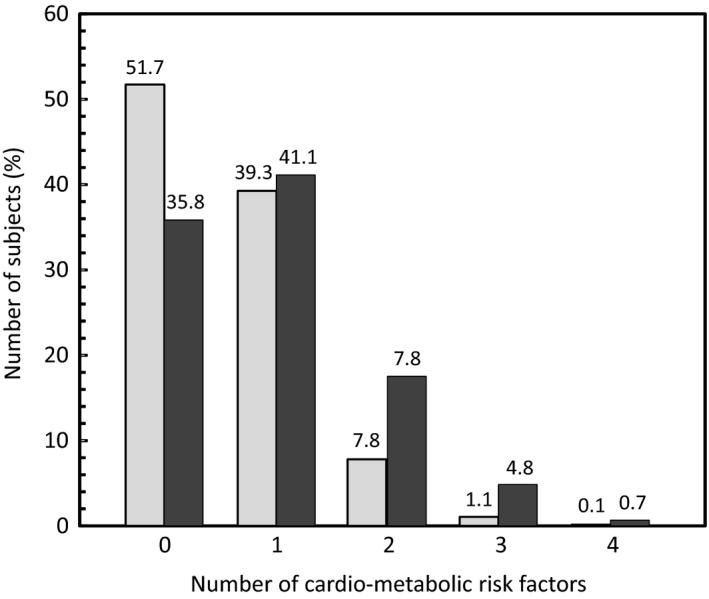
Overall, 7720 subjects (24.4%) were overweight and 8835 (28.0%) obese. The age-adjusted prevalence was 4.7% [95% CI: 4.4-5.0] for diabetes, 41.3% [40.6-41.9] for impaired fasting glucose, 5.5% [5.2-5.8] for hypercholesterolaemia (total cholesterol ≥ 240 mg/dL), 11.5% [11.1%-12.0%] for hypertriglyceridaemia (≥150 mg/dL) and 10.4% [10.0%-10.8%] for hypertension (diastolic or systolic blood pressure-or both-above upper limit of normal). These conditions were already present in the youngest age groups and rise progressively and rapidly with age. Of the 26 648 subjects with valid data for all cardio-metabolic risk factors, 16 563 subjects (62.2%) presented ≥ 1 factor, 6392 subjects presented ≥2 factors (24.0%) and 63 (0.2%) presented all five. Patients who were obese were more likely to present multiple cardio-metabolic risk factors and to have hypertension ( < 0.0001). All cardio-metabolic risk factors were highly correlated with each other.
This national cohort study in the UAE revealed that obesity, diabetes, impaired fasting glucose, hypercholesterolaemia, triglyceridaemia and hypertension are already highly prevalent in young adulthood. Public health initiatives are required to address these and to anticipate the future burden of diabetes and major cardiovascular disease for which these men are at high risk.
本研究旨在确定阿拉伯联合酋长国30岁以下男性心血管代谢危险因素的患病率。
这项横断面观察性研究纳入了2015年5月至2017年2月期间参加强制性标准化医学检查的33327名18 - 29岁的阿联酋男性。评估了体重指数、空腹血糖、总胆固醇、甘油三酯和血压。
总体而言,7720名受试者(24.4%)超重,8835名(28.0%)肥胖。经年龄调整后的糖尿病患病率为4.7% [95%置信区间:4.4 - 5.0],空腹血糖受损患病率为41.3% [40.6 - 41.9],高胆固醇血症(总胆固醇≥240mg/dL)患病率为5.5% [5.2 - 5.8],高甘油三酯血症(≥150mg/dL)患病率为11.5% [11.1% - 12.0%],高血压(舒张压或收缩压或两者高于正常上限)患病率为10.4% [10.0% - 10.8%]。这些情况在最年轻的年龄组中就已存在,并随着年龄的增长而逐渐迅速上升。在所有心血管代谢危险因素均有有效数据的26648名受试者中,16563名受试者(62.2%)存在≥1种危险因素,6392名受试者存在≥2种危险因素(24.0%),63名(0.2%)存在所有五种危险因素。肥胖患者更有可能出现多种心血管代谢危险因素并患有高血压(P < 0.0001)。所有心血管代谢危险因素之间都高度相关。
阿联酋的这项全国性队列研究表明,肥胖、糖尿病、空腹血糖受损、高胆固醇血症、甘油三酯血症和高血压在青年期就已高度流行。需要开展公共卫生举措来应对这些问题,并预测这些男性面临的糖尿病和主要心血管疾病的未来负担,因为他们处于高风险之中。