Huang Jing, Chen Yong, Landis J Richard, Mahoney Kevin B
Perelman School of Medicine, University of Pennsylvania, Philadelphia, PA, United States.
Institute for Biomedical Informatics, University of Pennsylvania, Philadelphia, PA, United States.
J Med Internet Res. 2019 Oct 7;21(10):e13146. doi: 10.2196/13146.
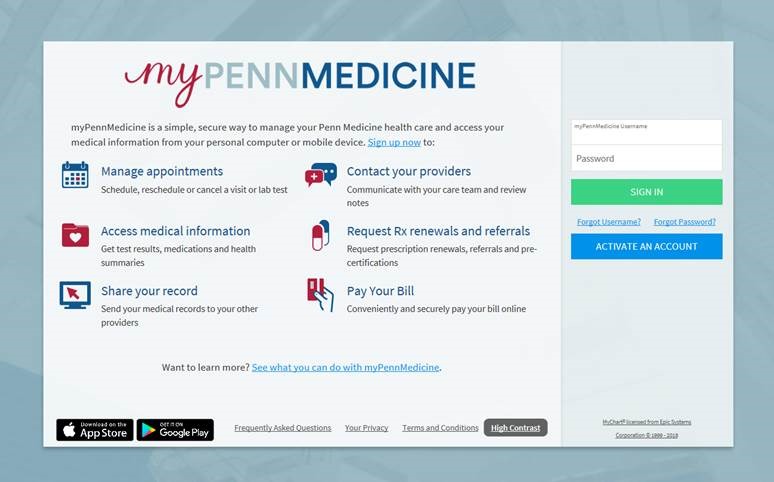
Patient portals are frequently used in modern health care systems as an engagement and communication tool. An increased focus on the potential value of these communication channels to improve health outcomes is warranted.
This paper aimed to quantify the impact of portal use on patients' preventive health behavior and chronic health outcomes.
We conducted a retrospective, observational cohort study of 10,000 patients aged 50 years or older who were treated at the University of Pennsylvania Health System (UPHS) from September 1, 2014, to October 31, 2016. The data were sourced from the UPHS electronic health records. We investigated the association between patient portal use and patients' preventive health behaviors or chronic health outcomes, controlling for confounders using a novel cardinality matching approach based on propensity scoring and a subsequent bootstrapping method to estimate the variance of association estimates.
Patient-level characteristics differed substantially between portal users, comprising approximately 59.32% (5932/10000) of the cohort, and nonusers. On average, users were more likely to be younger (63.46 years for users vs 66.08 years for nonusers), white (72.77% [4317/5932] for users vs 52.58% [2139/4068] for nonusers), have commercial insurance (60.99% [3618/5932] for users vs 40.12% [1632/4068] for nonusers), and have higher annual incomes (US $74,172/year for users vs US $62,940/year for nonusers). Even after adjusting for these potential confounders, patient portal use had a positive and clinically meaningful impact on patients' preventive health behaviors but not on chronic health outcomes.
This paper contributes to the understanding of the impact of patient portal use on health outcomes and is the first study to identify a meaningful subgroup of patients' health behaviors that improved with portal use. These findings may encourage providers to promote portal use to improve patients' preventive health behaviors.
患者门户网站在现代医疗系统中常被用作参与和沟通工具。有必要更加关注这些沟通渠道对改善健康结果的潜在价值。
本文旨在量化使用门户网站对患者预防性健康行为和慢性健康结果的影响。
我们对2014年9月1日至2016年10月31日在宾夕法尼亚大学医疗系统(UPHS)接受治疗的10000名50岁及以上患者进行了一项回顾性观察队列研究。数据来源于UPHS电子健康记录。我们研究了患者门户网站使用与患者预防性健康行为或慢性健康结果之间的关联,使用基于倾向评分的新型基数匹配方法和随后的自助法来控制混杂因素,以估计关联估计值的方差。
门户网站用户(占队列的约59.32%[5932/10000])和非用户之间的患者层面特征存在显著差异。平均而言,用户更可能更年轻(用户为63.46岁,非用户为66.08岁)、为白人(用户中72.77%[4317/5932],非用户中52.58%[2139/4068])、拥有商业保险(用户中60.99%[3618/5932],非用户中40.12%[1632/4068]),且年收入更高(用户为每年74172美元,非用户为每年62940美元)。即使在调整了这些潜在混杂因素后,患者门户网站的使用对患者的预防性健康行为有积极且具有临床意义的影响,但对慢性健康结果没有影响。
本文有助于理解患者门户网站使用对健康结果的影响,并且是第一项确定因使用门户网站而改善的患者健康行为中有意义亚组的研究。这些发现可能会鼓励医疗服务提供者推广门户网站的使用,以改善患者的预防性健康行为。