Dendere Ronald, Slade Christine, Burton-Jones Andrew, Sullivan Clair, Staib Andrew, Janda Monika
Centre for Health Services Research, Faculty of Medicine, The University of Queensland, Woolloongabba, Australia.
Institute for Teaching and Learning Innovation, The University of Queensland, Brisbane, Australia.
J Med Internet Res. 2019 Apr 11;21(4):e12779. doi: 10.2196/12779.
Engaging patients in the delivery of health care has the potential to improve health outcomes and patient satisfaction. Patient portals may enhance patient engagement by enabling patients to access their electronic medical records (EMRs) and facilitating secure patient-provider communication.
The aim of this study was to review literature describing patient portals tethered to an EMR in inpatient settings, their role in patient engagement, and their impact on health care delivery in order to identify factors and best practices for successful implementation of this technology and areas that require further research.
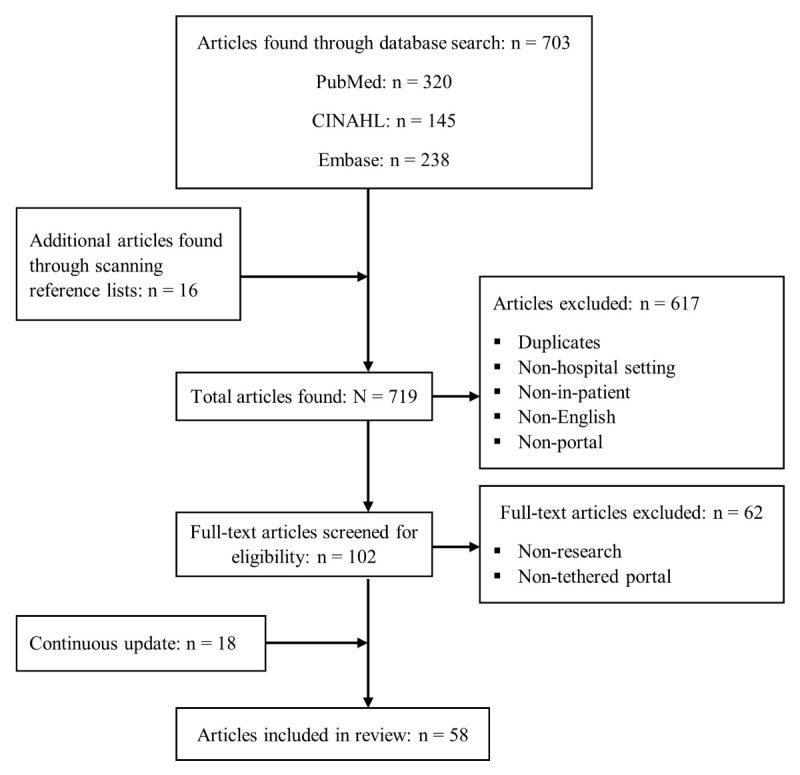
A systematic search for articles in the PubMed, CINAHL, and Embase databases was conducted using keywords associated with patient engagement, electronic health records, and patient portals and their respective subject headings in each database. Articles for inclusion were evaluated for quality using A Measurement Tool to Assess Systematic Reviews (AMSTAR) for systematic review articles and the Quality Assessment Tool for Studies with Diverse Designs for empirical studies. Included studies were categorized by their focus on input factors (eg, portal design), process factors (eg, portal use), and output factors (eg, benefits) and by the valence of their findings regarding patient portals (ie, positive, negative, or mixed).
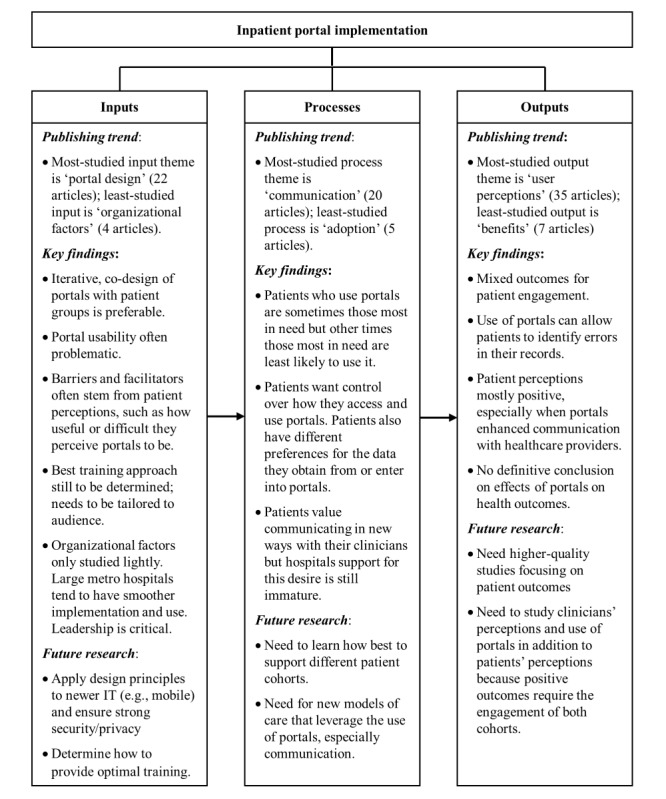
The systematic search identified 58 articles for inclusion. The inputs category was addressed by 40 articles, while the processes and outputs categories were addressed by 36 and 46 articles, respectively: 47 articles addressed multiple themes across the three categories, and 11 addressed only a single theme. Nineteen articles had high- to very high-quality, 21 had medium quality, and 18 had low- to very low-quality. Findings in the inputs category showed wide-ranging portal designs; patients' privacy concerns and lack of encouragement from providers were among portal adoption barriers while information access and patient-provider communication were among facilitators. Several methods were used to train portal users with varying success. In the processes category, sociodemographic characteristics and medical conditions of patients were predictors of portal use; some patients wanted unlimited access to their EMRs, personalized health education, and nonclinical information; and patients were keen to use portals for communicating with their health care teams. In the outputs category, some but not all studies found patient portals improved patient engagement; patients perceived some portal functions as inadequate but others as useful; patients and staff thought portals may improve patient care but could cause anxiety in some patients; and portals improved patient safety, adherence to medications, and patient-provider communication but had no impact on objective health outcomes.
While the evidence is currently immature, patient portals have demonstrated benefit by enabling the discovery of medical errors, improving adherence to medications, and providing patient-provider communication, etc. High-quality studies are needed to fully understand, improve, and evaluate their impact.
让患者参与医疗服务的提供有可能改善健康结果和患者满意度。患者门户网站可以通过使患者能够访问其电子病历(EMR)并促进安全的患者与提供者之间的沟通来增强患者参与度。
本研究的目的是回顾描述住院环境中与电子病历相关联的患者门户网站的文献、它们在患者参与中的作用以及它们对医疗服务提供的影响,以便确定成功实施这项技术的因素和最佳实践以及需要进一步研究的领域。
在PubMed、CINAHL和Embase数据库中使用与患者参与、电子健康记录和患者门户网站相关的关键词以及每个数据库中各自的主题词进行系统检索。使用评估系统评价的测量工具(AMSTAR)对纳入的系统评价文章进行质量评估,使用针对不同设计研究的质量评估工具对实证研究进行质量评估。纳入的研究根据其对输入因素(如门户网站设计)、过程因素(如门户网站使用)和输出因素(如益处)的关注进行分类,并根据其关于患者门户网站的研究结果的效价(即积极、消极或混合)进行分类。
系统检索确定了58篇纳入文章。输入类别由40篇文章涉及,而过程和输出类别分别由36篇和46篇文章涉及:47篇文章涉及这三个类别中的多个主题,11篇仅涉及一个主题。19篇文章具有高到非常高的质量,21篇具有中等质量,18篇具有低到非常低的质量。输入类别中的研究结果显示门户网站设计广泛;患者对隐私的担忧和提供者缺乏鼓励是门户网站采用的障碍,而信息获取和患者与提供者之间的沟通是促进因素。使用了几种方法来培训门户网站用户,但效果各不相同。在过程类别中,患者的社会人口统计学特征和医疗状况是门户网站使用的预测因素;一些患者希望无限制地访问其电子病历、个性化健康教育和非临床信息;患者热衷于使用门户网站与他们的医疗团队进行沟通。在输出类别中,一些但并非所有研究发现患者门户网站改善了患者参与度;患者认为一些门户网站功能不足但其他功能有用;患者和工作人员认为门户网站可能改善患者护理,但可能会使一些患者感到焦虑;门户网站改善了患者安全、药物依从性和患者与提供者之间的沟通,但对客观健康结果没有影响。
虽然目前证据尚不成熟,但患者门户网站已通过发现医疗错误、提高药物依从性和提供患者与提供者之间的沟通等方式显示出益处。需要高质量的研究来充分理解、改进和评估它们的影响。