Department of Neurology, Neurological Institute, Cleveland Clinic, Cleveland, OH, USA.
Genomic Medicine Institute, Cleveland Clinic, Cleveland, OH, USA.
Transl Psychiatry. 2019 Oct 8;9(1):253. doi: 10.1038/s41398-019-0588-1.
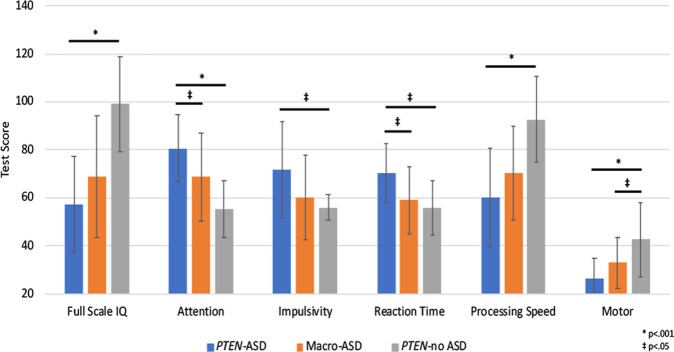
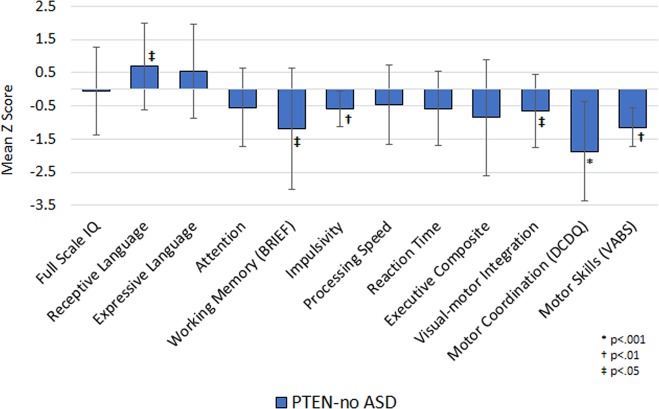
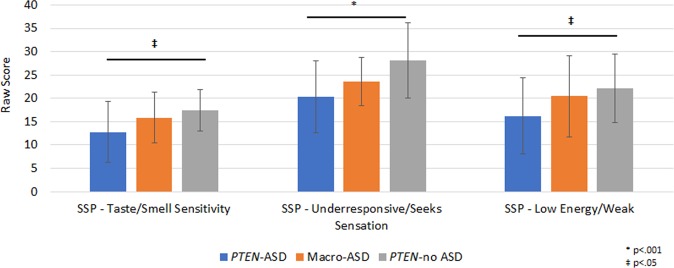
Germline mutations in PTEN, the gene that encodes phosphatase and tensin homolog, have been identified in up to 20% of children with autism spectrum disorder (ASD) and macrocephaly and are associated with marked abnormalities in the white matter of the brain. This study sought to characterize the neurobehavioral phenotype of PTEN-ASD. Comprehensive neurobehavioral evaluations were conducted in 36 participants (ages 3-21 years) with PTEN-ASD and compared to two groups of controls: non-syndromic ASD with macrocephaly (Macro-ASD, n = 25) and those with PTEN mutations without ASD (PTEN-no ASD, n = 23). Linear regression analysis or Kruskal-Wallis tests were used to examine group differences on neurobehavioral measures (cognitive, behavioral, sensory, and adaptive functioning) and, for select measures, one-sample t-tests were used to compare group performance to healthy control norms. These analyses revealed a distinct neuropsychological profile associated with mutations in PTEN suggesting primary disruption of frontal lobe systems (i.e., attention, impulsivity, reaction time, processing speed, and motor coordination). Cognitive deficits in PTEN-ASD are more severe than those in PTEN-no ASD and extend to other areas of neurobehavioral function, specifically, adaptive behavior and sensory deficits. While core ASD symptoms are similar in PTEN-ASD and Macro-ASD, PTEN-ASD had lower clinical ratings of autism severity and showed more sensory abnormalities suggestive of less sensory responsiveness. Together, these results suggest that PTEN-ASD has a distinct neurobehavioral phenotype compared to idiopathic ASD that is likely to warrant special consideration for overall assessment and treatment.
PTEN 基因的种系突变,该基因编码磷酸酶和张力蛋白同源物,已在多达 20%的自闭症谱系障碍 (ASD) 和大头畸形的儿童中被发现,并且与大脑白质的明显异常有关。本研究旨在描述 PTEN-ASD 的神经行为表型。对 36 名患有 PTEN-ASD 的参与者(年龄 3-21 岁)进行了全面的神经行为评估,并与两组对照进行了比较:伴有大头畸形的非综合征性 ASD(Macro-ASD,n=25)和无 ASD 的 PTEN 突变者(PTEN-no ASD,n=23)。线性回归分析或 Kruskal-Wallis 检验用于检查神经行为测量(认知、行为、感觉和适应功能)上的组间差异,对于特定的测量,采用单样本 t 检验将组间表现与健康对照组的常模进行比较。这些分析揭示了与 PTEN 突变相关的独特神经心理学特征,表明额叶系统(即注意力、冲动性、反应时间、处理速度和运动协调)的主要破坏。PTEN-ASD 的认知缺陷比 PTEN-no ASD 更严重,并扩展到其他神经行为功能领域,特别是适应行为和感觉缺陷。虽然 PTEN-ASD 和 Macro-ASD 的核心 ASD 症状相似,但 PTEN-ASD 的自闭症严重程度临床评分较低,并且表现出更多的感觉异常,表明感觉反应性较低。总的来说,这些结果表明,与特发性 ASD 相比,PTEN-ASD 具有独特的神经行为表型,可能需要特别考虑整体评估和治疗。