Department of Clinical Pharmacy and Outcomes Sciences, University of South Carolina College of Pharmacy, Columbia, South Carolina.
South Carolina Center of Economic Excellence for Medication Safety, University of South Carolina College of Pharmacy, Columbia, South Carolina.
Pharmacotherapy. 2019 Dec;39(12):1190-1203. doi: 10.1002/phar.2340. Epub 2019 Nov 3.
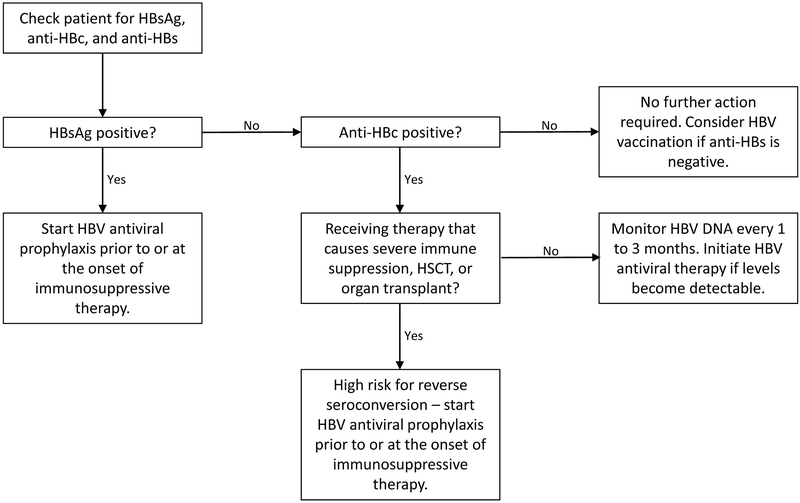
Hepatitis B virus (HBV) is a global disease with significant morbidity and mortality. Worldwide, ~257 million people are chronically infected with HBV, defined as having a positive hepatitis B surface antigen, but millions more have prior HBV exposure indicated by positive hepatitis B core antibody. Reactivation of hepatitis B implies a sudden increase in viral replication in a patient with chronic HBV infection or prior HBV exposure. Hepatitis B virus reactivation (HBVr) can occur spontaneously, but it is more commonly triggered by immunosuppressive therapies for cancer, immunologic diseases, or transplantation. Elimination of hepatitis C virus (HCV) in HBV-HCV coinfected individuals treated with direct-acting antivirals (DAAs) has also been identified as an important cause of HBVr. Hepatitis B virus reactivation is an underappreciated but important complication of common medical therapies that can delay treatment or result in clinical episodes of hepatitis, hepatic failure, or death. In this review, factors associated with HBVr, particularly medication-related risks, are explored. We review data involving rituximab and ofatumumab, doxorubicin, corticosteroids, tumor necrosis factor antagonists, tyrosine kinases, bortezomib, hematologic stem cell transplantation, and DAAs for HCV treatment. In addition, we discuss screening strategies, choice of antiviral prophylaxis, and the optimal duration of therapy for HBVr. With additional awareness, screening, and appropriate antiviral therapy, it is expected that most cases of HBVr can be prevented.
乙型肝炎病毒(HBV)是一种全球性疾病,具有显著的发病率和死亡率。全球范围内,约有 2.57 亿人慢性感染 HBV,定义为乙型肝炎表面抗原阳性,但还有数百万人曾感染过 HBV,表现为乙型肝炎核心抗体阳性。乙型肝炎病毒再激活是指慢性 HBV 感染或既往 HBV 暴露的患者中病毒复制突然增加。HBVr 可自发发生,但更常见于癌症、免疫性疾病或移植的免疫抑制治疗触发。在接受直接作用抗病毒药物(DAA)治疗的 HBV-HCV 合并感染患者中清除丙型肝炎病毒(HCV)也被认为是 HBVr 的一个重要原因。HBVr 是常见医疗疗法中被低估但重要的并发症,可导致治疗延迟或出现肝炎、肝衰竭或死亡等临床发作。在这篇综述中,探讨了与 HBVr 相关的因素,特别是与药物相关的风险。我们回顾了涉及利妥昔单抗和奥法妥木单抗、多柔比星、皮质类固醇、肿瘤坏死因子拮抗剂、酪氨酸激酶、硼替佐米、造血干细胞移植和 HCV 治疗的 DAA 的数据。此外,我们还讨论了筛查策略、抗病毒预防选择以及 HBVr 的最佳治疗持续时间。通过提高认识、筛查和适当的抗病毒治疗,预计大多数 HBVr 病例都可以预防。