Institute of Experimental Virology, TWINCORE Centre for Experimental and Clinical Infection Research, Hannover, Germany.
Instituto de Ciências Biomédicas Abel Salazar, Universidade Do Porto, Porto, Portugal.
J Virol. 2019 Nov 26;93(24). doi: 10.1128/JVI.01221-19. Print 2019 Dec 15.
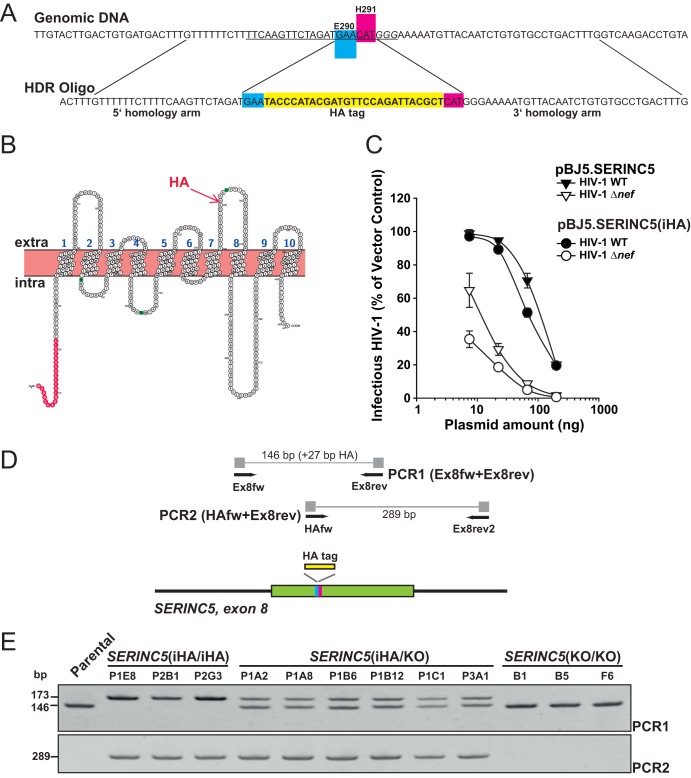
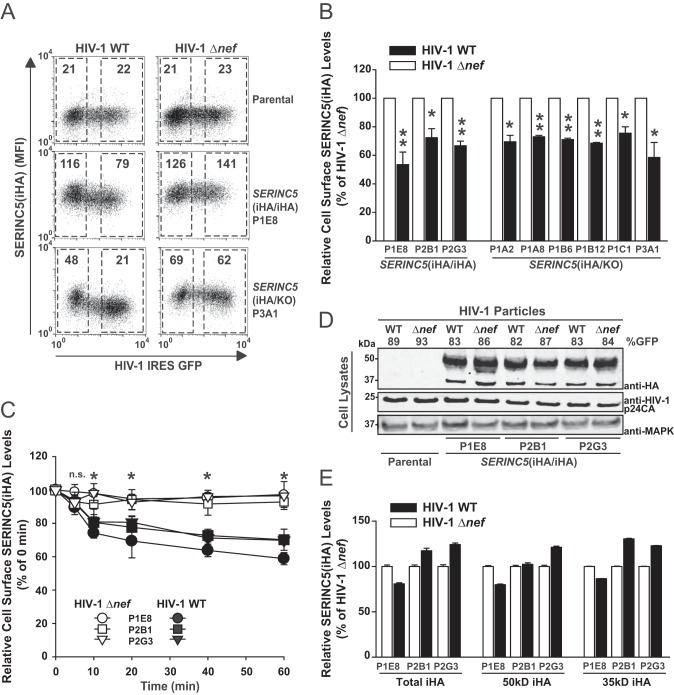
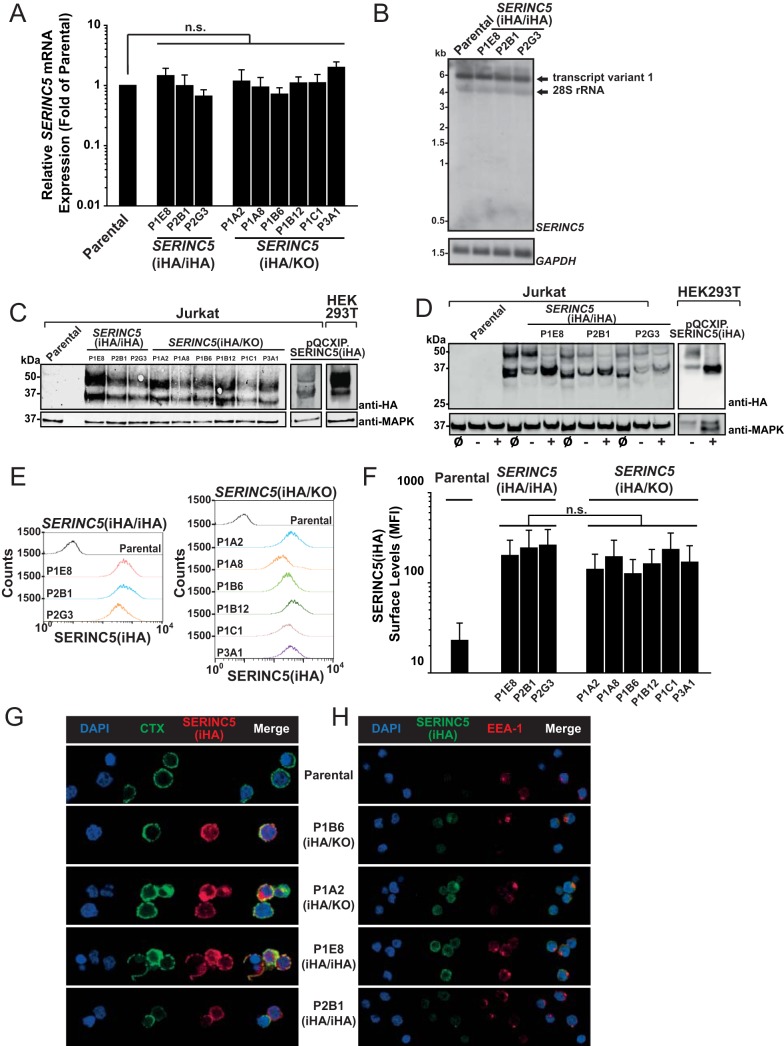
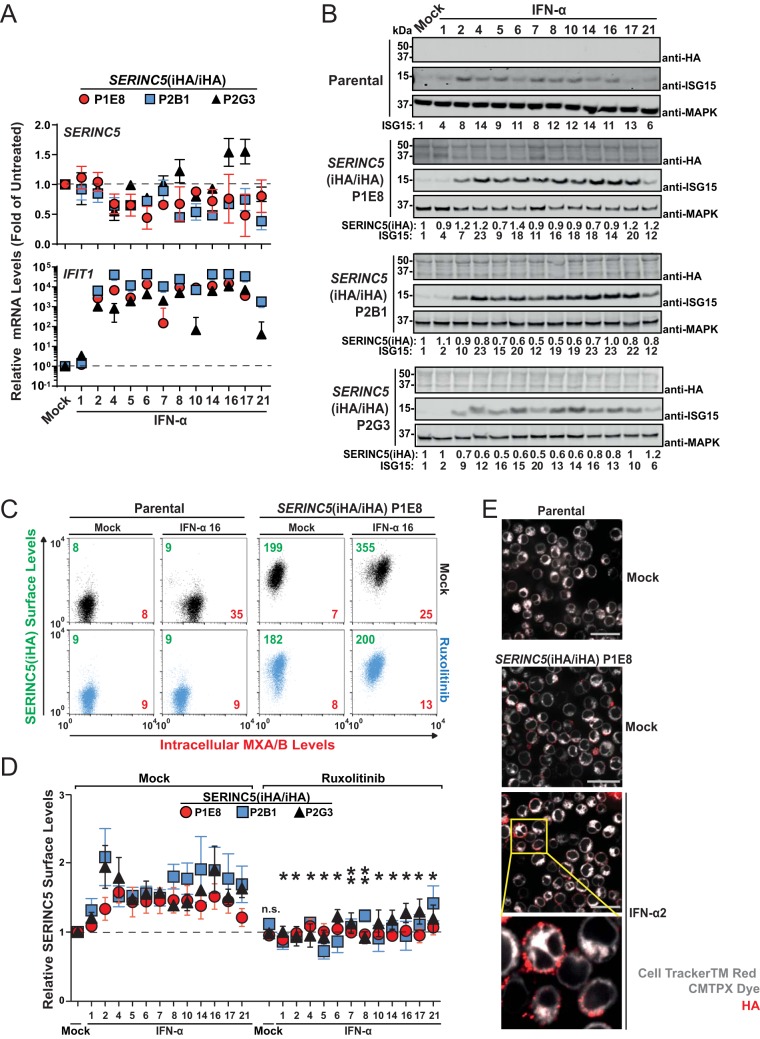
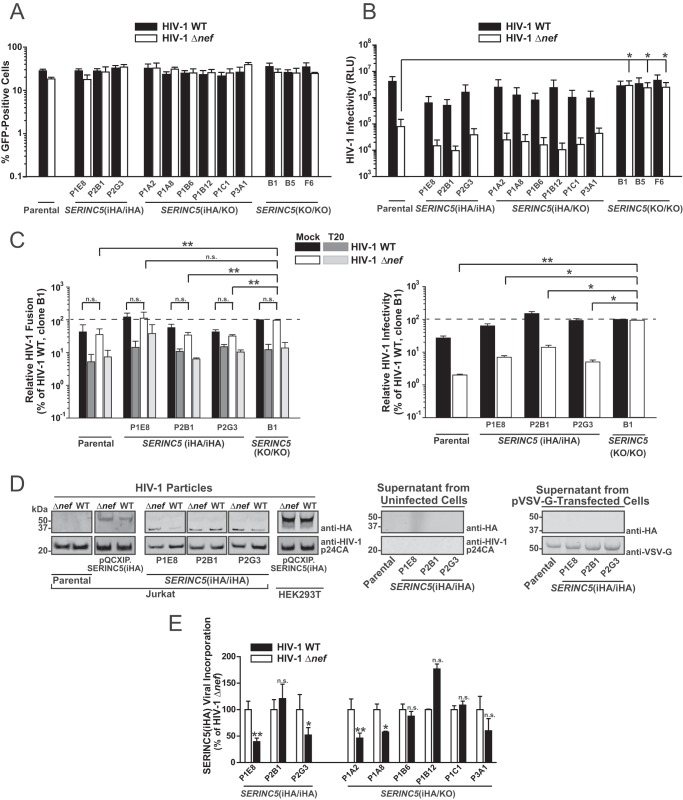
When expressed in virus-producing cells, the cellular multipass transmembrane protein SERINC5 reduces the infectivity of HIV-1 particles and is counteracted by HIV-1 Nef. Due to the unavailability of an antibody of sufficient specificity and sensitivity, investigation of SERINC5 protein expression and subcellular localization has been limited to heterologously expressed SERINC5. We generated, via CRISPR/Cas9-assisted gene editing, Jurkat T-cell clones expressing endogenous SERINC5 bearing an extracellularly exposed hemagglutinin (HA) epitope [Jurkat (iHA knock-in) T cells]. This modification enabled quantification of endogenous SERINC5 protein levels and demonstrated a predominant localization in lipid rafts. Interferon alpha (IFN-α) treatment enhanced cell surface levels of SERINC5 in a ruxolitinib-sensitive manner in the absence of modulation of mRNA and protein quantities. Parental and (iHA knock-in) T cells shared the ability to produce infectious wild-type HIV-1 but not an HIV-1 Δ mutant. SERINC5-imposed reduction of infectivity involved a modest reduction of virus fusogenicity. An association of endogenous SERINC5 protein with HIV-1 Δ virions was consistently detectable as a 35-kDa species, as opposed to heterologous SERINC5, which presented as a 51-kDa species. Nef-mediated functional counteraction did not correlate with virion exclusion of SERINC5, arguing for the existence of additional counteractive mechanisms of Nef that act on virus-associated SERINC5. In HIV-1-infected cells, Nef triggered the internalization of SERINC5 in the absence of detectable changes of steady-state protein levels. These findings establish new properties of endogenous SERINC5 expression and subcellular localization, challenge existing concepts of HIV-1 Nef-mediated antagonism of SERINC5, and uncover an unprecedented role of IFN-α in modulating SERINC5 through accumulation at the cell surface. SERINC5 is the long-searched-for antiviral factor that is counteracted by the HIV-1 accessory gene product Nef. Here, we engineered, via CRISPR/Cas9 technology, T-cell lines that express endogenous alleles tagged with a knocked-in HA epitope. This genetic modification enabled us to study basic properties of endogenous SERINC5 and to verify proposed mechanisms of HIV-1 Nef-mediated counteraction of SERINC5. Using this unique resource, we identified the susceptibility of endogenous SERINC5 protein to posttranslational modulation by type I IFNs and suggest uncoupling of Nef-mediated functional antagonism from SERINC5 exclusion from virions.
当细胞多跨膜蛋白 SERINC5 在产生病毒的细胞中表达时,它会降低 HIV-1 颗粒的感染力,并被 HIV-1 Nef 拮抗。由于缺乏足够特异性和灵敏度的抗体,SERINC5 蛋白表达和亚细胞定位的研究仅限于异源表达的 SERINC5。我们通过 CRISPR/Cas9 辅助基因编辑,生成了表达带有细胞外暴露的血凝素 (HA) 表位的内源性 SERINC5 的 Jurkat T 细胞克隆 [Jurkat (iHA 敲入) T 细胞]。这种修饰使内源性 SERINC5 蛋白水平的定量成为可能,并证明其主要定位于脂筏中。干扰素-α (IFN-α) 处理以依赖于鲁索利替尼的方式增强 SERINC5 的细胞表面水平,而不调节 mRNA 和蛋白质数量。亲本和 (iHA 敲入) T 细胞均具有产生感染性野生型 HIV-1 的能力,但不能产生 HIV-1 Δ 突变体。SERINC5 施加的感染力降低涉及病毒融合性的适度降低。内源性 SERINC5 蛋白与 HIV-1 Δ 病毒粒子的关联始终可检测到 35-kDa 种,而不同于异源 SERINC5,其表现为 51-kDa 种。Nef 介导的功能拮抗与 SERINC5 病毒粒子的排除不相关,这表明 Nef 存在其他拮抗 SERINC5 的机制,这些机制作用于与病毒相关的 SERINC5。在 HIV-1 感染的细胞中,Nef 在没有检测到稳定态蛋白水平变化的情况下触发 SERINC5 的内化。这些发现确立了内源性 SERINC5 表达和亚细胞定位的新特性,挑战了 HIV-1 Nef 介导的拮抗 SERINC5 的现有概念,并揭示了 IFN-α 在通过在细胞表面积累来调节 SERINC5 方面的前所未有的作用。SERINC5 是长期以来被搜索的抗病毒因子,它被 HIV-1 辅助基因产物 Nef 拮抗。在这里,我们通过 CRISPR/Cas9 技术工程化了 T 细胞系,这些细胞系表达带有敲入 HA 表位的内源性 等位基因。这种遗传修饰使我们能够研究内源性 SERINC5 的基本特性,并验证 HIV-1 Nef 介导的拮抗 SERINC5 的拟议机制。使用这种独特的资源,我们确定了内源性 SERINC5 蛋白对 I 型 IFNs 的翻译后修饰的敏感性,并提出了将 Nef 介导的功能拮抗与 SERINC5 从病毒粒子中的排除分离的可能性。