Graduate School of Tianjin Medical University , Tianjin , People's Republic of China.
Department of Clinical Laboratory, Tianjin Union Medical Center , Tianjin , People's Republic of China.
Ren Fail. 2019 Nov;41(1):946-953. doi: 10.1080/0886022X.2019.1655451.
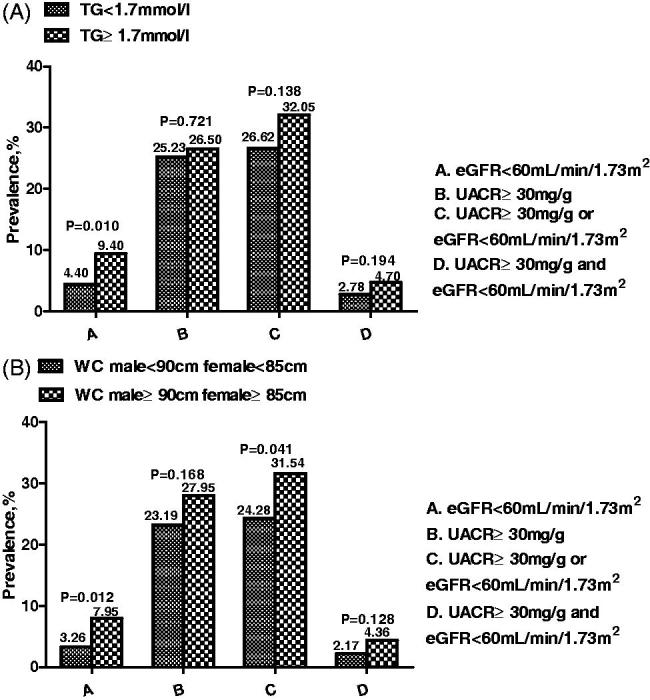
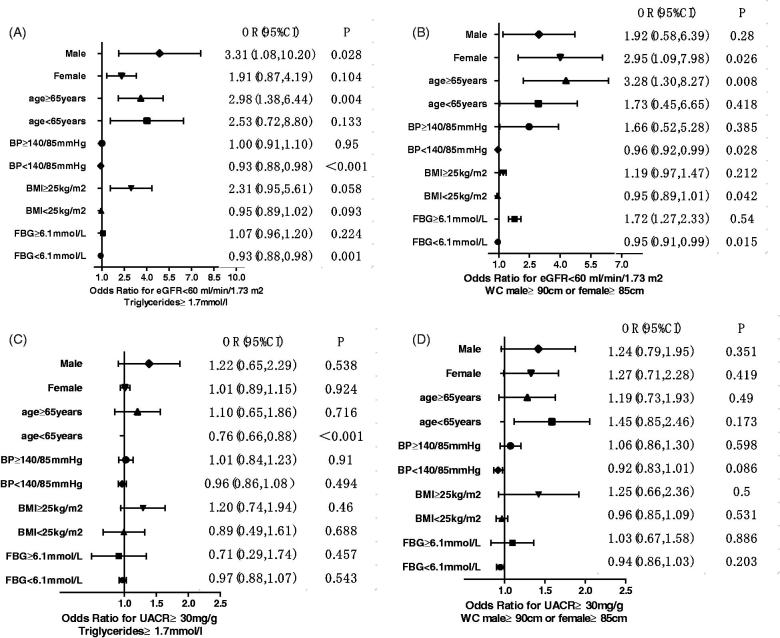
Despite the achievement of blood glucose, blood pressure targets, the risk for kidney injury remains high among older adults. This observational retrospective study investigated whether high TG or high WC contribute to this high residual risk for kidney injury. A total of 843 elderly from Dongli Community, Tianjin, China, we selected 666 individuals with a baseline estimated glomerular filtration rate (eGFR) ≥60 mL/min/1.73 m and negative microalbuminuria completing a 3-year follow-up. At baseline, subjects were grouped according to the levels of TG and WC. The primary outcome was the incidence of kidney injury, defined as low eGFR (eGFR <60 mL/min/1.73 m) or reduced eGFR (eGFR reduced >25%) or UACR ≥30 mg/g. Overall, 6.01% developed low eGFR, 11.11% reduced eGFR, 25.98% UACR ≥30 mg/g, and 3.45% low eGFR and UACR ≥30mg/g after 3-year follow-up. TG ≥1.7 mmol/L increased the risk of eGFR <60 mL/min/1.73 m by 1.44-fold, of UACR ≥30 mg/g by 32%, and of developing both abnormality by 1.41-fold in model 1; further adjustment for potential confounders factors, the association is slightly weakened in model 2 and 3; WC (≥90 cm in men and ≥85 cm in women) were associated with a 1.68-fold higher risk of eGFR <60 mL/min/1.73 m and a 1.43-fold risk of UACR ≥30 mg/g and a 1.89-fold risk of developing both abnormality in model 1. Further adjustment for potential confounders factors, the association is slightly weakened in model 2 and 3. In a population of Chinese community-dwelling older adults, high TG and central obesity were risk factors for the development of kidney injury over 3 years.
尽管实现了血糖、血压目标,但老年人的肾脏损伤风险仍然很高。本观察性回顾性研究探讨了高 TG 或高 WC 是否导致肾脏损伤的残余风险增加。我们从中国天津东丽社区中选择了 843 名老年人,共选取了 666 名基线估算肾小球滤过率(eGFR)≥60mL/min/1.73m 且无微量白蛋白尿的个体,完成了 3 年的随访。在基线时,根据 TG 和 WC 水平将受试者分为不同组别。主要结局是肾脏损伤的发生率,定义为低 eGFR(eGFR<60mL/min/1.73m)或 eGFR 降低>25%或 UACR≥30mg/g。总的来说,6.01%的患者出现低 eGFR,11.11%的患者出现 eGFR 降低,25.98%的患者 UACR≥30mg/g,3.45%的患者同时出现低 eGFR 和 UACR≥30mg/g。在模型 1 中,TG≥1.7mmol/L 使 eGFR<60mL/min/1.73m 的风险增加 1.44 倍,UACR≥30mg/g 的风险增加 32%,同时出现两种异常的风险增加 1.41 倍;在模型 2 和 3 中,进一步调整潜在混杂因素后,这种关联略有减弱;男性 WC(≥90cm)和女性 WC(≥85cm)与 eGFR<60mL/min/1.73m 的风险增加 1.68 倍、UACR≥30mg/g 的风险增加 1.43 倍以及同时出现两种异常的风险增加 1.89 倍有关。在模型 2 和 3 中,进一步调整潜在混杂因素后,这种关联略有减弱。在中国社区居住的老年人中,高 TG 和中心性肥胖是 3 年内肾脏损伤发展的危险因素。