Qin Shan, Wang Anping, Gu Shi, Wang Weiqing, Gao Zhengnan, Tang Xulei, Yan Li, Wan Qin, Luo Zuojie, Qin Guijun, Chen Lulu, Ning Guang, Mu Yiming
Department of Endocrinology, The First Medical Center, Chinese People's Liberation Army General Hospital, Beijing, China.
School of Medicine, Nankai University, Tianjin, China.
BMJ Open. 2021 Jan 5;11(1):e040214. doi: 10.1136/bmjopen-2020-040214.
The relationship between obesity and albuminuria has not been clarified. This study aimed to investigate the correlation between obesity and the urinary albumin-creatinine ratio (UACR) in Southern and Northern China.
A descriptive, cross-sectional study.
Eight regional centres in REACTION (China's Risk Evaluation of cAncers in Chinese diabeTic Individuals, a lONgitudinal study), including Dalian, Lanzhou, Zhengzhou, Guangzhou, Guangxi, Luzhou, Shanghai and Wuhan.
A total of 41 085 patients who were not diagnosed with chronic kidney disease (CKD) and had good compliance were selected according to the inclusion criteria. Patients who were diagnosed with CKD, who had other kidney diseases that could lead to increased urinary protein excretion, who were using angiotensin-converting-enzyme inhibitors or angiotensin II receptor blockers and whose important data were missing were excluded.
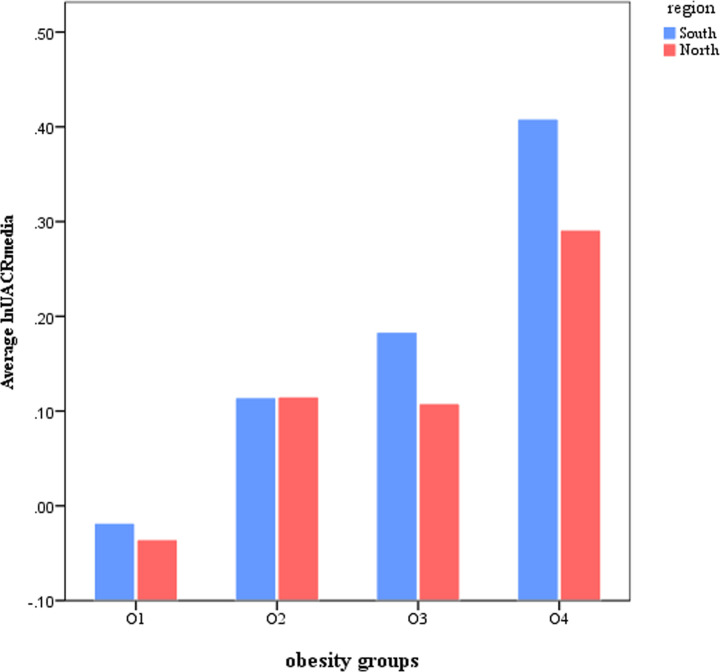
Participants with both, central and peripheral obesity, had a higher risk of elevated UACR, even after adjusting for multiple factors (OR: 1.14, 95% CI: 1.07 to 1.12, p<0.001), and the risk of high UACR in the South was more prominent than that in the North (OR : 1.22, 95% CI: 1.11 to 1.34; OR : 1.13, 95% CI: 1.04 to 1.22, p<0.001). The risk was also elevated in the male population, hypertensive individuals, glycosylated haemoglobin (HbA1c)≥6.5% and age ≥60 years in the South. Besides the above groups, diabetes was also a risk factor for the Northern population.
In China, people with both central and peripheral obesity are prone to a high UACR, and the southern population has a higher risk than northern population. Factors such as male sex, hypertension, HbA1c≥6.5% and an age ≥60 years are also risk factors for CKD.
肥胖与蛋白尿之间的关系尚未阐明。本研究旨在调查中国南方和北方肥胖与尿白蛋白肌酐比值(UACR)之间的相关性。
一项描述性横断面研究。
REACTION(中国糖尿病个体癌症风险评估,一项纵向研究)的八个区域中心,包括大连、兰州、郑州、广州、广西、泸州、上海和武汉。
根据纳入标准,共选取41085例未被诊断为慢性肾脏病(CKD)且依从性良好的患者。排除已诊断为CKD、患有其他可导致尿蛋白排泄增加的肾脏疾病、正在使用血管紧张素转换酶抑制剂或血管紧张素II受体阻滞剂以及重要数据缺失的患者。
即使在调整多个因素后,同时存在中心性肥胖和外周性肥胖的参与者UACR升高的风险更高(比值比:1.14,95%置信区间:1.07至1.12,p<0.001),且南方UACR升高的风险比北方更显著(比值比:1.22,95%置信区间:1.11至1.34;比值比:1.13,95%置信区间:1.04至1.22,p<0.)。在南方,男性人群、高血压患者、糖化血红蛋白(HbA1c)≥6.5%以及年龄≥60岁人群的风险也升高。除上述人群外,糖尿病也是北方人群的一个风险因素。
在中国,同时存在中心性肥胖和外周性肥胖的人易出现高UACR,南方人群的风险高于北方人群。男性、高血压、HbA1c≥6.5%以及年龄≥60岁等因素也是CKD的风险因素。