Instituto de Ciencia y Tecnología de Polímeros, Consejo Superior de Investigaciones Científicas, CSIC, 28006 Madrid, Spain.
Consorcio Centro de Investigación Biomédica en Red de Bioingeniería, Biomateriales y Nanomedicina, 28029 Madrid, Spain.
Int J Mol Sci. 2019 Oct 9;20(20):4996. doi: 10.3390/ijms20204996.
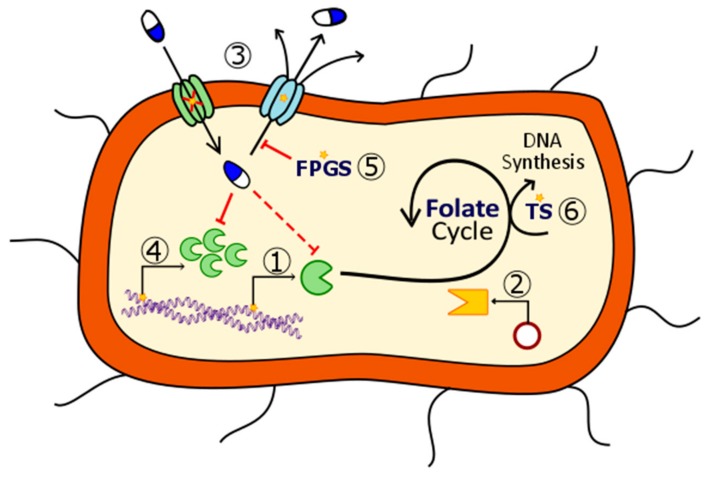
Bacterial, protozoan and other microbial infections share an accelerated metabolic rate. In order to ensure a proper functioning of cell replication and proteins and nucleic acids synthesis processes, folate metabolism rate is also increased in these cases. For this reason, folic acid antagonists have been used since their discovery to treat different kinds of microbial infections, taking advantage of this metabolic difference when compared with human cells. However, resistances to these compounds have emerged since then and only combined therapies are currently used in clinic. In addition, some of these compounds have been found to have an immunomodulatory behavior that allows clinicians using them as anti-inflammatory or immunosuppressive drugs. Therefore, the aim of this review is to provide an updated state-of-the-art on the use of antifolates as antibacterial and immunomodulating agents in the clinical setting, as well as to present their action mechanisms and currently investigated biomedical applications.
细菌、原生动物和其他微生物感染具有加速的代谢率。为了确保细胞复制和蛋白质及核酸合成过程的正常功能,叶酸代谢率在这些情况下也会增加。出于这个原因,自从发现叶酸拮抗剂以来,它们就被用于治疗各种微生物感染,利用这种与人类细胞相比的代谢差异。然而,自那时以来已经出现了对这些化合物的耐药性,目前仅在临床中使用联合疗法。此外,一些这些化合物已被发现具有免疫调节作用,这使得临床医生可以将它们用作抗炎或免疫抑制药物。因此,本综述的目的是提供关于在临床环境中使用抗叶酸作为抗菌和免疫调节药物的最新研究进展,并介绍其作用机制和目前正在研究的生物医学应用。