Department of Biology, University of Washington, Seattle, WA 98195.
CBE Life Sci Educ. 2019 Dec;18(4):es5. doi: 10.1187/cbe.19-03-0059.
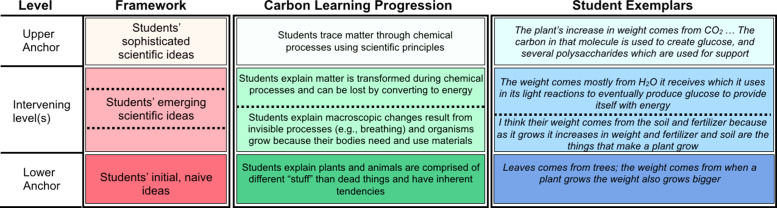
challenged biology instructors to develop evidence-based instructional approaches that were grounded in the core concepts and competencies of biology. This call for reform provides an opportunity for new educational tools to be incorporated into biology education. In this essay, we advocate for as one such educational tool. First, we address what learning progressions are and how they leverage research from the cognitive and learning sciences to inform instructional practices. Next, we use a published learning progression about carbon cycling to illustrate how learning progressions describe the maturation of student thinking about a key topic. Then, we discuss how learning progressions can inform undergraduate biology instruction, citing three particular learning progressions that could guide instruction about a number of key topics taught in introductory biology courses. Finally, we describe some challenges associated with learning progressions in undergraduate biology and some recommendations for how to address these challenges.
挑战生物学教师开发基于证据的教学方法,这些方法应以生物学的核心概念和能力为基础。这一改革呼吁为将新的教育工具纳入生物学教育提供了机会。在本文中,我们提倡将学习进阶作为这样的一种教育工具。首先,我们讨论了学习进阶是什么,以及它们如何利用认知和学习科学的研究来为教学实践提供信息。接下来,我们使用一个关于碳循环的已发表的学习进阶来说明学习进阶如何描述学生对一个关键主题的思维成熟度。然后,我们讨论了学习进阶如何为本科生物学教学提供信息,引用了三个可以指导介绍性生物学课程中教授的几个关键主题教学的学习进阶。最后,我们描述了与本科生物学中的学习进阶相关的一些挑战,并提出了一些应对这些挑战的建议。