Pathogen Biology Program, Rajiv Gandhi Center for Biotechnology, Thiruvananthapuram, Kerala, 695014, India.
Interdiciplinary Biology Program, Rajiv Gandhi Center for Biotechnology, Thiruvananthapuram, Kerala, 695014, India.
Sci Rep. 2019 Oct 11;9(1):14690. doi: 10.1038/s41598-019-51097-w.
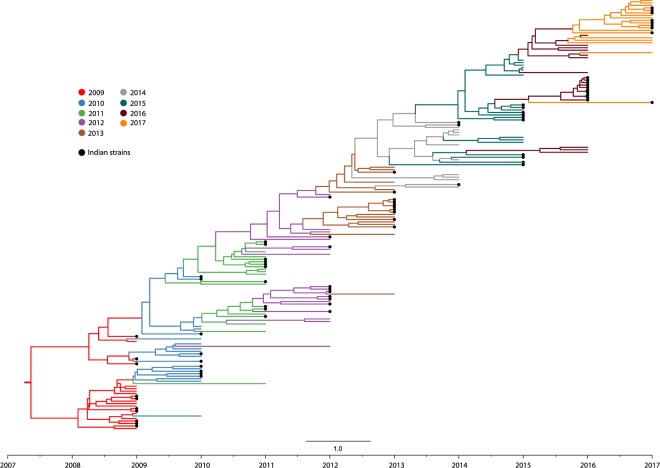
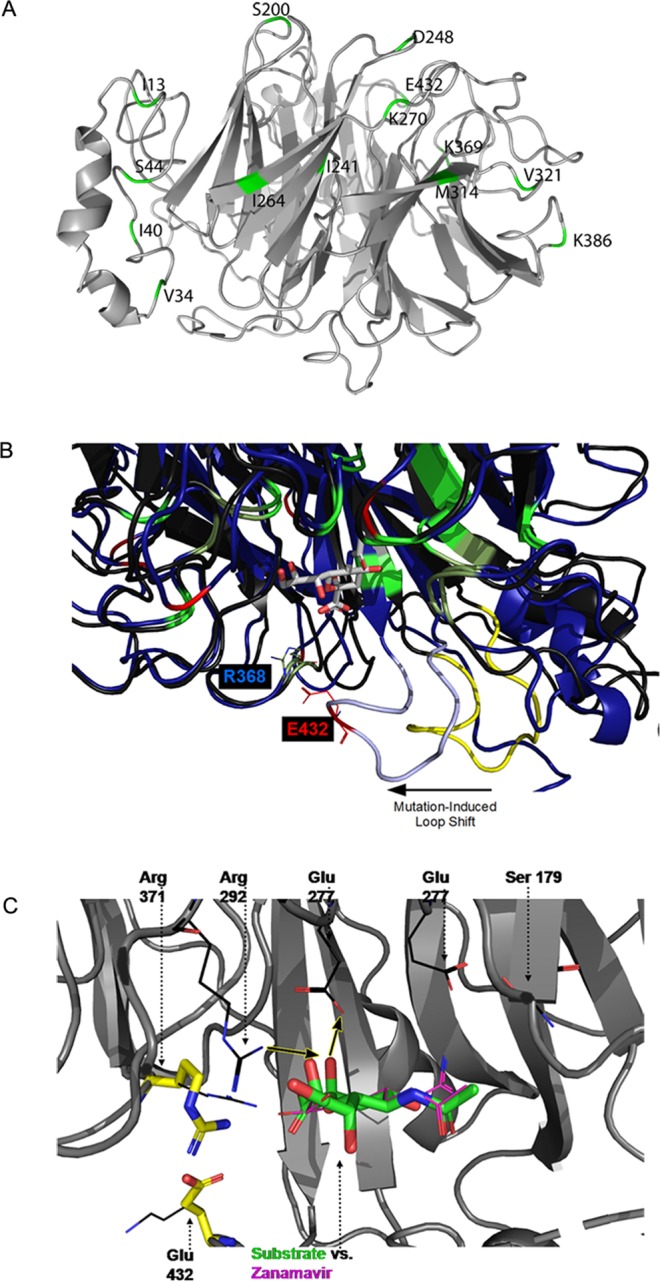
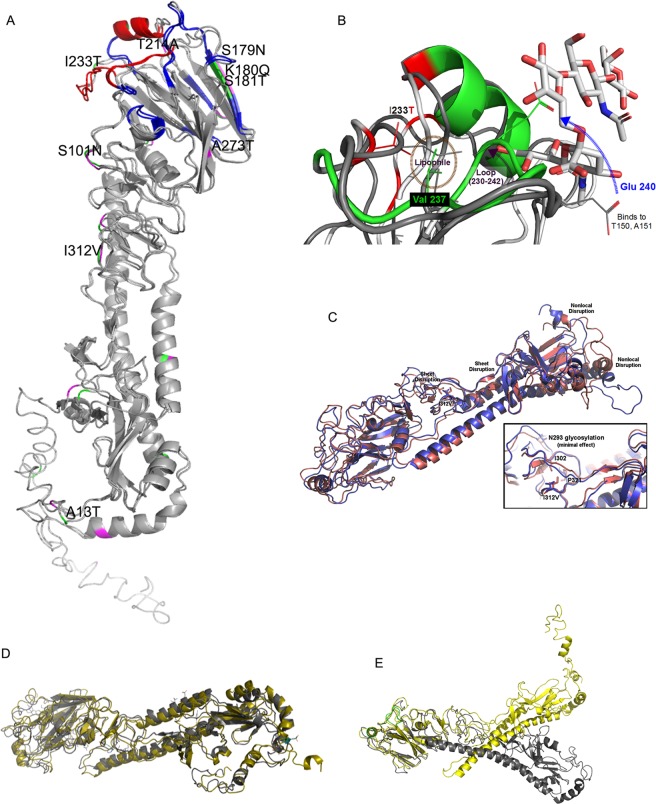
Influenza A (H1N1) continues to be a major public health threat due to possible emergence of a more virulent H1N1 strain resulting from dynamic changes in virus adaptability consequent to functional mutations and antigenic drift in the hemagglutinin (HA) and neuraminidase (NA) surface proteins. In this study, we describe the genetic and evolutionary characteristics of H1N1 strains that circulated in India over a period of nine years from 2009 to 2017 in relation to global strains. The finding is important from a global perspective since previous phylogenetic studies have suggested that the tropics contributed substantially to the global circulation of influenza viruses. Bayesian phylogenic analysis of HA sequences along with global strains indicated that there is a temporal pattern of H1N1 evolution and clustering of Indian isolates with globally circulating strains. Interestingly, we observed four new amino acid substitutions (S179N, I233T, S181T and I312V) in the HA sequence of H1N1 strains isolated during 2017 and two (S181T and I312V) were found to be unique in Indian isolates. Structurally these two unique mutations could lead to altered glycan specificity of the HA gene. Similarly, sequence and structural analysis of NA domain revealed that the presence of K432E mutation in H1N1 strains isolated after 2015 from India and in global strains found to induce a major loop shift in the vicinity of the catalytic site. The findings presented here offer an insight as to how these acquired mutations could be associated to an improved adaptability of the virus for efficient human transmissibility.
甲型流感(H1N1)仍然是一个主要的公共卫生威胁,因为可能会出现更具毒性的 H1N1 菌株,这是由于病毒适应性的动态变化导致功能突变和血凝素(HA)和神经氨酸酶(NA)表面蛋白的抗原漂移。在这项研究中,我们描述了 2009 年至 2017 年期间在印度流行的 H1N1 株的遗传和进化特征与全球株的关系。从全球角度来看,这一发现非常重要,因为以前的系统发育研究表明,热带地区对流感病毒的全球传播做出了重大贡献。HA 序列的贝叶斯系统发育分析以及与全球株的关系表明,存在 H1N1 进化的时间模式和印度分离株与全球流行株的聚类。有趣的是,我们观察到 2017 年分离的 H1N1 株的 HA 序列中出现了四个新的氨基酸取代(S179N、I233T、S181T 和 I312V),其中两个(S181T 和 I312V)在印度分离株中是独特的。结构上,这两个独特的突变可能导致 HA 基因糖基特异性的改变。同样,NA 结构域的序列和结构分析表明,2015 年后从印度分离的 H1N1 株和全球株中存在 K432E 突变,这导致催化位点附近的主要环移位。这里提出的发现提供了一个深入了解这些获得的突变如何与病毒的适应性提高相关,从而提高其在人类中的有效传播能力。